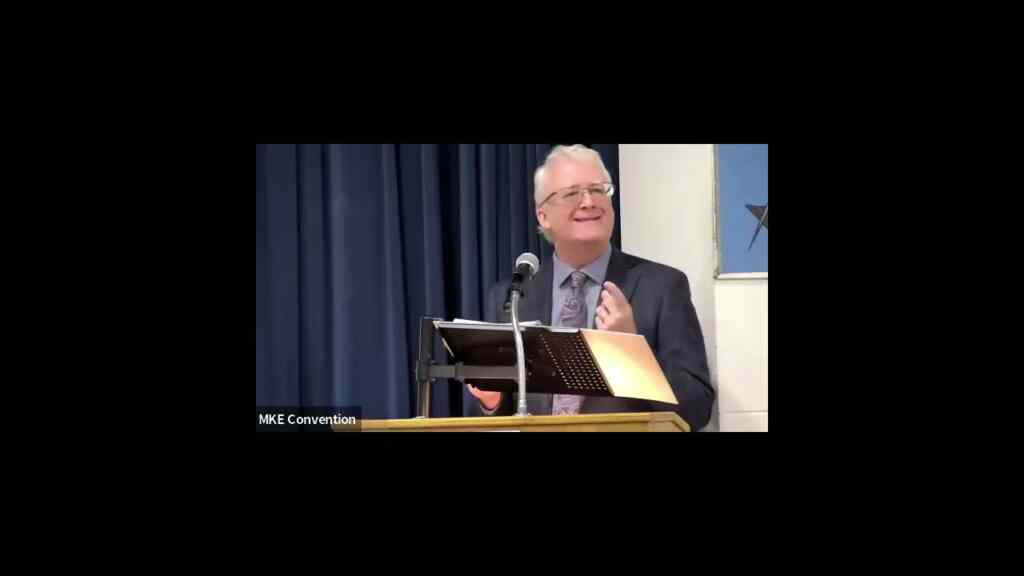
This transcript was generated automatically. Its accuracy may vary
Short Summary
The discourse warns of unprecedented spiritual dangers in modern times, highlighting how advances in technology, especially AI and social media, are being used to deceive and manipulate individuals, including the very elect, through sophisticated psychological techniques and pervasive data profiling. It emphasizes the importa...
This transcript was generated automatically. Its accuracy may vary
Short Summary
The discourse warns of unprecedented spiritual dangers in modern times, highlighting how advances in technology, especially AI and social media, are being used to deceive and manipulate individuals, including the very elect, through sophisticated psychological techniques and pervasive data profiling. It emphasizes the importance of vigilance, caution against political entanglement and conspiracy theories, and reliance on God’s guidance to avoid being led astray amid the rapid societal changes and increasing digital influence.
Long Summary
Detailed Summary of the Discourse “A Clear and Present Danger”
Theme and Scriptural Foundation
– The discourse is titled *A Clear and Present Danger*, based on Matthew 24:21, 24-25 (Amplified Bible).
– Key verses cited:
– Matthew 24:21 – “For then there will be great tribulation, such as has not been from the beginning of the world even until now…”
– Matthew 24:22 – “If those days had not been shortened, no flesh would be saved…”
– Matthew 24:24 – “For false Christs and false prophets will arise and show great signs and wonders, to deceive, if possible, even the elect.”
– Matthew 24:25 – “See, I have told you beforehand.”
– The speaker stresses that these times are unprecedented in distress and deception but assures believers that God ultimately wins.
Context of Current Times
– The rise in tribulation and deception is linked to technological and social developments unique to the modern era, especially the exponential increase in knowledge and digital communications.
– These tribulations will be intense but are limited in duration for God’s sake and the elect.
Deception as the Central Danger
– Three critical questions posed: Have you been deceived? Are you being deceived? Will you be deceived? The answer is “yes” to all.
– Deception today is pervasive and insidious, often unnoticed by individuals.
Technology and Deception
– Modern “wonders” include smartphones, computers, smart speakers, cars, search engines, and social media apps which serve as tools for deception.
– The speaker, with a background in database administration and IT, traces the evolution of technology from simple statistical analysis to AI-powered data mining and behavioral manipulation.
The Nature of “Free” Services and Advertising
– The concept of “free” is deceptive; users pay with their data and attention.
– Advertising drives revenue, and companies like Google are not merely search engines but sophisticated marketing tools that profile users extensively.
– Users agree to extensive data collection and sharing often without realizing it.
Evolution of Marketing
– Traditional mass marketing evolved into segmented marketing, and now to a “market of one” where data on individual users tailors ads and content specifically.
– This creates highly personalized manipulation and increases user engagement to maximize profit.
Artificial Intelligence and Machine Learning
– AI evolved from rudimentary machine learning to advanced neural networks capable of learning from massive datasets.
– AI is integrated into many aspects of life: healthcare improvements, social media algorithms, autonomous vehicles (e.g., Tesla’s 3.8 billion miles of driver data), and virtual assistants.
– AI enables “rabbit hole” effects on social media where users lose track of time and become addicted due to dopamine hits triggered by content.
Psychological Manipulation and Media Psychology
– Stanford’s Behavioral Design Lab, led by Dr. B.J. Fogg, pioneered “captology,” the study of persuasive technology designed to change attitudes and behaviors, including motivation, worldview, and compliance.
– These techniques are described as the most effective mind-influencing and propaganda tools in history.
– The implication is that social media apps deliberately employ behavioral psychology to addict and manipulate users.
Manipulation of Elections and Societies
– Cambridge Analytica scandal revealed how personal data from Facebook was used to psychologically profile and manipulate voters in over 200 elections worldwide since 1990.
– Individuals are profiled with thousands of data points, even if they do not use social media directly, due to digital footprints from various sources (taxes, licenses, healthcare, etc.).
Digital Twins and Deepfake Technology
– Social media and AI store billions of facial prints; “digital twins” can imitate real persons indistinguishably, including voice and video.
– This technology threatens the reliability of seeing and hearing as proof of truth.
– Psalm 95 is referenced to illustrate the danger of lies and deceitfulness in speech.
Global AI Arms Race and Future Predictions
– The U.S. and China are engaged in an AI arms race, with AI accelerating rapidly.
– AI is now broadly accessible (e.g., ChatGPT), with potential for unemployment due to automation (call centers replaced by AI agents).
– Robotics are advancing and expected to become common household tools within a few years.
– Future AI developments include:
– General intelligence (AI as smart as humans in specific fields).
– Super intelligence (integrated AI exceeding all human intelligence).
– This increase in knowledge and AI capability aligns with biblical prophecy of increased knowledge in the last days.
Social and Spiritual Consequences
– The polarization of society is exacerbated by algorithms that amplify controversial content for engagement.
– The danger includes distraction from spiritual priorities and entanglement in politics and conspiracy theories, which the speaker warns against strongly.
– Revelation 2:4 is cited: “I have somewhat against thee, because thou hast left thy first love,” warning against losing focus on Christ due to worldly distractions.
Practical Advice and Spiritual Encouragement
– Limit or avoid social media apps and notifications to prevent time loss and manipulation.
– Fact-check information before sharing to avoid spreading deceit.
– Maintain spiritual vigilance because deception will become more sophisticated, potentially deceiving even the elect.
– Embrace God’s sovereignty and the assurance that He controls the ultimate outcome.
– The parable of the sower is recalled: worldly cares and deceitfulness can choke the word and leave a person unfruitful (Matthew 13).
– Final exhortation: Keep consecration vows and avoid being drawn into earthly entanglements.
Concluding Affirmation
– The speaker ends with praise and trust in God: “For by him, and through him, and to him are all things. To God be the glory forever.”
—
Key Bible Verses Mentioned:
– Matthew 24:21 – Great tribulation will occur.
– Matthew 24:22 – The days will be shortened for the elect’s sake.
– Matthew 24:24-25 – Warning of false Christs and prophets who deceive even the elect.
– Isaiah 28:15 – “For we have made lies our refuge…”
– Psalm 95 – Warning about deceitful speech and hardened hearts.
– Revelation 2:4 – “Thou hast left thy first love,” warning against spiritual distraction.
– Parable of the Sower (Matthew 13) – Cares of the world choke the word.
—
Summary:
This discourse presents a sobering analysis of modern technological and psychological developments as tools of deception and spiritual danger in the last days. It draws on biblical prophecy to frame these challenges and offers practical and spiritual strategies to resist manipulation. The speaker highlights the pervasive nature of data collection, AI, and behavioral psychology in shaping beliefs and behaviors, warning believers to remain vigilant, focused on their spiritual covenant with God, and not to be drawn into worldly distractions or political entanglements. Ultimately, it reassures that God is sovereign and will shorten these difficult days for the sake of His elect.
Transcript
You know, at times we talk about the times in which we live, and these are really scary times to the flesh, and we’re going to talk about some things that are on the near horizon that are even perhaps scarier. But the one thing that we can all agree is we understand who wins God, and we need to keep that on the forefront of our minds as we discuss these things. So we’ve entitled our thoughts this morning A Clear and Present Danger.
And it’s based on Matthew 24, 21, 25, and we’re going to look at this according to the Amplified. I want to especially focus in on what it has to say and we’ll try to relate this to the details of the things I’m going to tell you. The first thing it says is for then there will be great tribulation, affliction, distress and oppression. Turn on the news.
Sounds like our day, doesn’t it? Such as has not been from the beginning of the world even till now. It’s going to be a unique time, and I’m going to suggest it’s going to be a unique set of circumstances that didn’t exist other than in the time of the increase of knowledge. No, it will never be again. So we have an assurance here it’s going to be distressing.
It’s going to be a unique distress unseen by mankind before, but it’s not going to. It’s not ever going to repeat again. So we want to keep this kind of the filter in the forefront of our mind of what we’re going to be talking about, and if those days had not been shortened, no human being would endure and survive total annihilation. But for God’s sake, of the elect, God’s chosen ones, those days will be shortened.
So we have an assurance that there will be a way of escape, and this is not the doomsday that some would have you believe. If anyone says to you, behold, here is Christ or the Messiah or there do not believe him. Well, we don’t have too much of a problem with that. But with some of the things that are on the forefront that we’ll discuss, they could deceive the very elect, because that possibility is out there, right?
For false Christs and false prophets will arise and they will show great signs and wonders so as to deceive or lead astray the very elect, if possible. Even the elect, God’s chosen ones, would be deceived. These are pretty sobering words, and finally he says, see, I have warned you beforehand, and so we’re going to look at These, this is part of that warning.
Be prepared. Now, I know from business continuity planning as a professional in that for a while we always want to identify what our risks are so that we can mitigate and prepare for them, and so a lot of the things that I’m going to show you and tell you may be very scary, but if you understand what they are, you can take actions to mitigate them, and we will suggest actions as well.
Deceive, that’s the main word. We’re going to focus in on that. So three questions for you. Have you been deceived? Are you being deceived?
And will you be deceived?
The answer, if we’re soberly looking at it despite our intellect, is yes to all of these. We’ve all been deceived. Have you ever been cheated? Have you ever been swindled? Yeah, I have.
I think all of us have had that collective experience. Are we being deceived now? Well, did you know you’re being manipulated now? You know, anything that influences you is a manipulation. But there’s a lot of insidious stuff happening that you may not be aware of and that we’re going to try to point out.
And so this brings us to our scripture, according to King James, where there shall arise false Christs and false prophets and, and show you great signs and wonders.
So where do we see the wonders of our day? Well, we see it on our phones, our computers, our tablets, our smart speakers, and even in our cars, and they’re served up by search engines and social media apps. This is a danger. This is what we’re going to talk about. This is a clear and present danger to your spiritual well being.
You know, in order to understand this, in order to understand any prophecy which this is, this seems to apply to our day. It’s really helpful if we have the history and the background.
You know, during my professional career, I was a database administrator and I saw the development of all of these things happening from their very rudimentary beginnings, and I would go to IBM global conferences every year and hear about the next increment, and I will tell you, all of these things all start very innocuously. There were good things, statistical analysis, good thing, you know, now we can see trends and things, and it continued on through different things. But the bottom line is if you don’t understand it, you can’t.
If you don’t understand the history, you can’t tell where you’re going. So how can we be deceived? I could ask this question of every one of you probably come up with a little different answer. But we’re going to show you some of the reasons that I’m telling you you’re being deceived today or you’re being manipulated. You know, the money, money and the Internet are, is where this problem started.
So you’ll remember back in 2000 there was the dot com bubble. Remember in the 90s, everything, everything was on the web. The world Wide web was going to take over the world. It did, it really did, but it was going to take over the world, and the problem was what Internet companies had to make money.
And the problem in 2020 was the bubble burst. They weren’t making money.
Sounds like what we’re hearing today about AI and it’s not making money yet. So here’s the trend looking back just at the part in the circle in 2020 or in 2000, 2001, 2002, they weren’t making money.
They had to figure it out. Now do you know, do you understand how they fixed it? Probably. No. I’m going to give you some insights into that.
Well, capitalism, which is what this is all about, depends on continual growth in audience and money, and we all know that the love of money is the root of all evil. So be advised, this is the motive, and you know, there are plenty of good businesses out there. They all have to make money.
We’re not slighting them for that. But the love of money, when it takes preeminence, can be evil. Now what is the fiduciary responsibility of any company to make money for the shareholders and so they do whatever is necessary to do that. We’re going to give you some insights on what that means. You know, it starts with the deceitful nature of free.
And this looks like I was a child in the 50s. This looks like us sitting around the TV in the 50s, and what was the wonderful thing about it? If you could get those rabbit ears adjusted, it was free, right? Didn’t cost you anything.
And the whole family get entertainment. How did it get. What is the nature of free? Well, we all like free, right? Free buffet, free ticket, free pass.
But free isn’t free. What do you mean, Brother Pop, that’s a mathematical equation. Is not free. If you think it’s free, you’re being deceived.
They’re getting something from you. What is it? Well, advertising was the key here. How do we inject advertising money to get people to buy products, to bolster businesses? And this is not new.
You know, here’s scientific evidence on the effects of smoking, how it’s healthier for you. This is an actual ad. Okay. Is that deception? Well, yeah, yeah.
And we all realize we’re in a multimedia advertising world. We go to a sports game. What, what flashes across the baseboards there? It’s advertisements. You come in, there’s that, that’s money.
Now I’m going to ask you a question. What is Google? And probably the majority, if you raise your hand would say it’s a search engine. Right, and it’s a good search engine.
I like it. But you’d be wrong. That’s not what Google is. You say, well brother Bob, I use it all the time. That’s exactly what it is.
Did you ever hear you gotta read the fine print? So here’s the content terms of use.
And there’s something, this is the thing that you always click on and say yes before you get a software product or an app, and you never read. But here’s what Google says. Some of your services give you the opportunity to make your content publicly available. That sounds really generous, doesn’t it?
Oh yeah, I’m going to help the public. That’s not what they’re saying. They determine how your content is used in their services.
Now if you look at wired magazine in 2012, asked this question directly and the response was there is no opt out for users. If they don’t want their browsing habits in Internet content mined or shared, there’s no out, and Google’s response to this when they inquired said, if you don’t like how Google treats your private data, then you can use someone else’s product. So what we’re telling you is Google is not a search engine, it’s a marketing tool. That’s how they make their money.
Now search engine is a nice feature. That’s how they bring you in. But did you know that you agreed to this when you clicked on and you name the app? They all have these disclosures when you load them up.
So in order to understand this, we’ve got to go back to the concept of mass marketing, and I kind of lived through this in information systems because these global conferences went through each step along the way. Well, traditionally we had mass marketing. So that was sitting at the TV and the same ads were for everybody in the United States, no difference, and then we, then they started to get smarter and say, well, let’s segregate population segments and demographics so that we’re selling fishing poles to men and not to women that might not be interested or any of those kind of things.
That was market segmentation and that Yielded better results. Because if I was looking at fishing poles, then I was in that segment that would see sporting equipment and maybe fishing poles would be there somewhere. So advertising and sales and marketing, Todd knows this supports our consumer economy. So once again, free is not free. You’re getting solicited.
Now, I attended these global conferences and we saw everything where we went from statistical analysis to data mining that found things that were not obvious in the data. So associations and sequences and other things that were helpful and that are helpful to businesses, but also to marketing organizations. Then we came up with learning machines and machine learning. You’ll hear it referred to as neural nets. Neurons are what you have in your brain and it’s modeled after the human brain, how it learns.
And that’s the basis of current AI technology. Early on that was thought, well, that’s not going to work. But then they did figure out how to get it to work to where it makes judgments, and these are based on probabilities, and then we went to AI, which was machine learning, kind of on steroids. It got much wider and much better integrated in what we do now.
I went and saw all of these stages year after year. We’d see the next stage and the next stage, and it all seemed wonderful and good. I work for a healthcare system. We can improve outcomes, and we did data mining and machine learning on that and we found very positive things.
How to improve outcomes with pneumonia, how to improve outcomes with men that present with heart attacks. He’s forth, and these were good things. So lowered our costs, improved outcomes. That’s a wonderful thing.
But things creep.
So what I witnessed real time was in 2002, at this conference, one company presented a machine learning model that ID’d all but one of the 9, 11 conspirators. It linked them all together. Now, this was after the fact, but they were using machine learning to look at all sorts of data and tie these together, and oh, by the way, did you realize there was an entire plane that never took off? They identified all of those conspirators as well.
That sounds pretty good. The next year, IBM bought that company because they were starting to develop this neural net machine learning model, and so they bought that company and acquired them.
AI, Automated intelligence.
The machine trains itself. So in traditional programs, I make an assumption, you tell me what you want, I write a program, it does A, B, C, D and spits out an output. In machine learning, it goes through massive quantities of data and it learns associations and so forth. Now, when you combine this with the ability for speech synthesis and speech analysis, Speech recognition. Once again, when all these things start to get married now, you talk to the machine and it tells you things.
And I don’t know if you saw Jeopardy. When the grand champion played against Deep Blue, IBM’s AI at the time, and Deep Blue one, they ingested, they talked about this at this conference. They ingested Wikipedia in Deep Blue. That was its knowledge base. So that’s why it was able.
Because, you know, Jeopardy. Is a lot of random facts, right? And most of that stuff is in Wikipedia, and it did a really great job, and then once in a while you had a totally stupid answer that any one of us would go, well, that’s, that’s completely bogus.
Right? But that was the nature of it, because it’s not the same intelligence we have, and now there are at least seven AI powers in the United States. Amazon, Apple, Facebook, Google, IBM, Microsoft and X. These are all in a business race with AI.
And social media has employed this and techniques and will continue to improve to increase user engagement. We call that sucking you down the rabbit hole if you ever find yourself on an app. So if you’re in Facebook and you, you go on Facebook, you go on YouTube, you go in X and you find yourself looking and all sudden you look up and it’s a half hour, 45 minutes, an hour later, you’ve gone down the rabbit hole. All of us have gone down the rabbit hole. The rabbit hole is dangerous because it’s consuming you.
We’re going to talk about that more, and Tesla is using self driving, is using its own cars to train its AI. Now, when I looked at this two years ago, they had 1.3 billion miles of driver data. Today, 3.8 billion in two years. The bigger the data sets, the better the model.
So what we’re telling you is over time, these things will get better and better and better.
You know, in the early 2000s, and Russ and I were talking about this beforehand, things were just not in place. It wasn’t the time, it wasn’t ready, the storage wasn’t there, the databases weren’t there, and they weren’t able to handle big data.
But that’s not today. By the 2010s, storage, database apps, processors, analytics networks, smartphones, and the Internet, all that stuff came together, and what it came up with is the social media that we have today, and most are unaware of this because unless you were in the industry and seeing these things happen, these are subtle changes in the background.
And what happened is, I remember one of the IBM conferences I went to, they said, we are going to have a market of one. So they went from those market segments, you know, here’s 60 year old plus men that are retired and you know, da, da, da, da, da. They know what they want. They want stuff for their grandkids, they want to get a chainsaw as their last hurrah, whatever. The thing is, you know, they marketing to segments.
But, but they said we’re going to have a market of one, and we said, how in the world can you do that? We can’t handle the data because the databases and the processors and networks weren’t there. They’re there today and you have a market of 1. How do you know?
Have you ever noticed whether you’re an Amazon which uses AI or Google searching, that you put something in and then you go on another app and in the sidebar are those products. That’s a market of one. Now what’s interesting is they’ve gotten down to individual users. So they know your individual user habits and it makes a difference. Is it Arbor or is it his wife?
It’s a market of 1. She has a different profile. So your data is being used to sell you. That’s what free is. So when you Google, they’re selling that to marketers.
That’s why you’re seeing those ads, same thing on Amazon. So we don’t need to be ignorant of these things and we’ve seen all of these things continue. What is the danger of AI intelligence? Well, the Hollywood danger is the Terminator scenario, and I can tell you there’s very few things I can tell you about prophecy, things in the future that are absolute.
But I can tell you that God will not permit that to happen, and I will tell you that Hollywood and a lot of the other proponents are telling you this is, this is where we’re going to go. But don’t worry about it. God has promised that’s not going to happen. He’s not going to let it happen.
What’s the danger of AI today?
Well, you know, the iPhone was introduced, doesn’t seem like, but 2007, that started a revolution. Remember the next thing that came was apps. There are apps on your phone. It’s like, well, they don’t do much, but here’s the weather, here’s a radar, here’s, you know, my security system, here’s this, that or the other. Here’s Facebook, here’s ebay.
They all had apps. That was a new thing that led to accessibility. You know, I went to Africa a number of times and I said, how are we going to get the truth to the brethren, and this was it. Very few had computers, but almost everybody had cell phones.
And once they went to smartphones, what they do is they buy air. In Africa, first time I went there, you buy air. What the heck is that? You’re buying air time. You get these little SIM cards, put them in and then they have data, then they’re on the Internet.
So it’s available to everybody throughout the world.
Now, something disturbing that I was never aware of happened in 2010 is they started to social media, introduced psychological test tactics and the smartphone was widely adopted. By 2014, these two things married and with this thing in everybody’s pocket and these psychological techniques being used could call it programming. What happened to usage and revenue? And so what we see is everything changed. Everything changed.
You see, in 2014, 54% of people in the United States had a cell phone. What do you think it is today? Well, it’s probably over 100% because many people have a work phone and a personal phone. But virtually all, even my grandkids have cell phones. Virtually everybody’s got a cell phone.
What is that? That’s a revenue opportunity. Look what happened to Internet revenue. It went from 6 billion hello in 2002 to 189 billion in 2021. I don’t know what the current is, but I can tell you it’s higher.
Now, what’s disturbing about how they’re getting. How they’re getting to all of us, and once again, if you don’t think you’re being deceived, that’s not correct. You’ve got to be very. We’ve got to have constant guard up.
But anyway, there’s a. Here’s the page from Stanford University. This is where it all started, the psychological stuff, and it was called the Behavioral Design Lab.
Sounds a little innocuous, but to me it throws up a warning flag. Well, hold it. You’re going to design my behavioral. Is this behavioral modification?
Let’s see what he says. So this is Dr. B.J. fogg. He is the head of, and he wrote a book on how Stanford’s persuasive technology lab to help build today’s digital media landscape.
This is how we got where we are.
And this is what he said. He created the term captology. Mostly today they have a little different term, but it’s still there, and this includes the design, research and program analysis of interactive computing products. That sounds pretty good, right?
But then it says they are created for the purpose of changing people’s attitudes or behaviors.
He could have said mind control. Could have said influence.
Look at the title. Under Pervasive Technology, he said, using computers to change what we think and do.
Do you find that scary? I do. This is on the COVID of his book.
Wow. It’s called Media Psychology Today. So if you want to look this up today, and it’s not just at one university, it’s throughout the United States. So put in Media Psychology. This is where they’re working on basically changing people’s minds.
At the very least, it includes behavior change, attitude change, motivation, worldview change. That’s kind of an interesting one, and compliance. This is what’s in his book, by the way. So I’m not making this up.
This is what they’re selling today. It’s called Media Psychology. Look it up. But it is. Here’s the most alarming thing.
This is the most effective mind influencing and propaganda tools in history.
Read that again. These are the most effective mind influencing and propaganda tools in history.
We should be concerned.
You remember what happened in Germany between World War I and World War II. There’s a tremendous propaganda machine that convinced the people they were being, you know, they were economically depressed and they all bought in. This is more effective, and by the way, it’s more pervasive. They use that word, pervasive.
That means anybody that’s got one of those little phones can be influenced. What’s got their attention? It’s not just the kids, although our kids are very susceptible. It’s young and old alike. We’re all hooked.
This is crack cocaine, and we’re all on it, you know, and if you don’t recognize that it can become that in your life, then you’re being deceived. Got to be on guard. So they use deep psychological techniques that have been used in magic, sleight of hand, in video games, casinos, and more.
I talked to a psychologist about this a number of years ago, and she. When she saw just what I had at that time, she said, I am deeply concerned because they are using things that affect your subconscious, which means you may. Unless you’re aware, you may not even be able to change your behavior. So they started manipulating social behaviors and beliefs. Hold on.
Beliefs? Yes, beliefs. Starting in 2015, you know, we had some interesting things happen, and 2016, 2020, 2024, these were techniques were employed. So if you don’t realize these things were being done, we’ll give you a little bit of insight on that.
So they are using these techniques to manipulate users. Now, if you’re being manipulated and you’re aware of it, you can counter that, but if you’re clueless like most people are, you don’t have a defense. Now there was a. This is from the news. This is a famous organization called Cambridge Analytica.
And they were, they were like a super company. They were growing, very profitable, and they described themselves as a global election management agency. What does that mean? Well, what they did is they acquired personal data from Facebook about users under the pretext that it was for educational or academic purposes.
And how did they use it? The data was used to influence or manipulate elections. Now how widespread was this? And brother Bob, you know, is this just out there? Here’s their own slide from Cambridge Analytica and it said that they worked on over 200 elections since 1990.
Look at the map. Those are where they influence. They use these psychological techniques, they use profiling, they use personal data to influence people and they use propaganda on this wonderful little device to influence elections, and here’s the thing. How many people realized it?
Very few.
Now here was their spiel. This is their own words. Today in the United States, we have somewhere close to 4 or 5,000 data points on every individual. So I don’t know how many people are in the auditorium, but we’re Talking about probably 100,000 or more data points in this room alone, and you say, well, I’m not on the Internet.
That’s what my mother in law said. I’m not on the Internet, so I don’t have to worry. If anyone in your family uses Facebook, if you pay taxes, if you pay your bills online, if you report to a credit agency, if you have a license plate on your car with your address, you’re on the Internet, unavoidable.
So you don’t have to have social media to be profiled. So all of us are being profiled. Realize that that’s a good defense. You know, in Isaiah 28:15 it says, for we have made lies our refuge, and under falsehood we hid ourselves. Now here’s the story, so here’s the reality of playing field that each of us and our children, it’s most distressing for our children and our grandchildren are facing.
So they’ve got artificial intelligence. It’s real and it’s coming up really quick now because one of the things with AI, it learns based on sets. Sets get larger, it gets better. It is also replicated. So anyone, if you replicate the AI, it could be anywhere.
So it can be pervasive. There’s massive cloud computing, there’s advanced programming, including AI programming that is programming using these techniques to influence us in their psychological manipulation. That’s versus you. How do you think you’re going to do?
This is why we got to be on guard. Who wins? Well, clearly they’re going to win. I love Amazon. Whatever I need, I order it and the next day it’s there, Right?
But they’re using these techniques to sell you the next. Realize it. Don’t be fooled, don’t be ignorant of it. But did you, did you realize, don’t be deceived, that free isn’t free? Hopefully that’s one thing you’ve learned here.
There’s always something behind it. Most apps give permission to sell or use your data. There are some that don’t. Everything on the Internet is tracked, period. So you leave a footprint and those footprints help identify and give data points for you.
So, you know, good luck out there. There are over 5,000 data points for everybody, including each and every one of us, and even our children may not be that number on our children, but there are metrics out there because they go to schools, they have health care, they have, you know, there’s lots of stuff. Now, healthcare. I will tell you, having worked in healthcare, your private data is protected there.
They don’t sell your data. They’re not allowed to do that. So there are HIPAA regulations on that. Every user gets a uniquely tailored search and social media experience. Did you realize that you and your husband get completely different feeds?
Now, if your interests are similar, they may look similar, but when you Google, if you Google, it’s tailored to you. You wonder how. You know, those brethren over there, they’ve kind of gone down this rabbit hole and they’ve got this conspiracy theory or something. You wonder, they’re intelligent people. How could they possibly do that?
Whatever you’re fed is what you’re going to believe, and if you’re constantly fed, they found out I’m interested in Bigfoot, so they send me Bigfoot stuff everywhere all along. Eventually, I’m probably going to say, I think Bigfoot’s out there, you know, and they will feed me more because that gets more engagement time, which gets more advertising money and more influence. Social media apps are designed to be addictive. Let me repeat that.
Social media apps, because of that Stanford Lamp, and by the way, all of the early programmers of all of these apps, Facebooks and, you know, Instagram and all those, they all went to that lab and learned the techniques so they could engage and increase market share, and that’s what’s in there, and when you look at those things, so you say, well, why do I go down a rabbit hole and I don’t realize I lose track of time is because every time you click on the next thing, you get a little hit of dopamine in your brain, another hit of dopamine. That’s why you go down the rabbit hole and lose track of time. Now, it’s not necessarily satisfying, but that’s what happens.
They’re using techniques to modify your behavior, and they found out that controversial topics gives six times more engagement. It may be higher now. That’s why we are so polarized. Because if you hit hot points like abortion or LGBTQ or whatever the topics are, and you get somebody that says, I’m on this side, that’s divisive. That’s us and them versus we.
You know, the danger of this to us is that we can have this happen in our personal life, but it can also overflow into our collegial lives and our spiritual lives, us and them, and that is not what God wants.
You know, many of these apps have transitioned from being tools to weapons of manipulation, and you are no match for supercomputers that are on the back side of these apps. You’re no match. You know, here’s the future of deceit, and this is an old picture, by the way.
And the statement was, Facebook has 2.6 billion face prints in its database. You know, early on at the information on demands, someone from the government security agencies spoke at the conference and said, you know, on the census form, I can’t ask. I can’t demand that you give me your any details at all. I can’t ask your religion, I can’t tell, ask your sexual preference. I barely can get your address and your ethnicity.
And they said then Facebook came, and Facebook was a total bonanza because what it gave them was everything, whether you’re on Facebook or not. Here’s his family tree. Here’s all the pictures. 2.6 billion face prints.
And by the way, digital twins. This is a digital twin. This is an old one. Are now becoming indistinguishable from real, and when we say a digital twin could be a business organization or it could be an individual.
And with a very little amount of video, they can twin you, they can clone you and then it’s voice too. So they can also have you say anything they would want. Now, that’s kind of interesting because we’re, you know, in that traditionally we believed what we read, but not so much anymore. You have to be discreet. We believed what we heard.
Remember when there was one news program And Walter Cronkite you could trust, and that was a big element of it, right? Well, you can’t do that anymore because what do you want to listen to? You got the full spectrum out there, and it used to be that seeing is believing, seeing is believing.
That still works, and watching is believing. But here’s the reality with this technology, and it will be available to everyone, and it’s available now, actually to anyone in this room. You can’t trust any of these things because you can make whatever you want once you can.
Digital twin. How many of you saw Jurassic Park? Those dinosaurs were real. You can’t convince me otherwise. But they weren’t.
And that technology will now be in the hands of individuals. You know, it reminds me of Psalm 95. Not a word from their mouth can be trusted. Their heart is filled with malice. Their throat is open, an open grave.
With their tongues they tell lies. You know, we heard the expression there are alternate truths. Now it’s like there’s one truth in any one thing, there’s only one. But now it’s accepted that there’s multiple. So there is no truth.
Did you realize that starting in the mid 2010s that we’re in a arms race with China? Now you might say, well, that’s weapons. No, this is an AI arms race. Because whoever wins this race will dominate the world. They will dominate the world.
Now, AI is accelerating very quickly. So this is the stuff that’s happened this year. First of all, there’s access to all. So if you want to go out to ChatGPT today, just put it in and you can go in there, you can ask it questions, you can have it design an electrical circuit. That’s something I did.
That’s reality today, and it’s free. Quote, it’s free. What do you say when they say free? You better question what they’re getting.
The it’s going to lead to more technical skill. Unemployment. Why do you say that, brother Bob? Well, they have started implementing AI call centers. You know, call center.
So you, you call in with a technical question or whatever, you’re going to speak to the machine. What happens to all of those people who are remotely coming in from their homes and supporting, whether it’s a Duke Energy or Microsoft or, you know, whatever. What’s going to happen to all those support people? Well, these big companies wouldn’t get rid of them unless it saved them money. It was more efficient and led to better service levels.
Right. 24 hours a day you get instant service. Sounds pretty good until you realize the Collateral damage. So there’s going to be a lot of collateral damage. This is happening starting this year.
They’re implementing virtual centers. AI agents are coming in. This is like a travel agent. So instead of doing one thing, you ask it a question. It’s kind of a concierge service.
So we could have a sample of an AI travel agent. Then they do exactly what a travel agent does, right? They take care, I want to leave on this day, I want to come back, I want to go here, and they take care of all the details so that the taxi is there from the airport to the cruise ship and your entertainment’s booked, and it does it like that.
Digital twins are here, and some organizations are actually twinning their organizational chart and all their processes so that AI can improve the efficiency. That may lead to a lot of layoffs. Robots are here now. We haven’t really seen robots.
We’ve seen them. Yeah, they’re sci fi, they’re on the lab. But the reality is now they’re talking about in the next two or three years, for 20 or 25,000, you’re going to be able to buy a robot at home that can do a lot of the mundane chores and so forth, and then the increase of usage. General intelligence is a term that you’re going to hear in the next two years. That’s when an AI is as smart as the smartest person in an individual area.
So an AI Einstein, an AI master radiologist, an AI whatever. So it’ll be a single field and they will have intelligence equal to all human intelligence in that field. Because this thing, as it learns more, doesn’t forget like we do, it continues to learn, it continues can be cloned, and so as the knowledge accumulates, it gets smarter and smarter. It will grow in integration.
So these things will be integrated into our businesses and we will start to depend on them more. So it will go from Google search to, you could say, I want you to go out on Google, I want you to find me all the recipes for banana nut bread, but I want to do some other twist with it and come up with a master recipe. That’s a nonsense one, but you get the point. It’ll be able to do things beyond just ask it a question, gives you an answer. Robotic growth will become more pervasive and there’ll be complete increasing reliance.
And this is one of the dangers when you’re increasingly reliant on things and take a search engine. I want to know when the train leaves the Milwaukee station today I just go out online and search it but there will be reliance in organizations on AI, and I know that the organization that I work for now requires that everybody in IT use chat GPT.
Once they do that, they will become reliant. They’re stepping up to the next level to where just like before we had Internet. How did we, how did we map things out? We went to AAA and we got a bunch of maps. We do a triptych now.
Our cars do it automatically and reroute us. So it will be increasingly reliant, and then super intelligence is another thing that you’re going to hear in the next five to 10 years, and that’s when the AIs kind of all get integrated, which will logically happen and they will exceed all human intelligence. By the way, you know you talk about the increase knowledge shall be increased.
It’s now going to be in days, it will double. So that’s how pervasive this is. There’ll be widespread unemployment as a potential because for the first time in history they will also.
It’ll be a lot of white collar jobs, a lot of thinker jobs, and so the question is, is there going to have to be a universal income? Because so many people won’t be able to work, and the issue with that is even if that is possible, people get satisfaction from their work. So it’s not going to lead to increasing happiness.
And we will become totally dependent on AI endgame. So why is this going to happen? Capitalism and competition and also this race with China. So how can AI be used? There’s lots of good uses and we’re doing some of them right now.
But there’s also potential for abuses and those realize one person could create a killer virus in the next five years. One person. So it doesn’t have to be nations, it’ll be individuals that can create a super poison, that can create a super virus that infects the Internet, that can do all of these things.
But the bottom line, the bright and shining side as they say, is that God has the only solution that will solve all the world’s problems, period. That’s the only peace plan, and he’s not going to let it go too far. That’s what that Matthew 24 is all about, and that’s what we need to embrace.
So these are going to be confusing times. No one can say for sure what’s going to happen. There will be massive change in the next five to ten years, unprecedented change, and what will this lead to? Mistrust of government, those kinds of things.
I think we read about this in the fourth volume, don’t we? Yeah.
What is anarchy? It’s when government is no longer abused. To people with these tools, with the political environment, we’re getting closer and closer to that day. So our advice, you know, we pray, lead us not into temptation. Get off social media apps.
Really? I mean, that’s extreme, but get off social media apps. They are cancer. They are using deep psychological techniques on you. Turn off most notifications.
That’s the noise stop behaviors. Anything that causes you to lose track of time, stop that behavior. Stop it.
Limit screen time. Seek balanced coverage and fact check. You know, so many of the brethren see something and then they put it out, fact check it. Before you do it, realize that even greater deceit is coming and how great it said it would deceive potentially the very elect and depend on your books.
It’s a time for change. We all have an opportunity to do that. So would you be deceived if prophets appeared making great promises on the Internet? Would you be deceived if angels materialized showing great miracles? Would you be deceived if you saw a video of Jesus returning in the clouds?
Would you be deceived if proof of aliens coming down and telling us about how we were all created by this master race and seated here on Earth? Would you believe that? Well, what we’re telling you is you’re not going to be able to trust your eyes and your ears with what’s coming over the Internet. So are we still in danger of being deceived? Very much so.
So what are the consequences? Well, in Revelation 2, 4, it says, I have somewhat against thee because thou has left thy first love. It’s not necessarily that we’re going to be sucked down these rabbit holes of, you know, angels coming down talking to us, but it’s that we would be distracted from our true spiritual purpose. How did Paul know? He said, look at your time, your talents and your affections.
Examine those and you’ll know where your affections are and whether you’re being deceived. So deceit is anything that takes us away from our consecration vows. Can we be deceived into losing sight of a vow? Yes. Are we evangelists for earthly causes?
Are we entangled in politics? And this is disturbing, but increasingly brethren are getting entangled in politics. Do not. Do not get involved in politics. If you have, you are living below your estate as an ambassador for Christ.
Ambassadors do not, do not get involved in the politics in the land. I can say this definitively. Do not get involved in politics. It will suck you down another rabbit hole.
Are we involved in conspiracy theories? You know what the Lord says when you take a vow? Keep it, pay it, and that’s what our focus should be.
We realize it says there will be great signs and wonders to deceive even God’s chosen ones. That’s the danger, and in conclusion, we have the parable of the farmers scattering the seed and the cares of this world and the deceitfulness of riches and the lust of other things entering and choke the word and they become unfruitful. This is what Satan wants, and if this happens, he wants, wins.
We can’t allow this to happen in our lives. We thank our Heavenly Father for these insights. For by him and through him and to him are all things. To God be the glory forever.
Click Here for the PDF transcript.