This transcript was generated automatically. Its accuracy may vary
Short Summary
The discourse focuses on Hebrews 10:24 as a call for mutual encouragement within the Christian fellowship, emphasizing faith, hope, and love as foundational virtues. It highlights the supremacy of Christ and the believer’s privileged access to God’s grace, urging believers to actively and thoughtfully provoke one another ...
This transcript was generated automatically. Its accuracy may vary
Short Summary
The discourse focuses on Hebrews 10:24 as a call for mutual encouragement within the Christian fellowship, emphasizing faith, hope, and love as foundational virtues. It highlights the supremacy of Christ and the believer’s privileged access to God’s grace, urging believers to actively and thoughtfully provoke one another toward love and good deeds through sincere faith, unwavering hope, and deliberate care for fellow brethren. The message underscores the importance of building up the body of Christ through communal support, practical actions, and love exemplified by Jesus.
Long Summary
Detailed Summary of the Discourse on Hebrews 10:24 and Related Scriptures
Theme Verse and Translations:
– The central text is Hebrews 10:24, emphasizing mutual encouragement among believers.
– Different Bible versions render the verse with slight variations:
– NIV: “And let us consider how to spur one another on to love and good deeds.”
– KJV: “Let us consider one another to provoke unto love and good deeds.”
– NASB: “Let us consider how to stimulate one another to love and good deeds.”
– The key idea is active, thoughtful encouragement within the Christian community.
Contextual Importance:
– To fully appreciate Hebrews 10:24, one must look at surrounding verses, particularly Hebrews 10:19–25.
– These verses encourage believers to approach God’s presence confidently through Jesus’ sacrifice and to maintain fellowship without neglecting assembly.
– The term “therefore” in verse 19 connects the exhortations to the supremacy and work of Christ explained earlier in Hebrews.
Supremacy of Christ in Hebrews:
– The Book of Hebrews addresses Christians from a Jewish background, emphasizing Jesus’ superiority over angels, Moses, and the Aaronic priesthood.
– Christ is described as the perfect high priest after the order of Melchizedek (Hebrews 5).
– His sacrifice is superior to the repeated animal sacrifices under the law because it perfects believers forever (Hebrews 10:11–14).
– This superiority grants believers confidence to enter “the holy place” (God’s presence) through the “new and living way” (Jesus’ flesh).
Christian Obligations and Exhortations:
– Amidst teaching Jesus’ supremacy, the author of Hebrews issues pastoral exhortations:
– Hebrews 3:12 warns against an unbelieving heart that falls away.
– Hebrews 4:1 urges not to miss God’s rest.
– Hebrews 6:1 calls believers to maturity.
– These exhortations prepare for the “let us” calls in Hebrews 10:22–24.
The Three “Let Us” Exhortations (Hebrews 10:22–24):
1. Draw near to God with a sincere heart and full assurance of faith
– This involves a clean conscience and purity of body, symbolizing total commitment—heart and body—to God’s service.
– Parallels Hebrews 4:14–16, encouraging believers to approach the throne of grace confidently to receive mercy and help.
2. Hold fast the confession of hope without wavering
– Believers are exhorted to maintain unwavering hope based on God’s faithfulness.
– James 1:6–8 warns against double-mindedness; 2 Peter 1:3–4 speaks of God’s promises as the foundation for hope.
3. Consider how to spur one another on to love and good deeds
– This is a communal and active exhortation, focusing on mutual encouragement.
– It involves thoughtful, deliberate care in stimulating love and good works among brethren.
– Emphasizes not forsaking assembling together, but encouraging one another, especially as “the day” (likely Christ’s return) approaches.
Meaning of “Consider” and “Spur On”:
– “Consider” implies deep, deliberate, and thoughtful attention.
– “Spur on” (Greek: proxismos) means to provoke or stimulate, sometimes sharply, indicating that encouragement may require challenge and effort.
– This is not passive support but active engagement to build up the body of Christ.
Foundation in God’s Love:
– To effectively provoke love and good deeds, one must be grounded in God’s love.
– 1 John 4:7–12 emphasizes that love originates from God, is perfected in believers, and is the mark of true fellowship.
– Jesus’ command in John 13:34–35 is the model: love one another as He loved us.
– Agape love, described in 1 Corinthians 13, is patient, kind, humble, enduring, and never fails—this is the type of love believers are called to provoke.
Practical Expressions of Provoking One Another:
– Acts of devotion and brotherly love, as in Romans 12:10, include being devoted, honoring one another, rejoicing in hope, perseverance, prayer, and hospitality.
– Hosting and attending conventions, active participation in ecclesiastical studies, asking questions, and sharing truth are practical ways to stimulate love and good deeds.
– Galatians 6:9–10 encourages doing good especially to “those of the household of faith,” underscoring the priority of care within the Christian community.
Faith, Hope, and Love:
– Hebrews 10:22–24 encapsulates the three theological virtues:
– Faith (draw near with full assurance),
– Hope (hold fast the confession without wavering),
– Love (spur one another on to love and good deeds).
– 1 Corinthians 13:13 confirms love as the greatest virtue, and the external expression of love through our relationships is central to Christian fellowship.
The Obligation and Privilege of Fellowship:
– Believers, justified and sanctified by Christ’s sacrifice, have the privilege to approach God’s throne.
– This privilege carries responsibility: to build ourselves up in faith and hope and to build others up in love.
– The body of Christ grows through every “joint supplying,” meaning each member’s active contribution.
– Mutual encouragement is essential for spiritual growth and readiness for the coming kingdom.
Final Charge:
– The speaker challenges listeners to embody these exhortations personally and communally.
– Look around and recognize fellow believers as partners in this mutual encouragement.
– The call is to stir one another up unto love and good works with deliberate, loving attention, reflecting God’s love in action.
– The fellowship and unity of believers are the most important work in this gospel age, preparing for the kingdom to come.
– The discourse closes with a prayer for God’s blessing on this mutual edification.
—
Key Bible Verses Referenced:
– Hebrews 10:19–25 (Theme and context)
– Hebrews 4:14–16 (Confidence to approach God)
– Romans 5:1–5 (Justification and sanctification by faith)
– James 1:6–8 (Warning against double-mindedness)
– 2 Peter 1:3–4 (God’s promises enliven hope)
– 1 John 4:7–12 (God is love; love one another)
– John 13:34–35 (Jesus’ command to love)
– 1 Corinthians 13:4–13 (Description of agape love)
– Romans 12:9–13 (Christian duties of love and service)
– Galatians 6:9–10 (Do good especially to the household of faith)
– James 2:14–26 (Faith demonstrated by works)
—
This discourse thoughtfully integrates the doctrinal foundation of Christ’s supremacy and sacrifice with the practical outworking of faith, hope, and love in the Christian community, culminating in the vital call for mutual encouragement as expressed in Hebrews 10:24.
Transcript
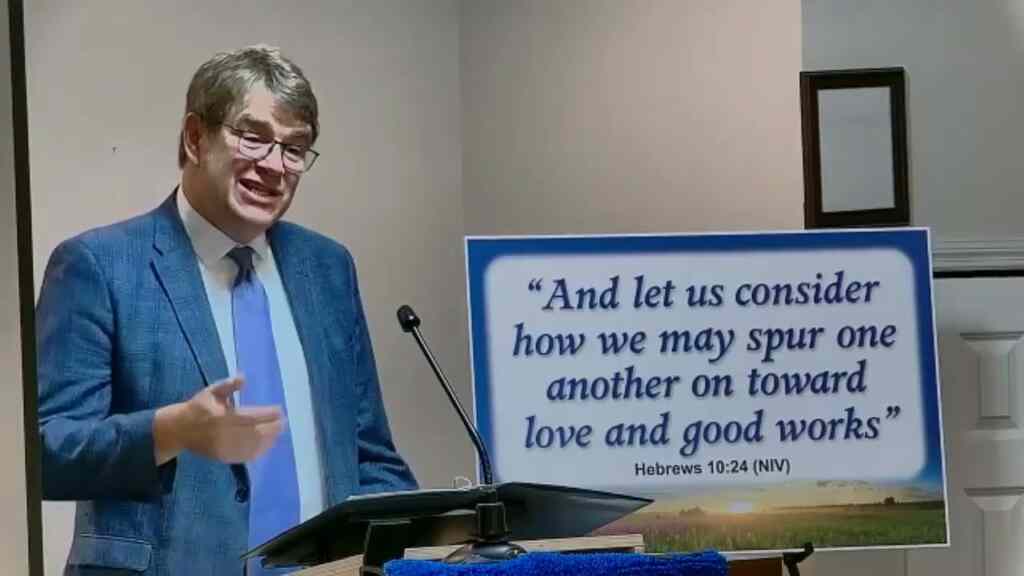
Our task this morning. Our assignment this morning is really to review the convention theme text. The theme text of Hebrews 10:24. The Orlando brethren seem to favor the NIV translation of the verse as shown on the program. So we want to begin by reading the verse in the NIV translation.
And it reads, and let us. Let us consider how to. How we may spur one another to love and, and to good deeds. That’s the niv.
Let us consider how we may spur one another untoward love and good deeds. Now, most of us are used to hearing it in the King James and most of us will recall this in the King James where it says, and let us consider one another to provoke unto love and good deeds. A slightly different wording. The first talks about us consider how we may spur one another unto love. The King James talks about considering one another to provoke unto love and good deeds.
We’re not going to parse that. That’s just a note. We would read mostly from the New American Standard Bible. So in the New American Standard, it reads, let and let us consider how to stimulate one another to love and good deeds. That’s the nasb.
As we read this verse over and over, we concluded that the words of Hebrews 10:24, the words of Hebrews 10:24 are really a timely reminder for us of the value and the essence of our fellowship. They’re a reminder of the value of the essence of our fellowship and truly a call to mutual encouragement. In the narrow way. This verse emphasizes and speaks to the importance of our need to have concern for and a consideration of our fellow brethren to the effect that we may have a shared responsibility in each other’s spiritual growth, especially as we encourage other each other to grow in love and to have good works. As you would expect to better appreciate this verse, it’s necessary to look at the context of the verse.
We need to look at Scriptures around the verse and also scriptures that are related to the central message of the verse. As we consider the Context of Hebrews 10:24, our theme text, and looked at the preceding verses, we thought it was reasonable to start with verse 19. We could go further and we will probably talk about other verses around it. But Starting with verse 19, and I want to read from Hebrews 10, we’re going to read verses 19 through 25. Hebrews 10, 19:25 says, Therefore, brethren, since we have confidence to enter the holy place by the blood of Jesus and by a new and living way which he inaugurated for us through the veil that is his flesh, and since we Have a great priest over the house of God.
Let us draw near with a sincere heart, in full assurance of faith, having our hearts sprinkled clean from an evil conscience and our bodies washed with pure water. Let us hold fast the confession of our hope without wavering, for he who promised is faithful, and let us consider how to stimulate one another to love and good deeds, not forsaking our own assembly together, as it is the habit of some, but encouraging one another, and all the more as we see the day draw near. That is some of the context of the Scriptures around our theme discourse. One of the first things that strikes me in when I, when I look at Scriptures is the word therefore.
When I see the word therefore, then I’m prompted to want to look a little bit further down to see what was said before the therefore, because therefore would signify a conclusion that the author is coming to. This part of the tenth chapter of Hebrews is a summary of the outcome of the theme of the Book of Hebrews as we see it. As we have studied the Book of Hebrews, we believe the main theme is the supremacy of our Lord Jesus Christ. The supremacy to a Jewish audience, an audience with a background in Judaism as we. The author is speaking to Christians with strong Judaism background.
And we say the author this is. I used to be very dogmatic about Paul wrote Hebrews and would argue it till. Till the cows come home. I don’t anymore because I really don’t know who wrote the Book of Hebrews. So I’m not dogmatic.
So you’ll hear me say author a lot. I just want to preface that, that I’m not. I’m not privy to who wrote it, and that’s okay. It used to be a sore point for me that people would argue that Paul didn’t write it, but I, I have a sense that maybe he didn’t or maybe we shouldn’t know who wrote it.
It would be one of the things to find out in the kingdoms who wrote the Book of Hebrews. But we know whoever wrote it was writing to a group of Christians that had a very strong background in Judaism because all, as you know, a lot of the. A lot of the elements of the book talk to things that they will be very familiar with, unlike the Pauline letters that were written to the Gentiles.
And so when you go to the opening of the book, this goes straight to the point of the supremacy of Christ to this Judaic background Christians. The opening of the first chapter states that in the past God dealt with the people through the Fathers and the prophets. That speaks to the background of, of. Of Jews.
But now in the last days, we’re told in the first chapter of Hebrews, God speaks through his Son, who is heir over all things. A l L all things, and the world was made through Him. That’s Jesus. The author further adds in that opening of the book that the sun is a radiance.
The radiance, 5, 41, and this is used just once in the New Testament of the heavenly Father’s glory, and that our Lord Jesus Christ is the perfect reflection or effulgence of God’s glory and an exact representation of God’s nature, and so right off at the very beginning of the book, we’re being told the supremacy of Christ is the essence of what this author is trying to get across, and incidentally, the word radiance and the word exact representation are words that are used only one time in the New Testament, which is very curious, and one that one we want to look into further later on.
But I thought it was important that they made, they made it very clear that this was God’s representative. So different than what folks might have been used to through the prophets and the fathers. Brethren, I know you’re all familiar with this context and so we’re not going to dwell too much on it, but there’s. But we need to touch on it a little bit, and I promise we’re not trying to do a full study of the entire book of Hebrews.
It might seem that way for a minute in the early church. Again, this church that had a very strong Judaic background. This was a major paradigm shift for them to move from what they had been taught and known to this new and living way that was inaugurated by our Lord. We see the care of the argument, as the author says, to which angel, to which angels did God ever say, you are my son? That’s in verse five of the first chapter.
And then in verse 13, the author again asks, which angel has God ever said, sit at my right hand? So the conclusion here is Jesus is obviously superior to angels in those statements. In the third chapter, Hebrews takes on establishing our Lord’s superiority to Moses. Moses is arguably one of the most revered figures in Judaism. We’re not going to do a study of Hebrews, I promise.
But subsequently, in the fifth chapter on, and all the way through the tenth chapter, we see that Jesus is again presented as a superior high priest. The Aaronic priesthood was God’s agent to minister to the people, and as Hebrews 5:1 says, the high priest is appointed in all things pertaining to God to offer gifts and sacrifices. Surely this is one of the most important personalities in the Judaic tradition. But the Author in verses 4 through 6 of Hebrews 5 makes the point that just as high priests like Aaron are called by God, so was our Lord called by God except.
Except to a more superior version of high priesthood after the order of Melchizedek. Again, you know this. The author makes very strong points about our Lord’s supremacy over angels, over Moses, and over the Aaronic priesthood, elements that are held in very high esteem in Judaism. This distinction goes on to include the superior perfect sacrifice that our Lord offered. That’s compared to the requirements of the law.
This discussion of our Lord’s superiority going from the angels to Moses to Aaronic priesthood, to the sacrifices, brings us then into the tenth chapter. In the opening of the tenth chapter, the sufficiency of Christ’s sacrifice is again confirmed. This is in contrast to the sacrifices under the law that applied every year and could not make folks perfect, and they were merely, we’re told, merely a shadow. Colossians 2:17 tells us that while those were shadow, the substance, the substance belongs to Christ.
So you have that comparison between the shadow and the substance again honing in on the superiority of our Lord.
So this was similarly confirmed as we read further in the 10th chapter of Hebrews in verse 14, we’re going to read from verse 11. This is Hebrews 10, starting with verse 11, and we think it makes the point where in verse 11 it says, and every priest standeth daily, ministering and offering oftentimes the same sacrifices, which can never take away sins. But this man, after he had offered one sacrifice for sin, forever sat on the right hand of God from henceforth expecting till his enemies be made his footstool. Verse 14.
For by one offering he hath perfected forever them that are sanctified.
But we also noticed, in fact, if I could read that in the New Living Translation, this is verse 14, it says, for by that one offering he forever made perfect those who are being made holy. If we also notice that as the case is being made severally about the superiority of Jesus to what they might, what the Jews might understand, especially the Christians that are coming out of Judaism might understand. There were several exhortations that were interspersed in between the submissions on our Lord’s superiority, we’re told the author calls us to take heed of our Christian obligations. So he’s still talking to Christians, and as he talks to Christians and talks about the superiority of Christ, he continues to minister to us and give us exhortations about our Christian obligations.
For example, in chapter 3, verse 12, he tells us to not fall away, but because of unbelief. In other words, stay the course in the narrow way. In chapter four, verse one, it tells us to not come short of entering into the rest that’s promised in our Lord. In chapter six, verse one, we’re told to leave the elemental things and press on to maturity. So we see that as he’s talking about this superiority of our Lord to what they might be familiar with and try to convince them about.
About the need to focus on. On what our Lord has offered. There is also some. Some pastoral work that’s going on in the teaching in the book of Hebrews. These examples of exhortations that we see were part of the discourse as our Lord’s supremacy was being established.
And this brings us back to Hebrews 10, Hebrews 10:19 through 25 that we just read, which we say is a conclusion of that discourse about the superiority of our Lord.
So going back to Hebrews 10:19, we want to just read the first three of those verses 19 through 21 says, Therefore, brethren, since we have confidence to enter, having now established that our Lord has done the work, and we have confidence to enter into the holy place by the blood of Jesus, by a new and living way which he inaugurated for us through the veil that is his flesh, and since we have a great priest over the household of God, he says here, because Christ has offered the one perfect sacrifice that we read about in verse 12 and has sat down at the right hand of God, and by this offering Jesus has perfected for all time for those of us who are sanctified. Therefore we have this confidence, we have this ability, this grace to enter the holy place and be in the Father’s presence through the blood of Christ. We have a similar conclusion earlier on in chapter four of Hebrews, Hebrews 4, 14, 16, where it tells us that therefore, since we have a great priest, great high priest who has passed through the heavens, Jesus, the Son of God, let us hold fast our confession. For we do not have a high priest who cannot sympathize with our weaknesses, but one who has been tempted in all things as we are yet without sin.
Verse 16, very critical and conclusive, says, therefore, let us draw near with confidence to the throne of grace, so that we may receive mercy and find grace, and grace to help in time of need. We have confidence to enter the holy place. We have confidence to draw near to the throne of grace. These are telling us that this access, this, this opportunity that we’ve been given is through our Lord. But it is one that’s not the very much on, very much unlike.
Not, not not unlike. But this is very much unlike what the, the folks that are, that have the Judaic background would have been accustomed to. We have this access to the Father. Not a typical thing that you find under Judaism.
We know this access to the throne of grace is for those who are sanctified. According to Hebrews 10:14. We are reminded of Paul’s confirmation that we are justified by faith, and we touched on this yesterday and we’re going to read this through. It’s in Romans 5:1.
Romans 5:1 says, Therefore having been justified by faith, we have peace with God through our Lord Jesus Christ, and through whom also we have obtained our introduction by faith into this grace in which we stand, and we exalt. We exalt in hope of the glory of God, and it goes on to say not only this, but we also exalt in tribulation. This is the work of our sanctification.
Knowing that tribulation brings about perseverance, perseverance, proven character, proven character, hope, and hope does not disappoint because the love of God has been poured out within our hearts through the Holy Spirit which has been given to us. Therefore, this privilege that we are, that we have, the privilege we have before the throne of grace comes with obligations and duties. It comes with a sense of appreciation of what we have. What do we do with it?
Now that we can come boldly into the presence of God, the Holy place? What do we do with this? Well, we think verses 22 and through 24 of Hebrews 10 begins to set some of that mark for us as to what we are compelled to do, because we have this unique privileged access to the throne of grace. The three exhortations here in Hebrews 10:22, 24 are clear expectations of us who have this privilege of grace to be in the Heavenly Father’s presence, receiving mercy and grace to help as needed. Now reading Hebrews 10:22,24,24 being our theme text, it reads, let us draw near, since we have this confidence to enter, says, let us draw near with sincere heart, in full assurance of faith, having our heart sprinkled clean from an evil conscience and our bodies washed with pure water.
Let us hold fast the confession of our hope without wavering.
For he who promised is faithful. Then he goes on to say, let us and let us consider how to stimulate one another to love and good deeds. I refer to this as the three let us exhortations. So air quotes intended because it says let us three times, and it’s very important to key in on that.
He could have just said, you go do this. But he says, let us if a call to action, which includes again the theme of our of our theme Scripture. Today it seems like the least we can be asked of, given the Heavenly Father’s love that’s so lavished upon us, is to heed this call, these three calls to action. The first call to action is to be fully present in this grace that we’ve been granted to, that we have been introduced into by the expression of faith. An expression of faith that suggests that we have our entire being.
It talks about our heart and body prepared for service. It talks about our heart sprinkled clean from evil conscience and our bodies washed with pure water. It’s inclusive of heart and body. Heart clean, body washed is bringing the complete self, bringing the complete self, body and will to our walk. The contrast to this is the warning in Hebrews 3:12 that talks about Hebrews 3:12 talks about the evil, unbelieving heart that fails, that falls away from God.
This first exhortation, this first led us in verse 22, is a call to action that’s about our faith, and no wonder. The author expands further on this issue of faith in the very next chapter in chapter 11. Let’s go on to the second. Let us second, let us is to maintain our hope without wavering.
We should never be double minded because we have a faithful Father in heaven that has provided all of this for us. This idea of wavering or being double minded is what James bluntly warned will not receive anything from the Lord. James 1:6 8 says, the one who doubts is like the surf of the sea, the surf being waves, as in wavering, driven and tossed by the wind and such should not expect to receive anything from the Lord, and being double minded is unstable in all things. The Apostle Peter says that our faithful heavenly Father has granted us everything pertaining to life and godliness.
In second Peter 1, 3 and in the very next verse, we are sure that with the precious and magnificent promises we have help to enliven our hope, to maintain our hope without wavering. I think it suggests that we need to come to a full understanding of the Lord’s of our Heavenly Father’s will. For us, it’s to study the words of truth, to be reminded and perpetually refreshed about the faithfulness of Jehovah. This call and the second led us is a call that’s about hope. The first was about faith.
The second is about hope. This brings us the third. Let us, let us exhortation. That’s the third. The third letters exhortation, which is a theme.
This theme scripture for our convention today is one that’s external to us. The first two, faith and hope, are things that we deal with internally. It’s part of us. We have the faith in our minds. We’ve given ourselves in our conscience to the service of God.
And in our belief in the Lord’s sacrifice. We have this hope of the magnificence of the coming kingdom and the work to come and the blessings of all the families of the earth. These are all things that we keep internally. This particular third exhortation, this third letter is external. It’s about our brethren.
We will read it again, but this time we’re going to read verse 25 along with verse 24, because we think it’s part of the same continuum, it’s part of the same thought that’s expressed in our theme text. In verse 24 it says, and let us consider how to stimulate one another to love and good deeds, not forsaking our own, assembling together as it’s the habit of some, but encouraging one another, and all the more as we see the day draw near. A couple of things to note. One is the word the.
The phrase one another, let us one another. These are communal phrases. It talks about a collective, so that’s one thing to consider, but it also talks about the need to consider. In other words, there is a sense of thoughtful consideration. We’ll get to that.
Now, this great expression, this particular led us, we believe, this theme discord, the theme text, is really a great expression of the essence of our fellowship as we seek to edify each other, and one of the many ways we build up the body of Christ in love. In the sixth volume, and we saw in the sixth volume on page 305, where it talks about this a little bit, it refers to it as a loving and beautiful thought as expressed, and we quote, says, while others consider their fellows to fault, finding and or discourage, or selfishly to take advantage of their weaknesses, the new creation is to do the reverse, to study. This is the word.
Again, the word consider. To study carefully each other’s disposition, with a view of avoiding the saying or doing of things which would unnecessarily wound, stir up anger, etc. But with a view of provoking them to love and good conduct. Relative to this verse the sixth volume continues that while the world and the flesh and the devil provoke to envy, selfishness, jealousy, evil, enticement to sin, the new creature must not only abstain from such provocations, but engage in provoking or inciting in the reverse direction towards love and good works. So this third exhortation is about the Body of Christ, our responsibilities to the Body of Christ.
Having now come into the presence of God’s grace by the sacrifice of our Lord, we have this obligation to the Body of Christ in stirring up one another unto love and good works. Brethren, as you might have concluded, the three let us exhortations are respectively about faith, hope, and love.
Faith and hope are about building ourselves up individually through the provisions of the Heavenly Father’s works, and especially the power of the Holy Spirit in our lives. The third is about building up our fellow brethren. To be useful for our brethren, we must be of sincere heart, with full assurance of faith, and we must be full of unwavering hope. Then we are equipped for the good work of stirring up and stimulating one another unto good works. The question is, how do we do this?
How do you stimulate one another unto love and good works? Let’s take a quick moment to consider the theme. Again, let us consider how we may spur one another on to love and good deeds. The verse implores us to consider. To let us consider is to imply a thoughtful attention and a deliberate care.
When you’re considering something, there is an attention that you’re given to it. When you give thoughtful attention, it is beyond a passive encouragement. It’s beyond just saying I’ll pray for you, right? This is a thoughtful attention to how to do something else. So it’s not just a thoughtful attention in of itself, but on how to do something else, which is the spurring part of calls for thinking through and acting deliberately to effectively implement that thought that we’ve just had.
On how we would we would consider how we would spur our brethren on. We’re told to consider how to provoke or spur on our brethren to love and good deeds. The word spur is not passive either. It has a meaning of staring up. It’s the Greek word prox.
I promised I would not speak Greek around here again, but here I am. It’s a Greek word proxy proxismos. Again, you look, I’m sure you’ll look it up, and it implies provoking. It implies spurring, sometimes even sharply.
In other words, there’s an edge to doesn’t always come easy. It’s not always comfortable. But it is necessary. Is why there is this exhortation because it is to the end of the building up of the body of Christ. Essentially, we are challenged.
We are, excuse me, we are to challenge one another with love, to live out our faith through love and good deeds. This would be the works that James talks about.
James said, I will show you my faith by my works. That’s second chapter of James, verse 18.
And then in the same second chapter of James, he concludes that faith without works is dead. This provoking of one another is part of our works, such that we might actually get even more works out of how we provoke one another. Reading James, chapter two from verses 4:14 to 26. We’re not going to read it here, but if you read that context, it would seem exactly like what the author of Hebrews is talking about. James is here provoking, provoking us to love and good works.
And he’s very direct and sharp about this issue, and he’s to the point. James 2:14, 26 to the discussion of how we are to do the spurring or stirring or provoking, depending on which translation you look at, how we spur each other. We must start by being grounded in love. Understanding the Father’s love that gives us this privilege that we have is the beginning. We must know what God’s love is so that we can embody.
Would be difficult to provoke others to do things that were yet to fully embrace and master. So we begin with God is love. This declarative statement in First John 4, 8, I think is the beginning is the foundational part of our call.
It’s foundational to the gift of the ransom. It’s foundational to the resultant justification into the grace that makes us fellow brethren. God is love. Reading from 1 John 4, from 7 to 11 says, Beloved, let us. That’s that phrase again.
Let us. Let us love one another. For love is from God, and everyone who loves is born of God and knows God. The one who does not love does not know God, for God is love.
By this, the love of God is manifested in us that God has sent his only begotten Son into the world so that we might live through him in this love. Not that we love God, but that he loved us and sent his Son to be the propitiation for our sins. Verse 11. Beloved, if God so loved us, we also ought to love one another.
To provoke others to love, we must know God’s love. His love must be perfected in us. As it reads in the 12 verse, verse 12 says, no one has seen God at any time. If we love one another. God abides in us, and his love is perfected in us.
That’s 1 John 4:12.
But just as Hebrews 10:24 says, Let us there provoke others to love. This begins with First John4.7 saying, Let us love one another. That intentional consideration begins with an expression of love for the brethren. Jesus sets the example and command for love as the mark of our fellowship with him.
John 13:34 says a new commandment. I give you that you love one another even as I have loved you. You also love one another. By this all men will know that you are my disciples if you love one another. Two verses it talks about loving one another three times.
This is the essence of our fellowship. This is the third exhortation in the Let us exhortations. In Hebrews 10 we know this is agape love, and sometimes it can be difficult to define what agape love is.
A common definition that we hear is agape love is disinterested love. Have you heard that phrase? How many of you like that phrase? Nobody I know, I and what it means is, it’s not filio, it’s not Eros, but it’s this love that doesn’t expect anything in return, and hence the word disinterested.
But that is a little cold to describe what is the utmost most beautiful thing.
We’re not going to try to define agape love because the Bible already defines it. It’s in First Corinthians 13. First Corinthians 13:4 says, Love is patient, love is kind, love is not jealous, love does not brag, love is not arrogant, it does not act unbecomingly, it does not seek its own it is not it’s not provoked, does not take into account wrong suffered, does not rejoice in unrighteousness, but rejoices with the truth. It bears all things, it believes all things, hopes all things, endures all things. Love never fails.
And we jump down to the 13th verse. It says, now faith, hope, and love abide these three, but the greatest is love. Now remember, we have those same three in our context. In Hebrews 10:22:24 it was about faith, hope and love. But the one that abided the most is that external expression that is love.
With our full assurance with a full assurance of faith and our confession of the hope with without wavering, we should bear each other in mind with an incitement for an incitement to love and to good good deeds. As he reads in the diag brethren, love is from God. Jesus says to love each other to exemplify his love. We definitely love the brethren, and we must, we must show that we love one another. We love one another and we want to actively provoke an incite to love.
As we continue to think about how we might incite our fellow brethren into love and good works, a couple of other scriptures come to mind. One is in Romans 12, Romans 12, Romans 12:10, where it talks about let us love without hypocrisy. But he also talks about being devoted one to another in verse 10 in Brotherly Love, giving preference to one another. You see the phrase one another over and over again in Scripture. I never noticed it until this study where there is a lot of reference to one another that calls for this communal relationship that we have, this obligation we have one to another.
It says rejoicing in hope. It says not lagging behind in diligence. Verse 11 Fervent in spirit, serving the Lord, rejoicing in hope, persevering in tribulation, devoted in prayer, contributing to the needs of the saints and practicing hospitality. This is part of the let us provoke one another. The idea of being devoted or loving affection is one that one to another helps us to understand what Hebrews 10:24 is saying, which is to consider one another.
It implies a very intentional attention or deliberate care in making sure that we live up to our call, contributing to the needs of the saints, of the brethren, practicing hospitality. We’ve seen that coming to convention, hosting a convention and actively attending one might qualify as a way of provoking the brethren to love and good words. This is a concerted effort. When you host a convention, it’s a very deliberate effort to cater to the needs of the brethren. As we see the day draw near, it is an opportunity to come away to an oasis where truth has been shared, where fellowship is being had such that we can encourage others one another.
This is provoking unto love and good deeds. Being hosted by a wonderful family, I think is an example that I will take with me. You know, when I landed at the airport, from the very moment I got in the car with Brother Adam, we talked about the truth and our imagination of the future of the hope that’s in us. Well, I hadn’t done that all week because I was busy working, and it’s just so gratifying to get off the plane after four hours or so flight to be in a car.
And that’s all I’m talking about. That’s provoking unto good works. I would say active participation in ecclesiastical studies is also another way of stimulating each other unto love. Sometimes we have differences of opinion about things and so it’s a little uncomfortable. But that’s where the growth comes from is when we share uncomfortable and we do it with love.
Being prepared to participate in lessons is important. It’s not just about coming up with all the right answers and beautiful thoughts. It’s also about just asking questions of the things that we don’t know that may spur a growth. Questions basic to thought provoking growth that we might have.
The second scripture which we’re not going to read is in Galatians 6, 9, 10, which talks about let us do good to all people and especially those of the household of faith. This scripture is relevant to us because the exercise of provoking others to love and to good works can be tedious even when done lovingly. Doing good to others is an extension of our faith, and so the practice of doing good generally is important. But charity begins at home.
We want to practice it with the brethren and obviously reflect it to others so they would know that we are in fact the disciples of our Master. In closing, brethren, we are beneficiaries of our Lord’s superior sacrifice by the grace of God. God is love. Heard one thing recently. God is love.
God has no beginning. If God is love, love has no beginning. It’s endured forever. God is love, and we are of God. We have a tremendous privilege of fellowship with the Father and His Son our Lord.
We believe we are compelled by our theme text today, therefore, to keep the faith with unwavering hope and to provoke. We have this obligation to go out and provoke and stir each other up unto love and good works. We are reminded by this text that our faith must be felt within the fellowship. The body of Christ is the most important work of this gospel age. It’s the most important work of the gospel age.
Looking forward to the bigger work of the kingdom, we are being challenged to have a part in that work. Every joint supplying according to the proper workings of individual parts, causing growth in the body of Christ in love. I’m going to ask you to look around left and right. Who do you see, brethren? That is us.
That is us, brethren. Let us stir each other up unto love and good works. May the Lord add his blessings.
Click Here for the PDF transcript.