This transcript was generated automatically. Its accuracy may vary
Short Summary
The discourse explores the distinctions and interrelations between wisdom, understanding, and knowledge, emphasizing their practical application and transformative power rooted in the knowledge of God and His principles. It stresses the importance of grasping universal principles over mere rules or data, highlighting that tru...
This transcript was generated automatically. Its accuracy may vary
Short Summary
The discourse explores the distinctions and interrelations between wisdom, understanding, and knowledge, emphasizing their practical application and transformative power rooted in the knowledge of God and His principles. It stresses the importance of grasping universal principles over mere rules or data, highlighting that true knowledge leads to life and fruitfulness, while cautioning against superficial or misguided pursuits such as divination or blind reliance on technology without understanding. The speaker also points to the necessity of aligning scientific and social understanding with enduring principles to foster genuine progress and peace.
Long Summary
Purpose and Approach of the Discourse
– The speaker aims to “stir up your pure minds” by way of remembrance, encouraging active participation via voting on questions about wisdom, understanding, and knowledge.
– This interactive approach follows Apostle Paul’s advice to direct minds toward joy and the goodness of God.
– Acknowledges that questions may be limiting, surprising, or uncomfortable, but are intended to provoke thoughtful reflection.
Questions on Wisdom, Understanding, and Knowledge
– Participants first choose what they value most among wisdom, understanding, and knowledge—majority chose wisdom.
– Definitions of wisdom were posed:
– Experience, knowledge, and good judgment
– Soundness of action in practical context
– A body of knowledge and principles with above-average judgment
– Most voted for wisdom as the ability to judge and decide with experience and good judgment.
– For understanding, options included: mental grasp/power of comprehension, ability to change from comprehension, mutual agreement, harmonious relationship. Majority chose “ability to change resulting from comprehension.”
– For knowledge, options ranged from familiarity with science/arts, information and skills from experience or education, understanding of universal principles, awareness of facts, to complete understanding. The majority favored “information and skills acquired through experience or education.”
– When asked what is valued most among data, information, comprehension, understanding, knowledge, or awareness, majority selected understanding.
Is Wisdom Possible Without Knowledge?
– Majority voted No—there can be no wisdom without knowledge.
– This introduces the importance of knowledge as foundational for wisdom and ultimately for life.
Biblical Foundations on Wisdom, Understanding, and Knowledge
– The speaker references Jesus’ teaching from Matthew 7:24-27 (the wise man who builds his house on the rock) to illustrate that wisdom involves acting on knowledge, not just hearing or memorizing.
– Parable of the Sower is cited to emphasize that hearing without understanding yields no fruit—true understanding leads to transformation and fruit-bearing.
– Story by Brother David Bruce about a parrot repeating “I’m happy” during a fire illustrates that mere memorization without comprehension is useless.
The earth being filled with the knowledge of the glory of the Lord as waters cover the sea (Habakkuk 2:14; Isaiah 11:9) is referenced to show the vastness and importance of divine knowledge.
Key Scripture: 2 Peter 1:2-3
– “Grace and peace be multiplied unto you through the knowledge of God and of Jesus our Lord, according as His Divine power hath given unto us all things that pertain unto life and godliness through the knowledge of him that had called us to glory and virtue.”
– This verse highlights that knowledge of God and Jesus is essential for life, godliness, and spiritual victory.
Jesus’ Prayer in John 17:1-3
– “Father, the hour is come; glorify thy Son… that he should give eternal life to as many as thou hast given him; and this is life eternal, that they might know thee the only true God, and Jesus Christ, whom thou hast sent.”
– Eternal life is defined as knowing God and Jesus Christ—knowledge is fundamental to salvation and eternal life.
– Knowledge is repeatedly emphasized in John 17 (nine times) as vital for life and transformation.
Knowledge and Words
– Jesus mentions giving His followers the Father’s words (John 17:6, 8, 14, 17, 20), underscoring that knowledge comes through God’s word, which sanctifies and transforms.
– The importance of continuing in Jesus’ word to be transformed (John 8:31-32) is stressed.
What Knowledge Is Not
– Knowledge is not divination, sorcery, or future telling (Deuteronomy 18:10-12). These are condemned practices.
– The Babylonian magicians and astrologers could not provide true knowledge or understanding.
– Prediction and so-called fortune telling are not true knowledge.
True Knowledge Defined
– True knowledge is deep understanding of universal principles that produce change and fruit.
– Ralph Waldo Emerson’s quote on principles vs. methods: many methods exist, but few principles; ignoring principles leads to failure.
– Brother Russell’s quote: “Rules for children, principles for men.” Principles are foundational and inform all life, more than mere rules.
Scientific and Social Illustrations of Principles
– Example of hospital janitor duties: extensive rules covering tasks but no instructions on humane treatment of others.
– Illustrations of janitors who go beyond rules to act with kindness and compassion, showing principles of humanity and care in practice.
– Principles are neglected in many spheres today, leading to crises and ineffective rules/incentives.
Principle of Conservation of Energy
– Scientific principle illustrating the impossibility of perpetual motion machines (perpetuum mobile).
– Understanding this principle prevents futile efforts and misdirection of resources.
– Similar with the speed of light limit—some scientific principles are absolute and guide realistic expectations.
Science and Knowledge Evolution
– Pre-Newtonian science was about observing what exists; Einstein and quantum mechanics introduced the concept that humans can influence and create knowledge, not just observe it.
– This shift in science shows knowledge is dynamic and includes human creativity and understanding of universal laws.
– The speaker emphasizes that many scientists do not grasp this fully.
Artificial Intelligence and Knowledge
– AI is described as a “black box” with unknown future effects, causing fear and confusion.
– Apostle Paul’s warning against being taken captive by philosophy and empty deception (Colossians 2:8) is applied here.
– The need to focus on principles rather than mere technological or philosophical forms is stressed.
Historical Perspective: Babylonian Astronomy and Greek Philosophy
– Babylonian mathematicians accurately predicted eclipses but did not understand the deeper principles.
– Greek philosophers invented explanations (e.g., the moon borrowing light from the sun) that evolved over time.
– Apostle Paul warned about empty philosophy leading people astray.
Conclusion and Preview of Part Two
– The speaker promises to continue exploring the often neglected principles of God that enable peaceful living and effective methods for good creation.
– Emphasizes the importance of understanding and applying principles rather than merely following rules or superficial knowledge.
—
Key Bible Verses Cited:
– Matthew 7:24-27 — Wise man builds on the rock, foolish man builds on sand
– John 17:1-3 — Jesus’ prayer emphasizing eternal life as knowing God and Jesus Christ
– 2 Peter 1:2-3 — Knowledge of God and Jesus given by Divine power for life and godliness
– Habakkuk 2:14, Isaiah 11:9 — Earth filled with knowledge of the glory of the Lord
– Deuteronomy 18:10-12 — Condemnation of divination and sorcery
– Colossians 2:8 — Warning against philosophy and vain deceit
—
Summary:
This discourse explores the distinctions and interrelations between wisdom, understanding, and knowledge from both biblical and practical perspectives. It highlights the biblical foundation that true knowledge—especially knowledge of God and Jesus Christ—is essential for eternal life and godly living. Wisdom is not mere knowledge but requires acting on that knowledge. Understanding involves transformation and fruit-bearing, not rote memorization. True knowledge is defined as deep comprehension of universal principles that inform effective action. The discourse warns against false knowledge such as divination and empty philosophy, encourages adherence to principles rather than mere rules or methods, and applies these ideas through scientific and social illustrations. It also touches on modern challenges like artificial intelligence and the ongoing human quest to comprehend the universe, all while pointing back to the supreme knowledge of God’s word as the foundation for life and transformation. Part two will further explore specific neglected principles of God’s kingdom.
Transcript
I would like to stir up your pure minds by the way of remembrance, and that’s why, as I mentioned earlier, I would like to invite you to participate in this what we are going to do, because I’m going to ask a few questions and some of you were already able to do this by connecting with me. I’m going to put the link again into the chat for those who maybe were not there because chat is not always visible, and as we go along, you would be able to go and vote. As I show things like this, you would be able to vote.
So now with that, with all of those of you who connected, who responded, I really appreciate and again I will say that I know those questions which I’m going to show are limiting. They may be surprising at times, they may be a little bit uncomfortable because they may propose a dilemma for you to consider. But we do this to follow the advice of Apostle Paul, to steer your minds, to share the joy and to remind us about the goodness of our Heavenly Father. So I would like to start by asking you a question which will appear there soon. What do you value most?
And I would like you to select one of those three things which are in front of you. Wisdom, understanding or knowledge, and I want you to vote so that I I think I know how you’re going to vote, but nevertheless I would like you to select out of these three concepts of wisdom, understanding and knowledge, how do you value them? And I know you may value all of them, but I really would like you to pick one just for the sake of this time when we are going to discuss it together. So without further explanation and do I’m going to show you how those who voted decided to vote.
And majority of you, as I expected, values wisdom, which again I am I’m not surprised but I would like to probe you a little bit more. What is wisdom in your opinion? And in here the options I would like you to consider is experience, knowledge and good judgment. Option B, soundness of an action in practical context. Whatever happens, sound action practically taken.
Or maybe it’s a body of knowledge and principles within a domain of knowledge, ability to judge and decide with soundness and intelligence above average judgment in practical context. So I want you to think about this and pick one of those definitions of wisdom which you indicated at least majority of you that you value wisdom. So how do you define in those limited terms wisdom, the concept of wisdom in your opinion? In a moment I’m going to show you how all of you who are voting voted.
That’s really interesting. Ability to judge and decide and experience and good judgment. Clearly there is a majority with some other. Again, in all those questions there is no wrong answer. So I don’t want you to feel bad, I just would like you to to think about this.
But what is understanding? Select now your preferred definition of understanding, and I am putting here again all of those are. Okay, just select one you like. Mental grasp, power of comprehension, Ability to change resulting from comprehension.
Mutual agreement, binding both sides. That’s what we say understanding is or harmonious relationship. So how do you feel in contrast to wisdom? What is understanding? And again I would like you to pick up something which comes close.
I know it’s not perfect, but something which come closest. So pick one of those options which you consider understanding is as you compare it to wisdom.
All right, let me show you how everyone voted. By the way, I don’t know who voted how, so it’s really safe to vote. Brethren don’t hesitate to vote. So ability to change resulting from comprehension. I find it amazing.
Please notice that there’s no wrong answers here. But please notice how the majority responding here, and finally I will make it even more difficult by asking you what is knowledge? So in your opinion, knowledge is what? Familiarity with science, art or technique.
B Information and skills acquired through experience or education. C Understanding of universal principles of reality. D awareness of facts and situations. Or maybe you think knowledge is some of what is known in general or complete and deep understanding of a subject. I know there’s more options and this is more challenging, but I still would like you to give it your best shot.
Again, I don’t know who voted what. I would like to know how you in general may be thinking about this.
And the reason I do that as I mentioned is so that I can tailor later on my words to what may be most beneficial not to say what you already know.
Okay, so majority of you it’s information and skills acquired. But there are also other proposals here which I do appreciate and I notice and I am going to continue along of this. Now out of these items here, which one do you value the most? Data, Information, comprehension, understanding, knowledge or awareness. Please decide between those points which I’m sure in those days when we use zoom and cell phone and gps, there are things here which you are going to be familiar with.
I would like you just to pick one term which you personally value the most, and again, thank you, thank you for voting so well. We have 20 votes and you can see clearly that the most is option D which is understanding.
The last question I believe here is somewhat Problematic. That’s why I put the title here. Maybe it is undesirable or unpleasant Choice. Can we have wisdom without knowledge? And I give you those options?
Yes. No, I do not know. I don’t even want to answer this. It’s also an option. So please find out what is your preference here and then I promise this is the last question today.
I may have some more tomorrow as we go into part two, and again, thank you for voting and I’m going to show you how majority of you voted. So clearly it is no majority of you decided that there is no wisdom without knowledge, and again, this is an interesting point which I would like to comment now on several of those questions.
Maybe not everyone agreed, but in my opinion when it comes to wisdom, these words of our master provide a really good understanding. When he spoke about wisdom and said, everyone who hears my words, that’s by the way I selected the hymn about beautiful words, important words. His words were important words of life and acts on them is like a wise man who built his house on the rock and when the rain wind came, it stood, the foundation was on the rock and it was firm. But the one who hears, and maybe even I would say, memorizes them but does not act upon them. It is the man who is called a foolish man.
So I think we would all agree that wisdom, this is what I would like to stress is here, is closely connected and related with acting, with doing, with works, and it’s shown in practice. Now when it comes to understanding, I would like to bring to what many of you said and I think we will all agree the Lord expressed in the parable of the Sower, even if you hear and if you memorize but you don’t understand it, you cannot bear fruit. For me, the meaning here is you don’t know if you memorize. Parroting or aping is not understanding. Brother David Bruce used to tell a story about a parrot which learned to say, I’m happy, I’m happy.
And then the house was burning, the parrot was sitting on the fence and was repeating I’m happy, I’m happy. That’s how it is when we even memorize but don’t deeply understand and don’t bring fruit. There is no change in us. We have to bear fruit. That’s why our master so much insisted on this and on multiple occasions said hear and understand.
Now last of those terms which I would really like to focus my attention is vast and measured just like the ocean. For the earth shall be filled with the knowledge of the glory of the Lord and the waters as the waters cover the sea, and the same quote from a similar quote from Isaiah, the earth shall be full of the knowledge of the Lord as the waters cover the sea. So today I would like to share with you Part one of certain considerations related to the knowledge of God and of Jesus our Lord.
Our theme verse comes from the epistle of Apostle Peter. Grace and peace be multiplied unto you through the knowledge of God and of Jesus our Lord, according as His Divine power hath given unto us all things that pertain unto life and godliness through the knowledge of him that had called us to glory and virtue. Please notice this opening statement of Apostle Peter. The knowledge of God and of Jesus contains everything which is necessary for life for our calling, for the victory for the goodness of the Lord, which He provided for all mankind. Knowledge of him that called us I have to admit that this topic became closer to my heart as we were going through our yearly memorial meditations.
Springtime when we were reading the last moments and events and passions of our Lord, my attention was caught by the words which were expressed in the last prayer of our Master in the garden of Gethsemane. Father, the hour is come. Glorify thy Son, that thy Son also may glorify thee, as Thou hast given him power over all flesh, that he should give eternal life to as many as Thou hast given him, and this is life eternal that they might know Thee, the only true God, and Jesus Christ, whom Thou hast sent. Please notice the highlighted power over all flesh to receive eternal life, life eternal that they may know the only true God.
So in here, those of you who said there’s no wisdom without knowledge, there is no life without knowledge. There is nothing without knowledge of our Heavenly Father. The conditions, the preconditions for life are the knowledge of the only true God and His Son, Jesus Christ. As a matter of fact, I notice that in this very 17th chapter where the prayer was recorded, knowledge as Life is mentioned 9 times, 7 times. This one specific Ginosko Greek word.
There’s also other expressions made known or declared to manifest the belief so they may believe, and also the other word which I started our consideration today is words. Knowledge is so important. Please notice that this last, most important prayer, this precious moment, the Lord directs, asking for knowledge, knowledge of the Heavenly Father. Often when we think about knowledge, we give it a very bad connotation.
I would like to change that at least for those who may have doubts about knowledge and come and say knowledge coming from words, because words are so stressed in this passage where the Lord says, I have revealed your name to those who you gave me, and they kept your word. For I have given them the words you gave me. I have given them your word. Sanctify them by the truth your word is true. Neither pray for these alone, but for them also, which shall believe on me through their word.
So, words, the truth gives us knowledge which provides transformation, which leads to life. That’s why we think knowledge is so important, and the pertinent question is, how do we gain this knowledge?
And you remember those words which are quoted here. You just have the references. If you continue in my word, if we all do this, we will be transformed. So today I would like to start an important topic of knowledge, which is a catalyst allowing or preventing the transformation of our character, and we would like to consider this.
What is true knowledge? What should we be studying? What should we be knowledgeable about? As often is the case in order to determine what is knowledge, maybe we will start by saying what knowledge is not, and this comes from the words of our master, when he addressed those who were very well versed in the Scriptures.
When evening comes, you say, the weather will be fair, for the sky is red, and in the morning today it will be stormy, for the sky is red and overcast. You know how interpret the appearance of the sky, but not the signs of the times. Did you notice? They were able to predict the weather, but they were not able to read the signs.
But in fact, there were things related to prediction which were even forbidden from very early on in the book of Moses. We have the Scriptures where the Lord said, let no one be found among you who will sacrifice his son, daughter, or practice divination, conjury, interprets omens, practice sorcery, future teller, seers, sorcerers. This is the judgment which the Lord had very harsh judgment against those who are sorcerers, adulterers, perjurers, oppressors of widows and fatherless, and as you recall from the book of Daniel, in the Babylonian court or system, the scientists were called magicians, enchanters, sorcerers, astrologers, seers. But none of them could explain what the king asked them to do.
What I would like to stress here is the future telling is not knowledge, even though there’s nothing wrong with sometimes predicting, and people certainly make lots of money. Prediction is really the essence of the business, how people make money off each other. But really it’s not the knowledge.
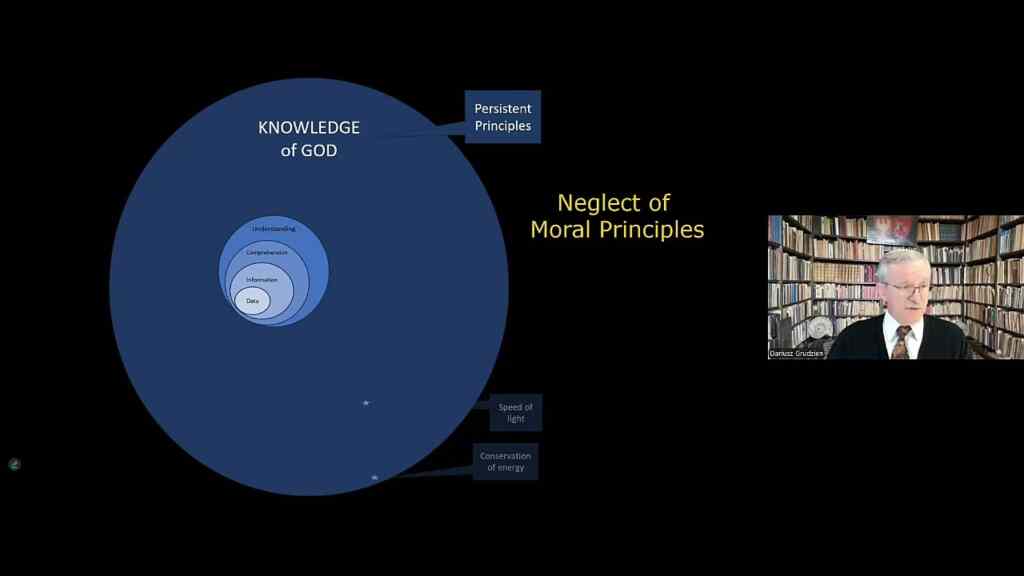
So what is true knowledge? I would like to suggest to you that this is the deep understanding of universal principles, and you already indicated as you voted that understanding means it makes a change, it brings fruitage.
I would like to spend some time stressing the importance of principles. The quotes I have here come from Ralph Waldo Emerson, which is often quoted in the reprints. One of the brothers wrote, brother Russell, after he read the volumes, that those principles were just what I needed. As to methods, there may be a million and then some, but principles are few. The man who tries methods ignoring principles is sure to have trouble.
The man who grasps principles can successfully select his own methods, and if I had to paraphrase the history of what we see in our days, it is countless methods how to do things bringing us more trouble, but very few who understand and adhere to principles. When Brother Asl was thinking about the importance of principles as the elements which constitute the knowledge of our Heavenly Father, he said this in 1888. There is always a tendency to substitute for form for spirit, rules for principles. It is so much easier to conform the conduct to a rule than to make a principle inform the whole life.
Moses prescribed rules. He said Christ inculcated principles. Rules are for children, principles are for men. This is extremely important and I would like to to illustrate those concepts for you with few illustrations from scientific and social perspectives. What you are going to see in a moment in front of you is going to be a list of duties as described for a hospital janitor.
So look at what’s going to be happening here when this comes. Excuse me, maybe before that I’m going to explain to you something else, maybe a little bit of the scientific aspect. You all heard about data, and I would like to help you to understand this concept. Because today there is a lot of discussion in the media about artificial intelligence, data and information. So I would like to help you and define data as something which you can measure, something which can be quantified or measured.
Now, when you’re measuring points, you can measure temperature. The fluctuation in the temperature will constitute information because there is a pattern. When someone has 100 degree temperature, you know, this is a fever. But then comes the explanation in context. For children who quickly run a fever, it may not be difficult, but for Brother Paul, who ended up in the hospital with the infection, fever could be very difficult.
So understood and comprehended in context by a physician, it becomes really important, and then comes the understanding, the understanding which is personal in context, integration and understanding of what’s happening. I put those icons here to indicate that there may be people who understand deeply medicine, physics, chemistry, deep scientific engineering concept. But unless we also understand them and bring them to our hearts, this knowledge is beyond our reach, and this is how those concepts of knowledge progress.
We look at the data points, we see certain patterns, we start understanding what they mean, and then they become useful if we connect them with the principles. Now let me explain that a little bit better by looking at the biblical example data point was disobedience of Israelites. Now I’m sure that you notice the pattern in the Book of Judges. Time after time, the Lord sends them a deliverer, a prophet, a judge, and they are delivered. Now, Apostle Paul really understood the pattern.
He knew that the promises given by the Lord would never become a void. They will always have the place in the Lord’s plan. But guess what? Even those who see the data and the patterns do not understand the role Israel plays in the Lord’s plan and they reject it. They provided the theory of substitution for Israel because they do not understand personally the hope for the nation of Israel, which really is understanding of the principle of our Heavenly Father character.
He is unchangeable, and more about this tomorrow. But look at this data points visible to everyone who has the Bible, even the patterns visible. But comprehension and personal understanding becomes problematic. There are many principles and I would like to give you a challenge to find more of those as we continue today and tomorrow.
For now, I would like to say that those principles can be different in the medical science, in physics, in chemistry, all over the place, and I would even say that there are people who invented their own universe where they talk about nonsense. We don’t want to talk about this. What we want to talk about is the world in which we live and in which people try to understand the science, technology, but they forget about the most important principles. When we look at the social sphere, what we observe today is blatant disregard for those principles.
In response to crisis which we observe today, people come up with more and better rules, smarter incentives. Little they know that those incentives and rules do nothing good. They just make the situation worse. We see this today when officers, police officers, military officers are facing situations when there’s no rule and they have to act somehow. People on the street are surprised by what’s happening.
No incentives and rules are smart enough to give us what we need and want. The topic of principles which we are discussing today, in my judgment, is a primary candidate for good witnessing effort because of these reasons, and now what I’m going to show you is a list of duties, rules and regulations for a hospital janitor. Just look what’s crawling in front of you. Mop the floor, sweep the Empty trash.
Restock the cabinet. The list is really long and has plenty of little things. It may be little surprising how many things you see in here. But what is really surprising is what is not on this list. There is nothing on this list which relates how to treat another human being.
Not a single one. Janitor’s job in the hospital could be as well a job in the mortuary. Yet when the psychologists look at this and they studied this, what they encountered was amazing. Mike, who told them how he stopped mapping the floor because Mr. Jones, who was just getting off bed because he tried to little exercise in the hallway and he was losing his strength, almost fell, he dropped everything and help Mr. Jones. Charlene told them how she ignored her supervisor’s admonition and she didn’t vacuum the visitors lounge because there were some family members who were there all day and who at this moment were happening to take a nap.
And then there was Luke. Luke who washed the floor in the comatose young man’s room twice. Because the man’s father, who had been keeping a vigil for the six months, didn’t see Luke do it the first time and was angry at this behavior. From janitors to technicians, nurses, doctors, people and their actions don’t just make people feel better. They actually improve the quality of life and the hospital.
They are extremely important. Principles which are neglected today provide for what we experience as wonderful humanity. Those principles which are neglected today have far reaching consequences. Allow me in the time which is left to talk to you at first about some principles in science. For example the principle of conservation of energy.
Because I want to show you how important they are. I don’t know if you remember from school a concept of perpetuum mobile. Perpetu mobile is a machine which would perpetually run without any fuel. It’s a hypothetical idea device which will continue to move forever without any additional energy, and this is the key point.
We know from school that it is impossible if today someone came to you and say hey, give me your money because I have a good investment to build a perpetuum mobile. I would tell you don’t waste your time and money. It’s impossible. We understand this principle really well, and you know, that doesn’t mean that we shouldn’t put our energy somewhere else.
What I am showing you right now is stem engine, internal combustion engine, and guess what? Because we worked hard on something which is possible. We came to hybrid and even electrical cars. But if we spent time building perpetual mobility, it would never go anywhere.
This is how important conservation of Energy principle is the same thing I could say about the speed of light. Anything which has a mass cannot go faster than the speed of light, and if someone tells you that they are going to create it, don’t waste your time and money. These are the principles which scientists uncovered and start paying attention to principles of the universe which are a must have. Which really brings a good question.
What is true knowledge? Well, for a long time the assumption was that true knowledge is running with the big and bigger and even bigger magnifying lens to find out what’s underneath, what’s inside, seeing what’s deeper, seeing more, seeing wider, seeing with more details, and that was applicable to, you know, literature, scriptures, geography, discovery of lands, plants, different machinery, physics, optics. It was all observation. What is?
I want to bring to your attention a brief lesson from scientific perspective. Until the times of Newton, and long after Newton, we were only observing what was possible to observe. No matter how big our magnifying lens was, it was always looking at what it was. But with Einstein, which you see in here, we started to experience something which came to the human mind, the mind of those physicists who never experienced or observed atomic bomb, gps, zoom, ulcer phone. Yet the quantum mechanics which was brought to science proved to mankind that there are things which are not forbidden men can do unobservable because they came to the heart of man.
This is absolutely critical observation. I would like to tell you that in my practice I noticed that 98% of people who even claim the title of scientist do not understand what happened when those scientists which you see here, Einstein, Bohr, Heisenberg, von Neumann, understood that the universe which we observe, it’s not only materialistic, but the humans who observe it, who ask questions, are a big part of it and they can change it. Just like Einstein and the invention of nuclear physics provided for atomic bomb. I want you to remember this, that this is a science for the first time, which was invented by human, not observed by human, but completely created, as every science can serve, for good or for bad, and here the scientists came to this conclusion which I wanted to share with you as we come to a close of this session.
Whatever transformation is not forbidden by the laws of the universe can be performed, provided that the requisite knowledge is created. This is a new branch of physics. Another Jewish scientist in Oxford talking about this and asking the question which to a large extent invalidate the big bang and the initial conditions of cosmology, which was delighted scientists for ages.
Why am I showing you this? It’s because this business of data, information, and now artificial intelligence is making people to go almost crazy. Theories of conspiracy abound. People are interested in the things which are irrelevant, and very few really possess a deep understanding what it is.
They certainly do not understand what artificial intelligence does or how it relates to the principles. Some of the scientists are ringing the bell of alarm and say, watch out what you are doing.
And I want to tell you just another story related to what was taking place when humans were trying to imagine how the world is created. In Babylonia in the days of Daniel, the ability to predict the ties or the moon eclipse was amazing. The accuracy of the Babylonian mathematicians is on par with today’s predictions, which are using sophisticated models to model the weather or to model the move the orbits of the planets. The big difference is they did not know why the Greek philosophers invented stories when they were looking at planets, Moon, sun. They said the moon is borrowing light from the sun.
But with time, this explanation, simple and bad, became improved time after time. Something which took people by surprise, as Apostle Paul predicted and warned us. See to it that there is no one who takes you captive through philosophy and empty deception. The artificial intelligence, which is a black box, no one understands how it’s going to work, is going to be rejected because we don’t know what’s happening. We reach the technology in which we don’t know the side effects of the future.
The principles of the world are deceiving and causing fear. This I say. Therefore Apostle Paul stated, walk not as Gentiles walk in the vanity of their mind, but look for principles, just like brother Russell said, not for form, not for rules, for principles which would allow us to be better, to be not afraid, to be amazed and delighted. What a wonderful creator we have. But what are God’s often neglected principles without which we cannot live peacefully, without which the life on Earth is going to be only more difficult, that you have to wait for part two tomorrow, where we try to look into what these are and why we don’t spend enough time to understand the principles which would enable people, as we said, to find good methods of creation, of good.
Click Here for the PDF transcript.