This transcript was generated automatically. Its accuracy may vary
Short Summary
The discourse explores the nature of true knowledge as a deep understanding of universal principles, emphasizing moral attributes of God—specifically that He cannot sin, be unrighteous, or lie—and how these principles set limits essential for meaningful knowledge and righteous living. It highlights the distinction between...
This transcript was generated automatically. Its accuracy may vary
Short Summary
The discourse explores the nature of true knowledge as a deep understanding of universal principles, emphasizing moral attributes of God—specifically that He cannot sin, be unrighteous, or lie—and how these principles set limits essential for meaningful knowledge and righteous living. It highlights the distinction between rules and principles, the importance of internalizing these divine truths, and the role of wisdom as knowledge applied in action, ultimately encouraging believers to seek and embody goodness, righteousness, and truth as fruitage of the light.
Long Summary
Detailed Summary of the Discourse on Wisdom, Knowledge, and God’s Universal Principles
Review of Previous Discussion:
– The discourse continues from the previous day’s session focusing on the concepts of wisdom, understanding, and knowledge.
– When asked what is most valued, participants cited *wisdom* and *understanding*.
– Wisdom was connected to “soundness of action” and “fruitage” arising from listening and understanding, referencing Jesus’ teaching about building on a solid foundation (implied reference to Matthew 7:24-27).
– Understanding was defined as the “ability to change,” an outward sign of grasping deep truths.
– Knowledge was defined as “understanding of universal principles of reality.”
– It was virtually unanimous that wisdom cannot exist without knowledge.
Nature of Knowledge and Universal Principles:
– Knowledge is more than observable facts; it includes principles invisible to the naked eye—like those inferred by Newton and Einstein.
– Examples include the speed of light and conservation of energy, which are universal and constant regardless of location.
– The speaker emphasized that “there are things possible and things forbidden” in the universe; knowledge allows creation within these limits.
– Data alone (as processed by artificial intelligence) is insufficient; true creative insight and explanations come from the Lord and His servants.
Importance of Internalizing God’s Word:
– Understanding must be deep and personal to be transformative.
– The speaker shared a personal story about his grandfather initially rejecting the Bible due to its harshness but later embracing its teachings on the permission of evil and restoration of all things (referencing teachings of Brother Russell).
– Apostle Paul’s warning was cited: “Therefore walk not as other Gentiles walk, in the vanity of their mind” (Ephesians 4:17), highlighting the danger of worldly principles.
Distinction Between Principles and Rules:
– Principles are universal and timeless; rules are limiting and often for children.
– Principles guide entire lives and enable eternal functioning.
– The discourse called for identifying *God’s universal principles*, which are often neglected in modern thought.
Three Fundamental Universal Principles of God:
1. God Cannot Sin:
– Supported by Habakkuk 1:13 (“Your eyes are too pure to look on evil”) and 1 John 3:9 (“Whoever is born of God does not commit sin, for God’s seed remains in him”).
– Emphasized that those begotten of God also “cannot sin” in a spiritual sense.
– Sin defined by James 4:17 as “to know what is right and not do it.”
– God’s actions always promote good; He created the earth and declared it good (Genesis 1).
– Humans live under the *permission* of sin but must seek to multiply good.
2. God Cannot Be Unrighteous:
– Quotation from Psalm 103:6 (“The Lord is righteous in all his ways”) and James 1:13 (“God cannot be tempted by evil”).
– Differentiated between “good” and “righteous”; example of Abraham helping Lot as an act of righteousness.
– Humans are called to meditate on and practice righteousness, not just goodness.
3. God Cannot Lie:
– Referencing Numbers 23:19 (“God is not a man, that he should lie”) and Hebrews 6:18 (“It is impossible for God to lie”).
– Apostle Paul’s statement in 2 Timothy 2:13 (“If we are faithless, he remains faithful, for he cannot deny himself”).
– The principle of truthfulness is foundational; lying is rampant in the world but incompatible with God’s nature.
Implications of These Principles:
– These universal principles act as limits—much like physical laws (e.g., conservation of energy).
– If humanity honored these principles, life would be fundamentally different.
– The discourse invited participants to consider adding more principles to the list.
Morals, Ethics, and Innate Knowledge:
– Morals (principles of right and wrong conduct) are often confused with ethics (rules of conduct in cultures or professions).
– Scientific studies show infants have an innate sense of morality, demonstrated by their preference for “good” puppets over “bad” puppets—suggesting moral principles are embedded in human nature/DNA.
Scriptural Examples of Principles in Practice:
– Psalm 15 describes the character of those who may dwell with God: upright walking, righteousness, truthfulness, condemning vile behavior, honoring those who fear the Lord, keeping promises even when hurtful, avoiding usury and bribery.
– This psalm sets a practical standard of God’s principles applied in social conduct.
The Story of Creation Revisited:
– A modified retelling of Genesis was presented, deliberately omitting God’s command not to eat from the tree of knowledge of good and evil.
– The omission highlighted the necessity of *limits* on knowledge; without knowing the prohibition, expulsion from Eden would be unjust.
– The principle: Knowledge must have limits; God has self-imposed limits (cannot sin, be unrighteous, or lie).
– Human knowledge and behavior must respect these limits.
Viktor Frankl’s Philosophy on Limits and Meaning:
– Quoted Frankl’s insight that man is a meaning-seeker and that limits make meaning possible.
– Limits allow functioning and order—e.g., traffic rules, cooking procedures.
– Similarly, moral and universal principles act as limits enabling human life and spiritual growth.
The Need to Acquire Knowledge of Good:
– After 6,000 years of “permission of evil,” acquiring God’s knowledge of good is essential for entry into eternity.
– *Ecclesiastes 3:11* cited: “He has set eternity in the hearts of men.”
– Humans are created with moral norms and an innate longing for eternal life.
– Preparation is underway for eternal life where time as known today will cease.
Invitation to Further Study and Reflection:
– The speaker invited feedback and further research into additional universal principles.
– The vision from Ezekiel 1:15-21 of “wheel within a wheel” representing God’s attributes was mentioned as a metaphor for the complexity and unity of divine principles.
– Emphasized that all attributes (power, wisdom, justice, goodness, righteousness, truthfulness) are encompassed in the concept of love (“God is love” – 1 John 4:8).
Conclusion: Knowledge of God and Eternal Life:
– The knowledge of God and His principles is fundamental to life and immortality.
– Jesus prayed multiple times for the knowledge of God (John 17), emphasizing its importance.
– God’s Word is truth (John 17:17 “Thy word is truth”).
– Studying, meditating, and applying God’s principles leads to transformation and sanctification.
– Wisdom is knowledge in action; true wisdom requires deep understanding and application of God’s principles.
– Ephesians 5:9-10 cited: “For the fruit of the Spirit is in all goodness, righteousness and truth… to prove what is acceptable to the Lord.”
– Encouragement to witness to others about the “fruit of the light” amid societal confusion and challenges like artificial intelligence and economic hardship.
Final Encouragement:
– God’s divine power has provided everything needed for life and godliness through knowledge of Him (2 Peter 1:3).
– The discourse ends with a prayer for mutual understanding of God’s glory, excellence, and eternal principles.
– This knowledge, rooted in God and Jesus Christ, is the passport to eternal life.
—
Key Bible Verses Referenced:
– Matthew 7:24-27 (implied, about wise builder)
– Ephesians 4:17 — “Walk not as the Gentiles walk, in the vanity of their mind.”
– Habakkuk 1:13 — “Your eyes are too pure to look on evil.”
– 1 John 3:9 — “Whoever is born of God does not commit sin.”
– James 4:17 — “To him that knows to do good and does not do it, to him it is sin.”
– Psalm 103:6 — “The Lord is righteous in all his ways.”
– James 1:13 — “God cannot be tempted by evil.”
– Numbers 23:19 — “God is not a man that He should lie.”
– Hebrews 6:18 — “It is impossible for God to lie.”
– 2 Timothy 2:13 — “If we are faithless, He remains faithful.”
– Psalm 15 — Description of those who may dwell with God.
– Ecclesiastes 3:11 — “He has set eternity in the hearts of men.”
– Ezekiel 1:15-21 — Vision of living creatures and wheels.
– 1 John 4:8 — “God is love.”
– John 17:17 — “Thy word is truth.”
– Ephesians 5:9-10 — “Fruit of the Spirit is in all goodness, righteousness and truth.”
– 2 Peter 1:3 — “His divine power has given us all things that pertain to life and godliness.”
—
Summary Keywords:
– Wisdom, Understanding, Knowledge
– Universal principles, Goodness, Righteousness, Truth
– Sin, Righteousness, Lying (God cannot sin, be unrighteous, or lie)
– Limits of knowledge, Moral principles, Innate morality
– Psalm 15, Ecclesiastes 3:11, John 17
– Fruit of the Spirit/light, Eternal life, Transformation
– Viktor Frankl, Meaning, Limits
– Artificial intelligence, Data vs. insight
– God’s Word, Sanctification, Faithfulness
– Invitation to study, Principles vs. Rules
Transcript
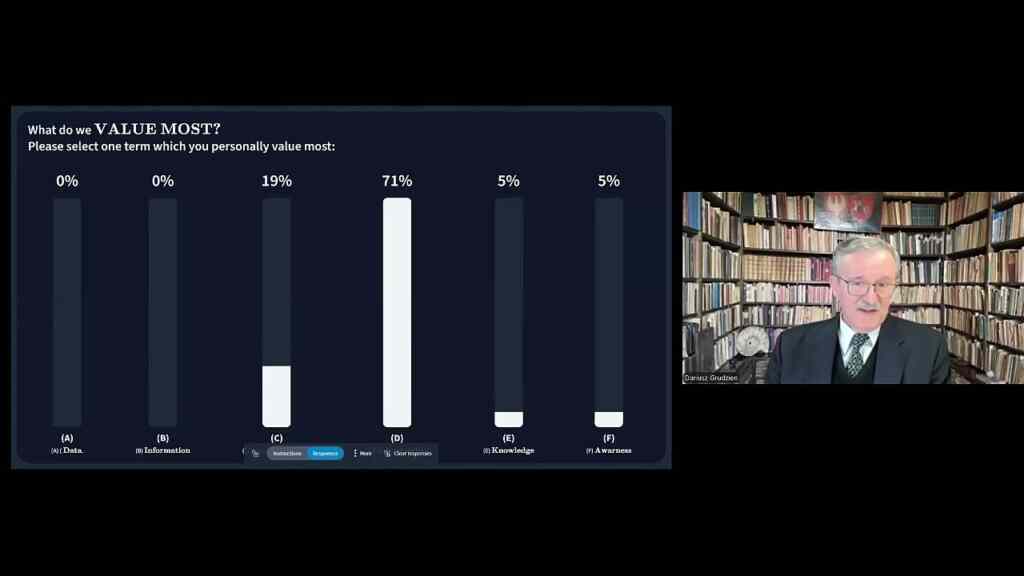
So today I would like to continue what we started yesterday to kind of connect. Let me review briefly what we said yesterday, because I think it’s important you helped me to answer a certain question. When I asked you what you value the most, you said wisdom, and I was not surprised by this. But there was also a fair amount of you who said understanding.
When I ask, what is wisdom? That was very interesting. There’s no wrong answer here. But my favorite, which I will reveal to you right now, relates to soundness of action. Option B, in which our master said, the one who listens and understands, builds properly, does properly, brings fruitage.
When I ask about understanding, we are almost anonymous, unanimous. Excuse me, and you said, ability to change. There is no fruitage. There is no understanding.
It’s an outward sign of deep understanding of certain truths and principles. When I asked, can we have wisdom without knowledge? It was almost unanimously no, and I’m very glad to see that when I asked for the definition of knowledge, your answers were pretty good. My favorite here is option C, understanding of universal principles of reality.
And I went through the question, what is knowledge? That it used to be. The knowledge is what we can see with greater magnifying lens and observe, and then I try to convince you that there are certain things which are invisible, like principles, and after we cherished what Newton taught us for good practical reasons, we learn that what came to Einstein’s mind was never observed, but was according to the principles of the universe.
And what was constructed after that in the form of both atomic bomb and those wonderful gadgets which we have, semiconductors, is of great importance to us. That was the beginning of a new look at the universe and reality which really relates to what I want to dwell upon.
There are things which are possible and things which are forbidden. If things are not forbidden, you just need enough knowledge to create those to make them happen, and this is really what I would like to talk about, about knowledge. Now, to be truthful and open, yesterday when I was showing you this picture, my family members told me, this is great, but it was hard to read. I had hard time.
So I want to restate something in here which is important.
When we look at knowledge, when we look at the data, data is simply something which we measure. But if we have many data points, we can see some interesting patterns, just like doctors see patterns in the change of temperature of a sick child. But it isn’t until we put this in context and explanation in relationship to the family or the child which is sick, to have a creative insight what the sickness may Be how the doctor diagnoses a patient, and then what doctor knows has to be in harmony to his own beliefs. You cannot have a doctor who just was told something and does not assimilate that deep internally.
And then we talk about artificial intelligence, which really plays only in the space of those data patterns and measurements, etc. It would never come to propose to us explanations, whichever never existed. I want you to remember this, that those explanations come from the Lord and from his servants.
Then this is really something important. What I’m going to say now. A creative insight. This is what Einstein had when he understood something. But this is going to remain out of reach for me until I fully understand this and it comes to a head of a child or someone who is learning.
What brother Asil said would remain on the shelf until I understand this deeply. The words of our Master would not transform us until we make them our own. We can personally with heart and conviction relate to them, and I will give you just one story to illustrate this very important fact. My grandfather, when he first learned about the Bible, it was shortly after the First World War in 1917.
He said it was too bloody for me to continue reading. He rejected it when he learned the permission of evil and restoration of all things, which brother Russell explained. For him it made a difference in his life. It made a difference in my life too. I made it my own.
I say this because I think that in the world we live we have shortage of deep understanding and ability to make this understanding really accessible to all. Especially for those who are young, who are children. Instead, we are exposed to certain captive frames of mind, principles of the world which can make our life more difficult. Apostle Paul warned us about this. This I say, therefore walk not as Gentiles walk in the vanity of your mind.
And finally, this quote which you saw yesterday. The tendency to substitute form for spirit rules for principles. Extremely dangerous tendency. Principles, once understood, will inform our whole lives, will allow us to choose the right course, right method and the right tool. Our Savior inculcated in us through his words.
Principles which are the principles of the Father. I left you yesterday with this question. So what are these? God’s principles, often neglected. So today in part two, I would like to elaborate on this a little bit more.
The definition of what true knowledge is remains the same. For me it’s the deep understanding of universal principles, and I want to start to emphasize universal. The speed of light or the principle of conservation of energy, which I mentioned yesterday, are true in California, in Oregon, in Africa and everywhere they are universal principle. They will remain no matter where you are.
Now, when we talk about principles, the scientists are mostly interested in the materialistic approach to what we observe or what we can create it, and the problem with this approach is fundamental because we tend to neglect the moral principles which are part of this universe, which are fundamental for this universe. I would like to convince you about this and briefly review three shining stars which exist in this space of global principles, universal principles which form our reality and impact our lives. So let’s talk about God’s often neglected principles. I would like to start with the principle which is he cannot sin.
You’re going to notice that often those principles are express what cannot happen.
Your eyes are too pure to look upon evil and you cannot tolerate wrongdoing. This is quote from the prophet Habakkuk which expresses this very idea that in our Heavenly Father there is not even a small tiny shadow of sin, of wrongdoing. In him there is no sin. Apostle John wrote in his whosoever is born of God does not commit sin, for his seed remaineth in him and he cannot sin because he’s born of God.
I don’t have to convince you about the truthfulness of this statement. What is often neglected, or maybe not discussed too often is that for us who are begotten of the Spirit, we cannot sin. We either die or live cannot sin. The new creature is just like the Father who created the new creature, and this is the message we have heard from him and announced to God is light, and in him there is no darkness at all.
And this statement that he cannot sin is fundamental. We don’t talk about this often, but maybe we should ask a different question. What is sin? Well, it was answered by Apostle James. For us, therefore, to the one knowing to do good and not doing it is sin.
So whatever our Heavenly Father does, it is always to promote, multiply, create good as he created the earth, different days of creation, and it was good. Everything he does is good, was good and will be good. That’s the meaning. He would never deviate from this. This is a principle which cannot be neglected.
This principle has serious implications in our lives because for us it’s an obligation to create, to multiply the good.
We live in the world under the permission of sin. We have learned about multiple shape years of sin, of evil. But we have a desperate need to learn more what good is.
So that’s the first principle. Second, he cannot be unrighteous. Again, it may seem like a trivial statement, but it is not. It is the principle which explains a lot for God. Is not unrighteous to forget your work and labor of love.
The Lord is righteous in all his ways and holy in all his works. Therefore, let no one say when he is tempted, I am tempted by God. For God cannot be tempted by evil. He does not himself tempt anyone.
It would be a separate topic to ask the question, how is righteousness different from good? Maybe they’re the same, and maybe we can explain it this way. But I think that those statements which I quoted to you are important, and later on I will stress it even more that as humans we have to meditate and think what is good and what is righteous. I will just give you one example.
Abraham did not have to go and help Lot. He did it because he was a righteous man and it was counted for him towards the righteousness.
There is a difference between good and righteous thing. We don’t have time to elaborate that. But let me add to those two shinings. Start the third one cannot lie.
God is not a man that he should lie, or a son of man that he should change his mind. Does he speak and not act? Does he promise and not fulfill?
Brethren, this is a simple truth. But when you look what’s happening in this world around us, not only little white lies, but people lying left and right, considering no second thought. When they issue a lying improper judgment, this becomes the norm.
God desiring to show more abundantly the unchangeableness of his purpose to the heirs of promise granted it by an oath. So by two unchangeable things in which it is impossible for God to lie. It is impossible for God to lie. We may have strong encouragement.
Sometimes people ask inappropriate question is God omnipotent so he should be able to do certain things like lying? Or the silly question, can God create a stone so heavy so he cannot lift it? These are improper questions. It is impossible for God to lie, and Apostle Paul stated this in this if we are faithless, he remains faithful, for he cannot deny himself.
These are the principles I just showed you. Three shining stars which are the limits. The things the Lord God would never do. Cannot sin, cannot be unrighteous, cannot lie.
Now the impact of principles is as we said yesterday. It explains informs, helps us with many things. Just think about these three. How our life would look like if only man honored those three universal principles.
They are not different than the principle of conservation of energy. You can never deny will not happen.
Now, I don’t know how many more of those principles we should list here. I only limited myself to three. But I would like to invite you maybe there is something we should add to this set of principles. I don’t know. Just keep in mind the difference between principle and rule.
Rules are for children. They will tell you what to do, but they are limiting in many aspects. Principles explain a lot of things and form the ability to live and function forever. In a moment I’m going to stress it even more. Those principles have to be deeply understood to give us a passage to eternity.
Yesterday, when we talked during the fellowship time, Brother Harry mentioned morals and ethics. How difficult it is to sometimes even function. Today the confusion is great. I agree. People think that morals are the principles or habits relating to the right of wrong conduct.
But based on individual’s own compass of right and wrong, that is deeply problematic. Ethics, rules of conduct in a particular culture or group recognized by an external source, and as Brother Harry said, for example, medical or engineering code of ethics that medical and engineering professionals must follow.
Morals, those three principles which I described briefly for you are with us almost from birth. I don’t know if you heard, but today the scientists who are studying morals, they do experimentations with children, very little children, almost babies. Babies who cannot talk, who cannot understand speech, barely walking, and the experiment of the experiments which caught my attention is the experiment in which children are shown a puppet show, and in this puppet show there is one puppet which is misbehaving by beating other puppets, really misbehaving.
After the show is over, children, each one receives the lollipop and they are asked to go and give the lollipop to their favorite puppet. Well, you probably guessed it already. The bad behaving puppet receives no lollipops, and what puzzles scientists is how do they know they cannot relate to any type of reasoning. They don’t barely speak and certainly they cannot be taught such a conscious concepts like you know what the morals are in the normal understanding.
So the prevailing theory in the scientific community is it’s in our DNA, it’s in our code. So what’s true knowledge? The deep understanding of those universal principles of which I gave you a sample of three, and I invite you to help me to maybe investigate and find out more if this is appropriate. I would love to hear from you.
I would like now to help you to understand what I understood. When I focused my attention on those principles. I started looking at the scriptures and seeing them all over the place. I will just give you today two examples. One of those examples is Psalm 15.
Psalm 15 is asking a question. Who shall abide in thy tabernacle? Who shall dwell in thy holy hill? It’s the question of who is going to be allowed in the kingdom. He that walketh uprightly and worketh righteousness, and speaketh the truth in his heart.
He that backbiteth not with his tongue, nor does evil to his neighbour, nor taketh up a reproach against his neighbour, in whose eyes a vile person is condemned. But he honoureth them that fear the Lord. He that sweareth to his own hurt and changeth not. He that pulleth not out his money to usury, nor taketh reward against the innocent. He that doeth these things shall never be moved, and, we may add, will abide in the Lord’s presence forever.
But did you notice walking uprightly, not speaking evil, doing the right thing, and properly judging those who are a vile person in this psalm, condemning them to tell the truth. When I look sometimes at the behavior of people, it’s very challenging in our days and sometimes even misleading because I heard judgments like, well, we shouldn’t be speaking anything not in favor of those who are in power. I have to tell you that I disagree, and this Scripture, in whose eyes a vile person is condemned, but he honored them that fear the Lord should be our daily activity. We will not get.
And I am not ever getting involved in any political activities. But I think that observing history, what took place, what was described in movies, the banality of evil, and the sentiments of this principle should make us pause and find effective way to tell people this is a vile behavior. I do not agree with it, and we should do differently.
Now, before we continue and move on, I have a special puzzle for you. I’m going to propose to you a special rendition of the story of Creation and what took place in Adam in Paradise. But I want to warn you, it is the special edition, and your job is to listen carefully and notice what is different in this rendition. Okay? So you.
You have to pay attention to tell me what is different.
Then the Lord God took the man and placed him in the Garden of Eden to cultivate and keep it.
And the Lord God commanded him, adam, you may eat freely from every tree of the garden.
And when the woman saw the tree was good for food and pleasing to the eyes and it was desirable for obtaining wisdom, she took the fruit and ate it. She also gave some to her husband who was with her, and he ate it.
Therefore, the Lord God banished him from the Garden of Eden to work the ground from which he had been taken. So he drove out the men and stationed cherubim on the east side of the Garden of Eden, along with the Whirling sword of flame to guard the way to the tree of life.
What’s wrong with this rendition?
I think you have found what is wrong. There was a serious omission.
I told you and I read that woman saw that the tree was good and the Lord told him the trees are good, so she ate from it, and if the story was presented to us like this, there would be no reason to expel Adam and Eve from paradise. What I did not tell you is what the Lord God said. But of the fruit of the tree in the middle of the garden. God said, you must not eat of it or touch it or if you will die.
Think about this, these two versions of the stories, one in which the Lord everything is good, go and eat and then he throws them out of paradise. That would be violation of justice. But what I wanted to stress by stating this story or rendering it this way is something which is really deeply related to those principles.
We cannot have knowledge without limits.
Just think for a moment about this. You cannot have knowledge without limits. I just told you about the limits of our Heavenly Father. Self imposed limits.
I think some of you may recognize the man and the famous book he wrote. This is Viktor Frankl who survived holocaust, spent a lot of time in three different concentration camps and came with the conclusion that man is a unique creature, always seeking meaning.
Limits make meaning possible, and I can explain this to you very quickly. Regardless if you are going shopping or baking bread or whatever we do, we always know that there are certain limits. When you bake bread, you probably don’t worry how far are you above the sea level if the pressure in the house requires to change the temperature, etc etc. We all put certain limits on what we do, how we understand things.
Without that we wouldn’t be able to function. Everyone would have to worry about everything. You would have to worry about the cars on the road and all over you. Trust you know that there are certain limits. The cars on the road would not cross and you would be safe.
This is really the meaning of limits which come often from those principles.
We cannot have knowledge without those limits. God cannot sin. Men shouldn’t either. They should do goodness, righteousness and truth never lie.
Then the Lord God said, behold, a man has become like one of us, knowing good and evil, and now brethren, after 6,000 years of permission of evil to live forever, we need to acquire the knowledge of God, the knowledge of good.
This is our visa. This is our passport. This is our entrance, our certificate, generally speaking to eternity. The Father has set eternity in the hearts of men. This is the quote from the book of Ecclesiastes.
Just like we were created with those norms of moral behavior, we have been created with the longing and desire for eternity, and all human creation groans and awaits eternity. Today we are being prepared to live in a new world, the world in which time does not even exist as we know it today.
Ages to come will be infinite. This is the essence of eternal life.
To enjoy eternity, we need to know God’s principles of can and cannot.
This is the most important motivating factor for humans. This is the purpose for the permission of evil. Neglecting those principles has the consequences which we are observing today around us.
God cannot sin. He can only promote goodness, righteousness and truth. As his children, we have to do the same thing. Now, I don’t want you to take me wrong, that I am limiting our Heavenly Father. I am not.
I am just starting a conversation and asking you, maybe there will be other things which we have to add to this, and the inspiration for me to do this comes from the book of Ezekiel, where the prophet said, when I look at the living creatures, I saw a wheel on the ground beside each creature with its four faces. You know this vision well, and the workmanship of the wheels looked like the gleam of beryl, and all four had the same likeness.
Their workmanship looked like a wheel within a wheel. As they moved, they went in any of the four directions without pivoting as they moved. Translators have the hard time to render the original Hebrew text in a way which would be readable to us. But I want you to notice that those living creatures with those four characteristics, besides each of them, there were those wheels, wheel within a wheel. I was thinking, how would I even imagine this wheel within a wheel?
This is an imperfect rendition of what may be there, and I am certainly not dogmatic about this wheel would be a sphere which is turning around and sitting there, and you know how we like to interpret this. These are the attributes of our Heavenly Father, his power, wisdom, justice. Today I elaborated a little bit more on his goodness, righteousness, truthfulness.
And you wouldn’t be wrong when you say all of this is all incorporated in the concept of love. God is love, he is light, but he is also love. So I don’t want to limit the discussion what are those those principles. But I want to stress it and encourage you to look at those principles and maybe add to the list. In conclusion, the knowledge of God is fundamental to life and immortality.
Our Lord prayed and he prayed nine times. The knowledge of God, all the principles of can and cannot must be discussed, comprehended and understood to bring footage.
The Word of God is the source of the true knowledge. When the Lord prayed, He stated multiple times, thy word is truth, the truth. The words of our Heavenly Father convey the message which is so critical for all of us. By studying it, meditating upon it, understand and receive the wonderful blessing of eternity. For us, for those who follow us, it’s not only eternity, it’s immortality.
The truth transforms and sanctifies us, and we know that well, and finally, wisdom is knowledge in action. Do not give in to the notion that knowledge is not important. This is the thing of the head. No, this is a false presumption.
True wisdom is based on true knowledge of God’s principle, and only when you understand them, you will bring fruitage by putting them into action. Wisdom is knowledge in action.
Once I considered this topic, I have to tell you that I started seeing this all over. We were studying the book of Ephesians, and there, in chapter five, verse nine and ten, the fruit of the Light. Walk as children of light, for the fruit of the light consists in all good, goodness, righteousness and truth.
Now I see this everywhere, the fruit of the Light. Some translations render this the fruit of the Spirit, and it would be a separate, interesting discussion, how we connect the fruits of the Spirit. But in here we clearly have the message. The Fruit of the Light consists in all goodness, righteousness and truth.
How to differentiate between them? How to put them in usage, how to deeply understand them? It’s a separate topic. But I would suggest to you that as you witness, as you hear your neighbors and friends worrying about the artificial intelligence, this and that cost of living and all these negative messages which are flooding humans, that you take some time and you tell them the fruit of light is goodness, righteousness and truth. I believe that this would equip you to test and prove what pleases the Lord.
Tell your neighbors they should benefit from this test and proof as well.
His divine power has given us everything we need for life and godliness through the knowledge of him who called us by his own glory and excellence, everything which is necessary for us. Everything the Lord was praying for in the garden of Gethsemane was given to us through the knowledge of him who called us by his own glory and excellence, and it is my prayer that we together will understand deeply his glory, his excellence exhibited in his principles. This is the knowledge of God and of Jesus our Lord, the everlasting principles of can and cannot.
Click Here for the PDF transcript.