This transcript was generated automatically. Its accuracy may vary
Short Summary
The discourse explores the prophetic vision of Zion and Jerusalem as central to the millennial kingdom of Christ, emphasizing a future time when mankind will willingly seek righteous governance and spiritual restoration under Christ and the ancient worthies. It contrasts the troubling transitional period of judgment and confl...
This transcript was generated automatically. Its accuracy may vary
Short Summary
The discourse explores the prophetic vision of Zion and Jerusalem as central to the millennial kingdom of Christ, emphasizing a future time when mankind will willingly seek righteous governance and spiritual restoration under Christ and the ancient worthies. It contrasts the troubling transitional period of judgment and conflict with the ensuing glorious reign marked by justice, peace, and the eradication of sin, highlighting the roles of Christ, the church, and the ancient worthies in guiding humanity toward a restored earth filled with knowledge of the Lord and everlasting joy.
Long Summary
Detailed Summary of the Discourse on Zion in Jerusalem and the Millennial Kingdom
Theme and Key Scriptures:
– The discourse centers on the biblical theme of Zion in Jerusalem, representing God’s millennial kingdom on earth.
– Main theme texts include Micah 4:1, Isaiah 2:2, which are nearly identical and describe a future time when all peoples will seek the kingdom of Christ for righteous government.
– Psalm 110:3 is cited: “Thy people shall be willing in the day of thy power,” indicating mankind’s willing submission after the time of trouble.
– Zephaniah 3:8-9 illustrates God’s zeal (“fire of jealousy”) to restore mankind, culminating in a pure language uniting all peoples to serve the Lord with one consent.
Millennial Kingdom Context:
– The kingdom is described as a golden age where people come to “the mountain of the Lord” to learn His ways (Micah 4:2-3).
– Two key aspects of the kingdom government are highlighted:
– The Spiritual Phase (Zion class) — representing Christ and the church, the new Jerusalem coming down from heaven (Colossians 3:4).
– The Earthly Representatives (Jerusalem class) — the ancient worthies who have received a “better resurrection” and will assist mankind in the kingdom.
Role of the Ancient Worthies:
– Galatians 3:26, 29 confirms that all baptized into Christ become Abraham’s seed and heirs, thus part of the kingdom blessings.
– Jesus’s references to seeing Abraham, Isaac, and Jacob in the kingdom (Luke 13:24-30; Matthew 8:10-12) show that the kingdom includes faithful followers from Israel and Gentiles alike.
– Isaiah 1:26 prophesies the restoration of judges and counselors (ancient worthies), transforming Jerusalem into the “city of righteousness.”
– The ancient worthies serve as intermediaries between heaven and earth, delivering God’s law and messages (Jacob’s ladder in Genesis 28:10-15 symbolizes this communication).
Illustration of Relationship Between Zion and Jerusalem Classes:
– The friendship of Jonathan and David (1 Samuel 18:1-3; 23:16-18) is used as a picture of the cooperation and mutual love between the ancient worthies and Christ’s followers.
– Psalm 45:14-16 portrays the ancient worthies as “princes” who serve under the King and Bride (Christ and the Church) in the kingdom government.
– Isaiah 24:23 speaks of the Lord reigning on Mount Zion “before his ancients gloriously,” emphasizing the dual leadership of Jehovah and his representatives.
Jehovah’s Reign and the Kingdom’s Structure:
– Jehovah is described as the ultimate emperor over all earth during the 7,000-year day, with Christ as king and the ancient worthies as princes (4th volume, pp. 615-646).
– The reign includes a *troublous reign* (Kingdom taking authority and purging evil) and a *glorious reign* (millennial blessing and government fully established).
– Revelation 11:15-18 is cited illustrating the seventh trumpet marking the kingdom’s takeover and the judgment of nations, with the rewards given to prophets, saints, and those fearing God.
Judgment and Restoration:
– The kingdom will judge not only individuals but also nations (Isaiah 2:4; Malachi 4:3).
– Isaiah 11 describes Christ as a righteous judge who judges with fairness, striking down the wicked with the “rod of his mouth.”
– Isaiah 11:6-9 presents a peaceful kingdom where natural enemies live in harmony, symbolizing universal peace and knowledge of God.
– Isaiah 33:24 and Isaiah 60:18 promise forgiveness of iniquity and an end to violence in the kingdom.
Humanity’s Transformation and Blessing:
– Micah 4:4 describes people sitting under their own vine and fig tree without fear—symbolizing security and prosperity.
– Isaiah 35:8, 10 speaks of the “Holy Way,” a consecrated path free from wickedness, where the redeemed will walk with joy.
– Physical and spiritual healing will be evident: the lame will leap, the blind will see, representing both literal and figurative restoration.
Contrast with Present and Past Systems:
– Isaiah 24 and Joel 3 contrast the removal of false religious and civil powers (host of the high ones and kings of earth) with the establishment of the kingdom.
– Present false systems, including Catholicism and Islam, will be removed as hindrances to God’s kingdom.
– The “moon” and “sun” in Isaiah 24 symbolize false Jewish and Christian teachings respectively.
Symbolism of Mount Sinai and the Covenant:
– Exodus 19 and 34 describe the giving of the law at Mount Sinai, foreshadowing the new covenant mediated by Christ and the ancient worthies.
– Hebrews 12:18-29 portrays the awe-inspiring scene of Sinai, symbolizing the seriousness and glory of receiving God’s kingdom.
– Moses’ radiant face (Exodus 34:29-35) illustrates the glory and transformation brought by the new covenant.
Future Gentile Inclusion and Universal Blessing:
– Isaiah 60:1-5 prophesies Gentiles coming to Israel’s light, reversing historical antisemitism and uniting all nations in blessing.
– The kingdom will be a feast of rich spiritual nourishment (Isaiah 25:6-9), where death and sorrow are removed, and God’s salvation is celebrated.
Summary of Kingdom Periods:
– The millennium spans roughly 1874 to 2874, encompassing the troublous reign (kingdom takeover and judgment) and glorious reign (restoration and blessing).
– The transition occurs with the binding of Satan and the completion of the church (Micah 5:5; Zechariah 14).
– The kingdom government consists of Jehovah as ultimate ruler, Christ as King, the church (Zion class), and the ancient worthies (Jerusalem class) as princes and counselors.
Encouragement and Final Blessing:
– The discourse encourages the study and storing of kingdom promises for faith and hope.
– The closing prayer references Isaiah 25:9: “Lo, this is our God; we have waited for him… let us be glad and rejoice in his salvation.”
—
Selected Bible Verses Mentioned:
– Micah 4:1-3
– Isaiah 2:2-4
– Psalm 110:3
– Zephaniah 3:8-9
– Colossians 3:4
– Galatians 3:26, 29
– Luke 13:24-30
– Matthew 8:10-12
– Isaiah 1:26
– Genesis 28:10-15
– 1 Samuel 18:1-3; 23:16-18
– Psalm 45:14-16
– Isaiah 24:23
– Revelation 11:15-18
– Isaiah 11:1-9
– Isaiah 33:24
– Isaiah 60:1-5, 18
– Micah 4:4
– Isaiah 65:21-25
– Isaiah 25:6-9
– Deuteronomy 18:15-19
– Acts 3:19-23
– Exodus 19; 34:29-35
– Hebrews 12:18-29
– Zechariah 14:3-5
– Joel 3:9-10
—
This comprehensive summary captures the discourse’s exploration of biblical prophecies about Zion and Jerusalem, the millennial kingdom’s spiritual and earthly governance, the roles of Christ, the church, and ancient worthies, the contrast with present evil systems, and the ultimate restoration and blessing of all mankind under God’s righteous government.
Transcript
Well, friends, our subject is Zion in Jerusalem, and this has been such a blessed study for us. We’re going to start with looking at the theme text, the context of it, verse 1 and Micah 4 and Isaiah 2, verse 2. These texts, by the way, the passages are almost identical. There are some differences, but this passage points to the time when mankind’s attention will be turned to the millennial government, the kingdom of Christ, and how all people will be brought forward to.
They will come to that kingdom for the righteousness government that will then be in place at that time. It’s rather Beautiful, friends. Psalm 110:3 says, Thy people shall be willing in the day of thy power. This is just after the time of trouble has ended, and they’ll be willing in that day of power.
They’ll be looking for answers to what happened. They’ll be trying to understand human history, the experience of evil that they have just gone through. They will be looking for. They have been looking for the golden age pretty frustratingly through the current governments of the Earth. Zephaniah 3, 8, 9 expresses it well that the Lord rises up to the prey.
The nations are gathered, his anger against sin is poured out against them, and the earth would be devoured with the fire of his jealousy. Really, it’s a fire of zeal to bring mankind back to his fellowship, to communion with Him, and so to that end, in verse nine, he turns the people to a pure language that they all call upon the name of the Lord to serve him with one consent and brethren. This gathering is quite interesting because it’s a gathering to trouble. It’s rather fascinating that today men look to Israel.
There’s more news out of Israel than just about any other country across the world. It’s like mankind’s attention is being predisposed to look toward the blessings that are going to come from the hand of the Christ and from his earthly representatives.
Our theme text in verses 2 and 3 confirms this. Again, many people will come and say, come, let us go up to the mountain of the Lord, to the house of the God of Jacob, that he may teach us concerning his ways and, and that we may walk in his paths, and here’s where that scripture about the people being willing in the day of his power. They will be desiring lessons necessary to live in that golden age promised to them, and here we find in the last portion the law going forth from Zion and word of the Lord from Jerusalem.
We find two aspects to that government that will be in the glorious reign of the kingdom Zion, which will represent the Spiritual phase of the kingdom, which really this is the Christ, the new Jerusalem coming down from out of heaven, and the word of the Lord from Jerusalem would be represented in those faithful men of old, those ancient worthies who receive a better resurrection, and they will come so well prepared that to help mankind in that glorious aspect of the kingdom.
Now, this first portion of the Zion class, the spiritual phase of the kingdom, Colossians 3, 4, tells us, when Christ, who is our life, is revealed, or King James says, shall appear, then shall you also be revealed, or appear with him in glory. Now, this isn’t a literal seeing of glory, brethren, but mankind’s eyes will grasp that there has been a change in earth’s affairs and that an unseen power is taking control of the earth, and the ancient worthies will be the ones able to explain this class. Galatians 3:26, 29 confirms to us that the church are sons of God through faith in Christ. All who are baptized into Christ’s death have fully put him on, have been conformed to his character.
And brethren, isn’t this a wonderful phrase? If you belong to Christ, if you are Christ, then you Abraham’s seed, her offspring and heirs, according to the promise. That means being part of the great blesser and restorer for mankind.
Now, Jesus told us, it’s pretty amazing. He told us that in the kingdom, not that he would be seen, but he refers to seeing Abraham, Isaac and Jacob, and we find this brethren, the two accounts, one is in Luke 13, verses 24 to 30. The other is in Matthew 8, verses 10 to 12, and Jesus actually talks to two different classes in these two passages, but he says pretty much the same thing.
You’ll see Abraham, Isaac, Jacob and all the prophets in the kingdom of God, and then he says they will come from east and west, from north and south, and will recline the table in the kingdom of God. Now that’s fascinating, brethren. Here, all these people coming and looking to Jerusalem, this is a confirmation from east and west, from north and south, they will come. Now, Luke 13, Jesus is speaking to the Pharisees.
And he tells them they will be cast out. They will not be the leaders in the kingdom, it will be Abraham, Isaac and Jacob. The Matthew account is pretty fascinating because Jesus is speaking to the centurion, a centurion who has shown great faith that Jesus can heal his servant, and Jesus says, I have not found such great faith with anyone in Israel. So here he tells a Gentile about the kingdom, that he will see Abraham, Isaac and Jacob in the kingdom, that their ministry of the ancient worthies won’t be just for the nation of Israel, but it will be for all mankind.
Brethren, there’s a wonderful scripture in the Hebrew text. It’s Isaiah 1:26. It says, I will restore thy judges as at the first, and thy counselors as at the beginning. Afterward, thou shalt be called the city of righteousness, the faithful city. Now, brethren, we believe that is a reference to Jerusalem.
When the ancient worthies appear, it will become the city of righteousness, this faithful city. Now, brethren, there are some in Israel, some trusting in the promises, who believe this, that their judges and their counselors, those we would call the ancient worthies, there are some looking for them to be restored to the nation. We wanted to mention. We meant to say this earlier, the fourth volume, pages 615 to 646. It’s a chapter on the establishment of the kingdom, how it will manifest itself.
Our pastor writes a tour de force there, brethren, just laying out the Scriptures on this subject so beautifully. I’m indebted to him for my understanding of these things. So if you want to look into this more, it’s quite a beautiful study. 615 to 646 in the fourth volume. Now, brethren, there are various pictures in the Scriptures of the Zion and Jerusalem class.
And one of the most beautiful of these is from Jacob’s dream of Jacob’s ladder in Genesis 28:10, 15. At a key moment in his life, Jacob has this dream that he sees messengers ascending up and down this ladder into heaven. He sees the Lord at the one end, and brethren, this dream is really about the intimate communication that will take place between man and heaven with the ancient worthies as the go betweens. They will receive the message from heaven, the law from heaven, and they will share that word of the Lord to mankind.
It’s really beautiful to think about how coordinated. I don’t know, brethren, if you’ve ever seen two people work together who could practically read their minds, and sister Karen, Su and I have had help from brethren occasionally. On one occasion, a father and his two sons helped us to move, and it was remarkable.
It was like they knew exactly what to do without even saying words to each other. It just makes me think about how well coordinated the kingdom will be for the benefit of mankind, how close the communication will be between Zion and Jerusalem classes. Brethren, another picture that shows really the beauty of the relationship between David and the great company and our Lord Jesus is a picture of Jonathan and David. In this picture, Jonathan is older. He’s about 15 years older than David.
Who is fairly young, and if you ever read the accounts of David and Jonathan, their friendship is just about the most beautiful you can find in the Scriptures. In 1st Samuel 18, we find Jonathan meeting David after David has defeated Saul and Jonathan. It says that his soul was knit to the soul of David, and Jonathan loved him as his own Soul. That’s verse 1 of 1st Samuel 18:3.
Jonathan and David make a covenant because Jonathan loved David as his own soul, and Jonathan takes off his robe and gives it to David, his garments, even his sword, his bow and his girdle. You know, brethren, Jonathan recognizes the worthiness of David, and as the story continues of their friendship, he protects David from Saul’s anger. Saul, who would kill him because he sees David as a threat, and Jonathan is even willing to let David take his place.
Indeed, he really favors him. In 1st Samuel 23, verses 16 to 18, Jonathan meets David during one of the days of his flight from Saul, and Jonathan says, fear not for the hand of Saul. My father shall not find thee. Thou shalt be king over Israel, and I shall be next to thee.
And this also Saul my father knows, and the two made a covenant before the Lord, and brethren, this is so beautiful because it shows the attitude of the ancient worthies that Jonathan loved David as his own soul, and he wanted to see him succeed. He recognized him as the one that God would work through to bless Israel. Similarly, brethren, the ancient worthies, knowing the promises, knew that Christ would come later, and they had hints that there would be followers of Christ who would also work with him.
Brethren, if you’re ever discouraged a bit by Hebrews 11:38, 40, where it speaks about the ancient worthies receiving a good witness, but they didn’t receive the promise that they without us should not be made perfect. Keep this picture in mind of how much Jonathan wanted to see David succeed, and that that represents the attitude of the ancient worthies desiring for the Christ to succeed.
Another aspect of this beautiful relationship between the Zion and Jerusalem class is found in Psalm 45:14 16. Here is a picture of the church being led to the king, really being led to the marriage the virgins. That represents the great company who are companions with her. They follow, and they go forth with gladness and rejoicing, entering the king’s palace, and the next verse is quite fascinating.
The peace of your fathers will be your sons. You shall make them princes in all the earth. Well, brethren, here is a key. The fathers of Israel were Abraham, Isaac and Jacob, and others who went before faithfully before the nation. Here the Bride is told that her fathers, those that we look to, the ancient worthy, will become our children in that kingdom, but they will also have a role in that government.
They will be princes in all the earth, while Christ and his bride are representatively the king or the king and queen. In this picture here, the ancient worthies become the princes. Now, friend, there’s quite a beautiful prophecy in Isaiah 24:23 that speaks of when the Lord of hosts will reign in Mount Zion and, and in Jerusalem and before his ancients gloriously. Now brethren, we call this the glorious reign for reasons you’ll see here in a moment, and the Lord here is Jehovah.
This is talking about the restoration of his reign over the earth, and it is through these two parts of the government, the Zion class and the Jerusalem class, and I think you recognize the phrase here, ancients is a reference to the ancient worthies, and what we’re trying to get at here, brethren, is that the aspect of Christ’s reign that is glorious, that is the future aspect of his reign, that is connected with the appearing of the ancient worthies, that both the Zion and the Jerusalem class will be in place to undertake the work of restoring mankind. I’d like to make a point here because in the kingdom there are kingdom royalty.
And you can find this on page 617 and 618. In the battle of Armageddon, we’ll stumble over the point that, well, this says Jehovah. This doesn’t say Jesus or Christ or Messiah. Well, in this arrangement Jehovah is the emperor over all the earth. We have to keep in mind that the rain to restore mankind is still during the 7,000 year day.
It is still during the period when Jehovah is resting. His work is being undertaken by his Son, the Christ which is representative of kings and priests in that kingdom, and then the princes, as we mentioned earlier, that’s the ancient worthies. So you have Jehovah resting but enjoying joyously watching this work that will unfold by the Christ taking care of the spiritual aspects of the kingdom, giving the messages to the ancient worthies who will then give those messages to mankind.
Now the Context in Isaiah 24 appreciated Brother Jerry’s he did a very blessed thing for me, Brother Jerry, in your comments. But the preceding context says it shall come to pass in that day, and this is talking about the last days that the Lord shall punish the host of the high ones that are on high, and the kings of the earth upon the earth. It’s quite interesting. This is a reference to the religious and Civil powers that have to be removed before the kingdom lessons can go forward.
The host of the high ones, we believe that’s a reference to the heavenly representatives. You know, brethren, we have all kinds of religiously oppressive systems in place still today. Catholicism, you take a look at Islam, brethren, what Islam teaches. These are things that would be hindrances in the kingdom and have to be removed, and it’s a host that is removed.
They lose their hopes in any of those systems as bringing about a golden order or heavenly blessings. Kings of the earth. It’s rather interesting. It’s the kings of the earth upon the earth seems to really emphasize these are, you know, these earthly ones with earthly ambitions, and they’ll be gathered together as prisoners and the pit shall be shut in the prison.
After many days they shall be visited. That may be a reference to all of human history, of all the ones who’ve been high throughout history, who have to wait for the blessings of the kingdom. But in that last day, the moon being confounded and the sun ashamed. This would be the false moon and the false sun. The teachings of false systems that can’t explain the permission of evil, that can’t explain mankind’s destiny and that offer Hus in return.
I think it’s interesting the moon and the sun are mentioned because, you know, even among the Orthodox Jews today, there are wrong teachings. There are modern Pharisees, you know, brethren, the nation of Israel, all are being tested as to whether they’ll trust the Lord or whether they’ll trust in the nations. The nations are like idols to them. So the moon, we believe, is a reference to Jewish theology and the sun to false Christian theology.
Now, in our context, again returning to our theme text, in verse 4 of Isaiah 2 and Malachi 4:3, there’s a mention of they were hammered, their swords into plowshares and their spears into pruning hooks. Now, brethren, this is rather amazing to think about that. Why with Zion and Jerusalem being mentioned, why this issue comes up so early? And friends, we believe because it is an aspect of what Satan said in Isaiah 14, 13 and 14. I will ascend to heaven.
I will raise my throne above the stars of God. I will make myself like the Most High. He had ambition for his own dominion, to dominate others, and what are weapons of war except a means to dominate others, for one side to dominate another? And it’s already been mentioned the Gog and Magog us that comes in the little season that you know, that is really another aspect that those that have learned the kingdom lessons will have Completely gotten rid from their hearts any idea of dominating or being master over others.
Those who haven’t done that will be represented in Gog and Magog, and quite amazing that where Satan fell seems to be exactly where Gog and Magog in the end fall, and brethren, this can be a subtle test even to us, because the disciples, before they had the Spirit, the apostles, I should seven times it’s recorded that they asked who would be greatest in the kingdom. You know, we have to have the spirit of an honor, preferring one another, of seeking the blessing of all and not seeking the blessing for ourselves. One last point, brethren.
Joel 9 and 10 is quite a contrast to our theme text here. This context, I should say, because it mentions prepare for war, beat the plowshares into swords and the pruning hooks into spears. It is exactly the opposite, and it also mentions, let the weak say I am strong, and brethren, we’ve seen a fulfillment of that.
Not the overall fulfillment, but a fulfillment that the nation of Ukraine, in its battle against Russia, they’ve been taking farm equipment and turning it into military weapons. They have quite a house industry, you might say, of creating drones and other weapons, and in order to defeat their far more powerful enemy, the weak indeed have said that they are strong in that one instance at least. Well, friends, we mention the glorious reign because something that is often an issue amongst the brethren at large is the point of whether there is only the glorious reign or if there are two aspects of Christ’s reign, and brethren, we believe there are these two aspects which we refer to as the troublous reign, the first part of it.
And then the glorious reign, as we noted, would begin with the ancient worthies up here, and we believe the millennium, the thousand years, covers this whole period from 1874 to 2874, and in proof of that, we find in Revelation 11:15 that. That it’s the seventh angel sounding or the seventh trumpet, that the kingdom of this world has become the kingdom of our Lord and of his Christ, and he will reign forever and ever. That period of the kingdom becoming the kingdom of our Lord Satan’s kingdom, the kingdom of this world is what we would describe as that troublous reign.
Now, as we go forward, brethren, and we look at this, Revelation 11:18, we believe, gives us both portions of the rain, because it mentions, the nations were enraged. This is as a result of the Christ taking power and reigning. The nations are enraged, the wrath against sin has come, and then in regard to the systems of earth, it’s time to destroy those who destroy the earth. All of that that is in yellow, brethren, we can attribute to the troublous rain.
But the portion that’s in white, the time for the dead to be judged, the time to give the reward to your bondservants, the prophets. There’s a reference to the ancient worthies and to the saints. Here is to the church, and then to those who fear thy name, small and great, that would be the world of mankind, as they come to fear him, as they come through the kingdom. Lessons to learn about Christ.
So we believe that just in this one text, we can separate these two aspects that are both a part of Christ’s reign. Now, in the fourth final page, 622, it’s pretty remarkable. The Scriptures are very clear to give us an order because it’s under the seventh trumpet, power is taken by the Lord as king of earth, and the rain begun, and then you have the time of trouble. The rain begins before the time of trouble.
It also begins before the resurrection of the saints and its prophets. But that rain will continue after these for a thousand years, and, brethren, it’s interesting. Brother Jerry mentioned Ezekiel 20, 33, 34. In that passage, the Lord God declares, with a mighty hand, with an outstretched arm, and with wrath poured out, I shall rule over you.
That word rule is the same as it’s used for all the kings of Israel and Judah, when they ruled or when they reigned, and then it says, I will bring you out from the people, gather you from the lands where you are scattered with a mighty hand and an outstretched arm. So the reign also begins before the regathering of the nation of Israel. We find that again in Ezekiel 20, verse 33 and 34. Well, brethren, we believe there’s a transition period here between the Gospel age and the millennial age.
And that overlap is what we have as the troublous reign, and it’s a very confusing time, brethren, whenever you have two ages overlapping, and that’s why it is a troublous period, because Satan is losing his kingdom, Christ is taking it away for him from him, and, brethren, sometimes this aspect is confusing because Jesus has all power in heaven and earth. He is so far above the adversary.
Couldn’t the kingdom just come instantly? Well, brethren, using that line of reasoning, you could say, yes, it could come like that. But really, brethren, human history is about mankind learning the lesson of the permission of evil and then being ready for the contrasting lesson of the matchless brilliancy of righteousness. So that troublous reign, that slow taking away of the adversary’s kingdom lets mankind examine all the systems of the earth, all the good and bad that they have done, and in the end render a verdict that none of these are worthy of continuance, and so we find here it is a judgment of systems of the earth, the nations, the governments, the religious element, the social element, financial element.
Brethren, this is also a period because when Christ returns, he returns as a restorer. There’s a general lifting up of mankind. Isaiah 43 speaks of it very beautifully. That the mountains and hills are made low. That’s the judgment of the systems.
But the valley is lifted up and the crooked places are made plain. We think this is about general restitution, that mankind are investigating their rights. What should their place be in society? What kind of life should they have? Should there be rich and poor?
Should things be shared equally? All of those things are questions that belong to this time period. Now, that line between troublous reign and glorious reign. We would like to speak a bit more to. Because that’s the turning point when Satan is bound.
We’d say the church is completed, and in our context of Zion and Jerusalem, Micah 5:5, which was also previously referenced, it fixes this turning point to be when the Assyrian invades our land. This is Israel. Here is a reference to Jacob’s trouble, that climax of the trouble when the forces of Gog come down against the land, and when he tramples on Israel, what the citadels here as that’s referred to, then we will raise against him seven shepherds.
This is a reference to the Christ, and particularly the church. The seven phases of the church, but also eight leaders of men. Some translations also make this eight princes of men. Remember, Psalm 45 mentions that the Christ will make their fathers their children, and they’ll make them princes in all the earth. It’s rather amazing how some of these themes will carry through the Scriptures.
So it’ll be at that time, brethren, that the trouble has ended. We find in Zechariah 14 this description of all nations going against Jerusalem. Brother Jerry mentioned this as well, and the Lord would go forth and fight against those nations, as when he fought in the day of battle. That’s Zechariah 14.
3. The portion that follows, though his feet will stand on the Mount of Olives, and the Mount of Olives will be split in the middle from east to west by a very large valley. That’s what this picture is meant to depict. The northern side would represent the Christ, and the southern side would represent the ancient worthies. These two aspects of the government of the kingdom, the valley in between, we can think of as a valley of blessing to which mankind will flee.
And that’s what Zechariah 14, verse 5 says. You will flee by the valley of my mountains, and they do that for safety and protection, overshadowed by those two aspects of the government of that kingdom. Friend, there are many, many pictures here. We can’t go into detail.
And I’ll probably miss some of your favorite kingdom scriptures. There are so many that we could go through today. But looking again at some of these pictures now, brethren, Moses, mediator prophesied. This is in Deuteronomy 18, verses 15 to 19. He prophesied that God would raise up a prophet that they would hear, and that if they didn’t hear the prophet, then they would die.
That’s again Deuteronomy 18, 15, 19, and brethren, you recognize this prophecy being quoted in Acts 3, 1921, that Christ would be raised up and that he would speak the words of truth, and those that would not hear, this is verse 23 in Acts 3, would be destroyed from amongst the people. So Moses prophesied there would be a mediator like him to teach mankind about his father and the truth in that kingdom. Now, brethren, the picture in Exodus 19 of Mount Sinai and the making of the covenant.
Really pictures later the making of the new covenant for mankind, and Moses again here pictures the mediator, and it was quite a scene. I’ll read a little here from Exodus 19. It came about on the third day when it was morning that there thunder and lightning flashes and.
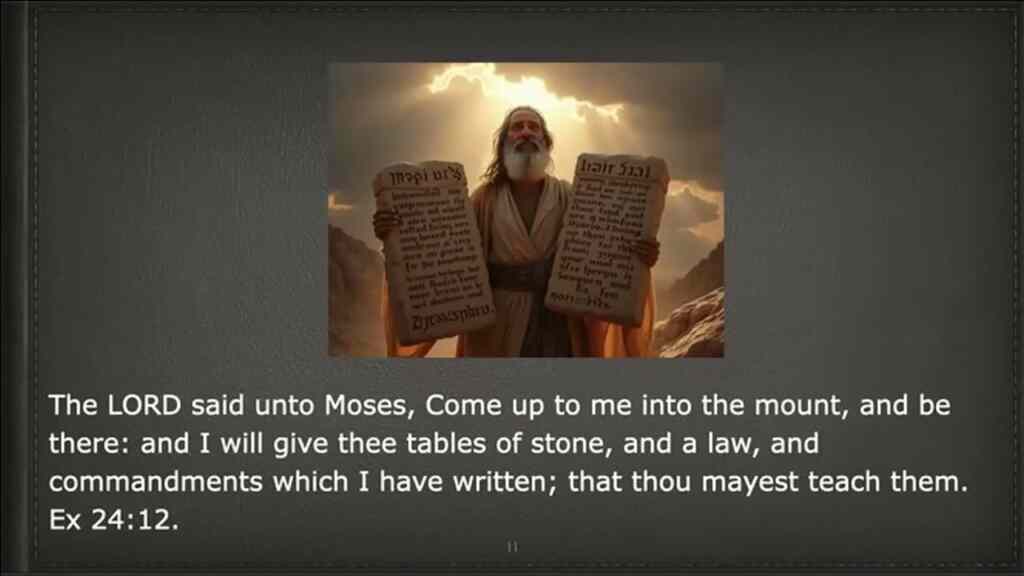
And a thick cloud upon the mountain and a very loud trumpet sound, so that all the people who were in the camp trembled, and Moses brought the people out of the camp to meet God, and they stood at the foot of the mountain. Now, Sinai was all in smoke because the Lord descended upon it in fire, with its smoke ascended like the smoke of a furnace, and the whole mountain quaked violently, and brethren, you’ll remember that God’s voice boomed down from the mount the Ten Commandments.
And you’ll also recall that Moses went up to receive the tablets that contained the Ten Commandments and came down later and broke the tablets because of the people’s unfaithfulness and turning to idol worship during that time when he was up in the mount. Well, Hebrews 12 picks up this picture. The whole account is Hebrews 12, 18, 29, and it says there that Moses was so full of fear and trembling because the sight what he saw was so terrible, and brethren, the context speaks of receiving a Kingdom.
And again, this would be the glorious aspect of the kingdom. When the new covenant becomes operational. There’s a lot more we could say here, brethren, because the sequence of they come to Mount Sinai three days before this scene is really important. Those days of waiting really represent the Gospel age. So it’s important to note that the new covenant making is tied in with the trouble that follows the Gospel age.
Well, the reason we raised this, brethren, is the Zion and Jerusalem class are shown in the picture of Moses coming down from the mount the second time, this time with the second tablets of the law, and this would represent the new covenant. Again, Moses did not know it. You can read this in Exodus 34, verses 29 through 35. Moses didn’t know it, but his face shone when he came down.
And the people must have given him quite startled glances because of that, and they asked him to veil his face because it was so radiant to look upon, and you know, brethren, they had asked earlier when Moses, they had them come before the mount and you saw the scene of the trouble and everything. They asked Moses to go talk to God. It was too much for them.
And it was a good thing because it pictures again that mediator role, how the ancient worthies like that Jacob’s ladder picture, they will be the intermediaries between the spiritual phase of the kingdom and mankind.
Now, dear friends, in Isaiah 60, turning to a little different item, here we find a prophecy of the light coming to mankind. Arise, shine, for thy light has come. The glory of the Lord is risen upon thee. For, behold, the darkness shall cover the earth, and gross darkness the people. But the Lord shall arise upon thee.
And I believe this upon thee is first upon the nation of Israel, and again, this comes through the Zion and Jerusalem classes, and it is such a beautiful prophecy because it goes on to say, the Gentiles shall come to thy light. You think of how antisemitism just about pervades the world today and how it pervades human history, and you would see the Gentiles come and how they will come.
The prophecies tell us they will come to help Israel in the future, and as Israel was a curse among the nations, so Israel will be a blessing. Oh, how different the kingdom will be. Verse 4 says, Lift up thine eyes round about and see all they. This is the Gentiles gather themselves together.
They come to thee, and then thy son shall come from far those rebels that were purged out that brother Jerry mentioned, and thy daughter shall be nursed at thy side. Then thou shalt see and flow Together and thine heart shall fear and be enlarged. Because the abundance of the sea shall be converted to thee. This is interesting.
The abundance of mankind. They will become Israelitish brethren. They will become a part of that seed of Abraham, and the forces of the Gentiles shall come to thee. Now another prophecy which mentions the kings and princess.
So again here we find Jerusalem Zion classes is in Isaiah 32 and this says a king will reign in righteousness. Now brethren, if you ever read in brother Russell’s writings about glorious reign, you’ll know he is speaking of that time future when the ancient worthies are on the scene blessing mankind. Or anytime he writes about the reign of righteousness again it is talking about that future time. Because here we find not only does the king reign in righteousness, but the princes will rule with justice, and now we get into some of the beautiful description of what that kingdom will be like.
And because you have an unseen spiritual phase, brethren, this next portion we believe is particularly referencing these princes. That they will be like a hiding place from the wind, a covert from the tempest. You know brethren, you think about that, that mankind coming out of the time of trouble and realizing their need of a righteous rule. The ancient worthies will be like this, a hiding place, a place of protection from the storms that just prevailed in the ending of the human experience with evil, and they’ll be like streams of water in a dry place.
Think brethren, of the thirst that mankind has had for truth. Think about all the lies that you hear today and that prevail across the earth, and then think of it would be like a dying man dying of thirst, being given life giving waters that will be a privilege of those ancient worthies, and like the shade of a great rock in a weary land. You know brethren, a shade that protects, a shade that is not like the shade of sin and evil and death that prevailed from before, but a place of rest and of restoration.
And here we find in the prophecy, the eyes of those who don’t have sight will not be closed, and the ears of those who have hearing will listen. I’m sure that sounds familiar to you and it’s a beautiful second witness, brethren. I’d like to read verse four and five here too because it adds some things we don’t find in Isaiah 30:5.
Isaiah 32:4 says, the mind of the hasty will discern the truth, and the tongue of the stammerers will hasten to speak clearly. No longer will the fool be called noble, or the rogue be spoken of as generous. There will be clear distinctions made between right and wrong, between those who are cooperating with the rule of the kingdom and, and between those who. Who are not doing so now whoops the wrong way.
Okay, so in our context again, and that Isaiah 2, 4 and Malachi 4, 3, the character of the judge is also described that the Christ will judge between many peoples and rent decisions for mighty distant nations. Now this is amazing, brethren, because it’s not only individual that mankind will stand before that great white throne, but there also be decisions upon the nations. Now, most of that belongs to the troublous reign. But you’ll recall the scripture that speaks about Egypt, that if it does not go up to Jerusalem, if for some reason a group of people is recalcitrant and won’t come under kingdom rule, upon them, as the prophecy says, upon Egypt there will be no rain. It’s quite an interesting aspect of the kingdom.
Now Isaiah 11 gives us the most beautiful description of this great Judge. That he will delight in the reverence of the Lord. He will not judge by what his eyes see, nor make a decision by what his ears hear. You know, brethren, it doesn’t matter how beautiful you are, doesn’t matter how eloquent you are. This judge will judge with righteousness the poor and decide with fairness for the afflicted of the earth, there will be no favoritism in judgment.
He will strike the earth with the rod of his mouth, and with the breath of his lips he shall slay the wicked. There will be the power of the truth, brethren, those that cooperate versus those who do not cooperate. That the truth will be the slayer of any who persist in wickedness.
Now going to Isaiah 11, the last few verses 6 through 9, that was verses 1 through 5 I just, or 2 through 5 I just went through. But Isaiah 11, 6, 9 says, the wolf will draw the lamb, the leopard will lie down with the kid. The calf and the young lion and the fatling together, and a little boy will lead them. The cow and the bear will graze, the young will lie down together, and the lion will eat straw like the ox. The nursing child will play by the hole of the cobra, and the weaned child will put his hand in the viper’s den.
They will not hurt nor destroy an all my holy mountain. For the earth will be full of the knowledge of the Lord as the waters cover the sea. Now that is about as great a contrast, brethren, today as you can, and brethren, we would encourage you in your storehouse of truth to put all these kingdom promises in there. Another one, Isaiah 33:24 in that kingdom the inhabitants shall not say, I am sick.
The people that dwell therein will be forgiven their iniquity, and Isaiah 60, verse 18 Violence shall no more be heard in the land. Now brethren, I think about that after the October 7, 2023 attacks in Israel, to think of that promise violence will be no more hurt in her and the other prophecy in Micah 4:4 that none shall make them afraid, and in Deuteronomy 23:2 Israel is admonished not to go with a mob to do evil, and how everyone will be individually held to account in that day, so there will be no violence, no mob violence, no fear from crowds, and so forth, and among our favorite promises, brethren, is Isaiah 35:8, 10 about the highway called the Holy way, that the unclean will not travel on it.
They will have to consecrate to enter in upon that way. But it shall be for God’s people, those who’ve made a commitment to him, and no one, not even fools, would be able to go astray on that highway. There would be nothing to hinder them, no lion and no stumbling stones. The deemed will walk there.
It will be a way of redemption, dear brethren, and here is where the ransomed of the Lord, when they return, will have the opportunity to come to Zion with singing everlasting joy, and they will obtain their own joy and gladness and sorrow and sighing will flee away in the earlier part, brethren, the lame will leap. The blind shall see in that kingdom. You know, brethren, we had a study recently about how the lives of people in the kingdom will learn to forgive, or how they’ll overcome their past when they see practical demonstrations of the Lord’s kindness, like the lame being given the ability to walk and the blind eyes being open.
And they realize that those are only portents of being able to walk correctly before the Lord, being able to see the truth, to see the king in his beauty, to see the Creator in all his awesomeness with that, you know, vision of the Spirit, not that they would literally see them, brethren. It is such a beautiful, beautiful picture and of the earth’s restoration.
We mentioned Micah 4:4 earlier. Each would sit under their own vine and fig tree and no fear, brethren, Think about what a great motivator fear is for so many people. Today I worked with a man who told me, I asked him what his secret was of all his good work. He was a very hard worker, and it was fear. He was afraid of losing his job.
Think of a world with no fear, brethren. It’s amazing. Isaiah 65:21 25 expands on Micah 4:4 we’ll just leave that as a reference. They won’t build houses for others to inhabit. Will be quite a different picture.
We like to close with the feast of fat things in Isaiah 25 on this mountain, this kingdom the Lord of hosts will make for all people a feast of rich food, a feast of well aged wines, of rich food filled with marrow, of well aged wines strained clear and brethren, these are really pictures. Don’t take this literally, but you think of pure doctrine, refreshing, enjoyable doctrine. You think the nourishment from truth that will come, and the satisfaction that will come from such rich, beautiful truth, and verse 7 in Isaiah 25 says, he will destroy on this mountain the shroud that is cast over all peoples, the sheet that is spread over all nations. All the falsities, all the untruths, all the darkness of error and sin will be removed.
And verse 8 he will swallow up death forever. Then the Lord God will wipe away the tears from all faces, and the disgrace of his people he will take away from all the earth. The King James renders that that he will remove the rebuke for his people. You think about that, brethren. All of the disgrace that sin has brought, all the mistakes that men have made, for all the willing they will be able to have that rebuke removed.
And then their last comment it will be said on that day, lo, this is the God we have waited for him so that he might save us. This is the Lord for whom we have waited. Let us be glad and rejoice in his salvation. May the Lord bless your considerations of these things, dear brethren.
Click Here for the PDF transcript.