This transcript was generated automatically. Its accuracy may vary
Short Summary
The discourse emphasizes the foundational importance of Genesis to the Christian faith, highlighting its detailed accounts of creation, early human history, and God’s covenant with Abraham as essential to understanding the gospel. It contrasts the straightforward, monotheistic biblical creation narrative with the pagan,...
This transcript was generated automatically. Its accuracy may vary
Short Summary
The discourse emphasizes the foundational importance of Genesis to the Christian faith, highlighting its detailed accounts of creation, early human history, and God’s covenant with Abraham as essential to understanding the gospel. It contrasts the straightforward, monotheistic biblical creation narrative with the pagan, mythological Babylonian accounts, asserting that archaeological discoveries support the historicity and reliability of Genesis despite modern scholarly skepticism and theories like the documentary hypothesis. The speaker also explains literary features of Genesis, such as the phrase “these are the generations of,” as concluding statements rather than titles, and clarifies the use of different names for God as purposeful distinctions rather than evidence of multiple authors.
Long Summary
Importance of Genesis to Christian Faith:
– Genesis is foundational to the entire Bible and Christian faith, despite some churches claiming to be “New Testament churches.”
– The New Testament and all of God’s Word are based on the truths and events recorded in Genesis.
– Genesis 1:1 describes the creation of the heavens and earth, and Genesis 1:2–31 details the six creative days culminating in the creation of Adam and Eve.
– God gave the first law to Adam and Eve in Genesis 2:17: “Of the tree of knowledge of good and evil, thou shalt not eat of it: for in the day that thou eatest thereof, thou shalt surely die.”
– Satan’s lie through the serpent: “Ye shall not surely die” contradicts God’s warning.
– The fall of man, death sentence, expulsion from the Garden, toil, and return to dust (Genesis 3:19) are all recorded here.
– Early genealogies from Adam through Methuselah, Shem, and Abraham establish a continuous historical line.
– Skilled civilization existed before the flood, e.g., Tubal Cain as an artificer of copper and iron.
– The Nephilim and fallen angels are introduced as part of mankind’s increasing wickedness.
– The flood narrative, Noah’s ark, and repopulation of the earth form key historical events.
– Abrahamic covenant promises in Genesis 12:2-3 (“In thee shall all the nations be blessed”) and the sacrifice of Isaac (Genesis 22:8) foreshadow the gospel.
– Genesis 3:15 contains the first promise of redemption through the seed of the woman.
– Hebrews 11:19 references Abraham’s faith in God’s power to raise Isaac from the dead, implying resurrection.
– Without Genesis, Christian faith is “vain” and the gospel loses its foundation.
Skepticism and Criticism of Genesis by Scholars and Theologians:
– Herman Schultz (1893) argued the pre-Mosaic narratives were legends passed orally and adopted from other cultures, thus Genesis is mythical.
– The New Oxford Annotated Bible (2018) states Genesis was written over centuries from oral and written traditions, mostly after the monarchy of Israel, with parts written during Babylonian exile (post-586 BCE).
– The Mosaic authorship hypothesis has been largely rejected since the 17th century.
– John Astruc (1766) proposed the documentary hypothesis, suggesting Genesis is a patchwork by multiple authors, based on different divine names used.
Archaeological Discoveries Supporting Biblical History:
– Ruins of ancient Mesopotamian cities like Babylon, Ur, Nineveh, and others remained buried and unnoticed until 19th-century excavations.
– Discovery of cuneiform tablets from Mesopotamia dating before Abraham shows existence of writing and record-keeping.
– Tablets include personal letters, contracts, religious and historical documents.
– King Ashurbanipal’s library contained copies of ancient flood and creation tablets.
– These tablets reveal the existence of ancient cultures with advanced writing and record-keeping long before Moses or Abraham.
Comparison of Biblical and Babylonian Creation and Flood Accounts:
– Babylonian accounts are polytheistic, involving vengeful gods battling and creating the earth from a slain god’s body.
– The biblical creation account is monotheistic, orderly, and reasonable, portraying God as benevolent and non-threatening.
– Babylonian myths emphasize fear and placation of gods by priests and kings for control.
– Biblical patriarchs offered sacrifices in reverence, not fear.
– The Epic of Gilgamesh contains a flood story with similarities but is a corrupted, embellished version of the true biblical flood narrative.
– Scholars debate whether Babylonian accounts corrupted the Bible story or vice versa; historic believers affirm the Bible as original.
Literary Structure and Language of Genesis:
– The phrase “These are the generations of…” (Hebrew: toledath) appears 11 times in Genesis, marking the *end* of sections, not the beginning.
– This phrase means “history” or “origin” and serves as a concluding signature or seal confirming the preceding narrative.
– Examples:
– Genesis 2:4 ends the creation account: “These are the generations of the heavens and the earth when they were created.”
– Genesis 5:1 ends Adam’s history.
– Genesis 6:9 ends Noah’s history.
– Genesis 37:2 ends Jacob’s history, which actually began much earlier.
– This usage parallels cuneiform tablets where colophons (signatures/seals) appear at the end, authenticating the text.
Explaining Different Divine Names in Genesis:
– Different names for God are used: Elohim (God), Jehovah (Lord God), El Shaddai, El Olam, etc.
– Critics claim this proves multiple authorship (documentary hypothesis).
– The text uses “Elohim” primarily from Genesis 1:1 to 2:4, then “Jehovah Elohim” from Genesis 2:4 onward.
– Exodus 6:3 states God appeared to Abraham, Isaac, and Jacob as “El Shaddai,” but not by the name Jehovah.
– Moses used the name Jehovah to clarify which “Elohim” (god) is being referenced, since many false gods (plural Elohim) existed.
– 1 Corinthians 8:5 acknowledges many so-called gods and lords exist.
– The combined use “Jehovah Elohim” in Genesis is a deliberate clarification by Moses to distinguish the true God from false gods.
– The original creation account was given before other gods were known; later usage reflects cultural realities.
Early Writing and Authorship of Genesis:
– Writing existed long before Moses, Abraham, and even Noah.
– Antediluvian (pre-flood) pictographs and writing have been reported.
– The creation account (Genesis 1:1 to 2:4) is likely compiled from early written records.
– Adam, endowed with language and intelligence, likely recorded early events as instructed by God.
– Genesis 1 describes God’s spoken communication and creation process in a straightforward, reasonable manner.
– The account predates the naming of the sun and moon (Genesis 1:14), highlighting its antiquity and purity from mythological embellishments.
– The biblical account is scientifically reasonable, unlike Babylonian myths.
Other Supporting Biblical References:
– Job 26:7 describes the earth suspended “upon nothing,” indicating early divine revelation of cosmology.
– Genesis 1:27 emphasizes man created in God’s image.
– God’s communication (“And God said…”) three times in Genesis 1 shows Adam’s capacity for understanding and recording.
– Genesis 1:31 concludes creation as “very good,” meaning perfect.
Summary and Conclusion:
– Genesis is the original foundation of biblical faith and the gospel.
– It is historically reliable, supported by archaeology and linguistic analysis.
– Alleged contradictions and criticisms stem from misunderstanding literary style, historical context, and ancient writing practices.
– Biblical creation and flood accounts are distinct from pagan myths in their monotheism, reasonableness, and purpose.
– The phrase “These are the generations of…” functions as a concluding signature, not a title.
– Use of different divine names reflects cultural realities and clarifies the identity of God.
– Early writing and records validate the authenticity of Genesis.
– Without Genesis, Christian faith and the gospel lose their foundation and meaning.
Key Bible Verses Cited:
– Genesis 1:1 — “In the beginning God created the heavens and the earth.”
– Genesis 2:17 — “Of the tree of knowledge of good and evil, thou shalt not eat of it: for in the day that thou eatest thereof, thou shalt surely die.”
– Genesis 3:15 — First promise of redemption through the seed of the woman.
– Genesis 3:19 — “In the sweat of thy face shalt thou eat bread, till thou return unto the ground; for out of it wast thou taken: for dust thou art, and unto dust shalt thou return.”
– Genesis 12:2-3 — Abrahamic promise: “In thee shall all the nations be blessed.”
– Genesis 17 and 22:8 — Birth and near sacrifice of Isaac; God’s provision of a lamb.
– Genesis 1:27 — “So God created man in his own image, in the image of God created he him; male and female created he them.”
– Genesis 2:4 — “These are the generations of the heavens and of the earth when they were created.”
– Hebrews 11:19 — Abraham’s faith in God’s power to raise Isaac from the dead.
– Exodus 6:3 — God’s statement about His name to Moses.
– Isaiah 42:8 — “I am the Lord: that is my name: and my glory will I not give to another.”
– 1 Corinthians 8:5 — Recognition of many so-called gods and lords.
– Job 26:7 — “He stretcheth out the north over the empty place, and hangeth the earth upon nothing.”
This detailed summary covers the discourse’s key points regarding the validity, foundation, literary structure, historical criticism, archaeological evidence, and theological implications of the book of Genesis.
Transcript
So, all right, the validity of Genesis, why this talk? Well, it is the first talk which I found out last night. The first talk. But Genesis, how important is Genesis to our faith? The reason I ask that is I know there are a lot of churches out there who say, well, we’re a New Testament church.
Oh, well that’s great. A New Testament church. Well, what is the New Testament and all of God’s word really based on and how is important to our faith? Well, let’s take a look. Well, in Genesis, if you go to Genesis 1:1, you have the creation of the heavens and the earth, we have the creative days.
In Genesis 1:2:31, you have the creation of Adam and Eve in in perfection, along with their dominion. We have God’s first law given to them in Genesis 2:17. But of the tree of knowledge of good and evil, thou shalt not eat of it. For in the day that thou eaters thereof, thou shalt surely die. So God’s condition for life is given Satan’s great lie.
The serpent said to the woman, ye shall not surely die. I mean, here’s the Harrison. What, what virtually every other religion on earth believes, believes that lie, and a lot of nominal Christians seem to believe that as well. We have the fall, the death sentence, the eviction from the garden, the sweat of faith, the permission of evil, and return to dust.
Genesis 3:19. In the sweat of thy face shalt thou eat. Shalt thou eat bread till thou return to the ground. For out of it out was thou taken, for dust thou art, and unto dust thou shalt return. We have the story of Cain and Abel, we have Noah and his lineage.
Then I’m going to make this a little bigger. The knowledge of God, from Adam to Methuselah, to Shem to Abraham, this continuous line of information. Adam would have known Malthusla, Methuselah would have known Shem. Shem, Shem would have known Abraham. We know that.
So we have Tubal Cain, the artifact artificer of copper and iron, showing us that mankind, they weren’t just scratching in the dirt before the flood. They were skilled, they were intelligent, they had wonderful capabilities. We were told about the angels who fell, created the Nephilim, who were also destroyed in the flood. We have the, the story of the wickedness of man increased. Why?
Well, because God really had had a hands off attitude toward man during that time. We have the stories of Noah, Shem, Ham, Japheth, his sons. We have the ark, the great flood, mankind being destroyed, the repopulation of the earth, then the 427 years to the covenant with Abraham. We have the Abrahamic promise in 12 Genesis 12 verses 2 and 3. The the birth of Isaac in Genesis 17, the sacrifice of Isaac in Genesis 22 8.
The the statement that God would provide himself a lamb. Abraham’s seed, the blessing of all mankind. In Genesis 22:17 and 18, we have the story of Isaac and Rebecca, Esau And Jacob, Jacob’s 12 sons, Joseph going to Egypt. The interpretation of Pharaoh’s dream, Israel being saved through Joseph, Jacob’s blessing to his 12 sons and his death and burial in Canaan. Then we have the death of Joseph and the desire that his bones would be taken to his own land.
We also have a precise chronology in Genesis to trace the chronological outworkings of God’s plan. It’s all there. The brethren, do we believe these things? Is this the basis of your faith? Do you believe in the gospel?
Well, Paul did. Galatians 3:8. In fact, I’ve shared that with some other folks outside of our fellowship. I said, do you know one, one scripture that tells you exactly what the gospel is? Well, here it is, Galatians 3:8.
And the Scripture foreseeing that God would justify the heathen through faith preached before the gospel unto Abraham, saying, in thee shall all the nations be blessed. Genesis is the basis of our Faith. In Genesis 3:15, we have the first hint of the promise of recovery through the seed of the woman, the promise to Abraham over 2,000 years after Adam’s fall, and this must, and the fact that this must mean a resurrection if there’s going to be a blessing of all the families of the earth, that implies there must be a resurrection.
Paul said about Abraham in 11, in Hebrews 11:19, accounting that God was able to raise him, that is, raise Isaac up even from the dead, from once also he received him in a figure, a figure, really a picture of the resurrection. But without Genesis, our faith is vain, creation is a fable and God’s promises are false. There’s no need for a ransom. You know everything about every. The basis of everything we believe begins in Genesis with God’s creation and dealings with mankind.
We have and must have a firm belief in the validity of Genesis and the logic of God’s plan as presented there. That’s the. That’s really the beginning. That’s the basis. That’s the original foundation of.
Of our belief.
So the second point we want to talk about. How do many seminaries, universities and theologians regard Genesis? Well, this is from Herman Schultz, the and brethren, the whole reason I’m giving this talk is when I became aware of these things. I was appalled. I might say appalled, disappointed, but so thankful that in the mediation when the kingdom is fully established, all these crazy ideas will be wiped away and supplanted by the truth.
But Herman Schultz in the Old Testament theology, he wrote this in 1893. That’s an important date because when you see other evidence was available to him long before he said this. The legendary character of the pre Mosaic narratives, the time of. The time of which they treat is a sufficient proof. It was a time prior to all knowledge of.
No, that should say writing whatever that was. Okay, I didn’t proofread this well enough. Prior to all knowledge of writing. In other words, there’s is everything was handed down through through word of mouth. It’s therefore impossible that such men could hand down their family histories in any other way than orally to met to wit in legend.
So in other words, he’s saying all of Genesis is just legendary. Myths were thus adopted really from other cultures. He sang they appropriated these myths, these crazy ideas from other cultures. Their original form remains and indicates their kinship with stories of a wider circle of nations. In other words, Genesis just is a bunch of fables adopted from all these other pagan cultures is what he’s saying.
And what that means is that all the stories in Genesis are myths. They’re false and they’re lies. That is what this man is saying now you might say, oh well that’s 1893. That’s a long time ago. Certainly they got that cleared up right.
Well, here’s the New Oxford annotated Bible, the fifth edition, page seven and eight, and this is. This was published in April of 2018.
And he says 250 years. 250 years of historic. This is right out of. Right out of their preface on Genesis. 250 years of historical scholarship on Genesis have established that Genesis was written over many centuries using oral and written traditions.
In the beginning, so to speak, were oral traditions. Since Genesis was composed in a largely oral oral culture, most go excuse me. Most scholars agree that the text now found in Genesis began to be written down sometime after the establishment of the monarchy in Israel. That means after the time of saul in the 10th century BCE or later. Many important parts of Genesis, however, were not written until after the monarchy had fallen in 586, which is their, their term, their date for that.
And Judean leaders were living in exile in Babylon. According to many scholars, this is the time when the Abraham narrative was written. Oh my word. The Hypoth. The hypothesis of Mosaic authorship has been questioned since the 11th century and rejected in scholarship since the 17th century.
That’s a quote from the 2018 version of that Bible. Well, John Astruc, a physician who died in 1766, note the date 1766, was one of the main proponents and initiators of these theories, which have expanded and proliferated into universities and seminaries all over the world.
There’s a picture of him. Nice fellow, nice looking guy. I’m sure he was well meaning, but very misled. These theories are based on assumptions and conjectures about ancient times, with no direct evidence of those times at all, or their cultures, or their abilities, or their communications, their literature, and these theories were developed in a relative vacuum.
They didn’t know what they were talking about. They were like Aristotle. Aristotle thought he was such a brilliant man and he reasoned on things and figured, oh, that must be how it is. Many, many of Aristotle’s thoughts, his what were considered as natural laws, have been completely blown away because other folks would say, well, let’s check it out, let’s experiment, let’s look at actual evidence. These fellas had no direct evidence to judge what they were saying.
Enter archaeological discovery. Well, for millennia, the pyramids were visible above the Egyptian sands. Here’s a picture of some nice folks visiting the pyramids. How’d you like to ride the camel dressed in all these things? Here’s the Great Pyramid in the background.
Notice the Sphinx. Here is. The head is outside, but most of it is still buried in the sand in 1880. But other prominent landmarks in Mesopotamia, the land of the early Genesis, these landmarks were hidden. The ruins of Babylon, Ur, Eric Calne, Nineveh, were covered so thoroughly that they went almost completely unnoticed for millennia.
And then speaking of Babylon, Jeremiah says her cities were a desolation, a dry land, a wilderness, a land wherein no man dwelleth, neither doth any son of man pass thereby. Well, this was true not only in Jeremiah’s time, but for millennia. I mean, they may pass by, but they had no idea what they were passing by. In fact, here’s a, here’s a picture of a mound of ancient Babylon. Here it is so completely covered.
It’s just a mound of soil, that’s all it is. I mean, why would you go there and look for anything or Eridu. The Eridu was very near to Ur, the Chaldees. Look at this. Here’s a mound of a ruin of a civilization that’s buried under this.
But the folks in that area, they just they grew their crops, they, they went by, they paid no attention until after rainstorms furrowed the sides, revealing broken pottery and clay tablets with intricate patterns. So excavations began about 1811. About 1811, and in 1824, clay tablets with cuneiform, or wedge writing is really what cuneiform means. These were, were located, they were sent to the British Museum.
Now a lot of, in the beginning they thought, well, this is a very interesting decorative pattern. You know, they, they put on these little tablets and pottery and things and that, oh, it’s just decoration, okay. But later they realized cuneiform is actually writing writing, this wedge writing on soft clay tablets which were then either sun dried or, or baked in an oven to make them hard and permanent. Here are some examples. In fact, in later years they were able to realize this is actually an Alphabet, and not an Alphabet like we have abcde, but this is more syllabic.
In other words, these different symbols stand for syllables. So it’s not as small as an Alphabet, but it’s not as huge as hieroglyphics where you’d have to have thousands and thousands of symbols. You have a reduced set of symbols for the different syllables in your language, and because it’s syllabic, that means cuneiform can be used for different, different, different languages as well. So here’s a picture of a cuneiform tablet.
In fact, cuneiform is so dynamic in this way. You can even have your own name written in cuneiform, and the Oriental Institute at the University of Chicago, on their website, they said, they said, you want to write, see your name in cuneiform? So I said, yes, and this is my name. This is wild blood in cuneiform.
So I probably won’t use that other than just for this talk. Well, hundreds of thousands of these tablets have been found recording every aspect of life in areas of Mesopotamia, and this goes before the time of Moses, before the time of Abraham. I mean, just for centuries and centuries before Abraham, and how widely this was used, they found hundreds of thousands of these things for personal family letters, you know, a wife talking to her husband, contracts, bills, invoices, receipts, tax forms, government documents, as well as religious records and historical documents.
Historical documents. Well, many of the earliest tablets were copied and preserved by scholars and kings for their extensive libraries. I mean, this was historical, this was history. This is very important. So there are many kings and scholarship said, we want copies of these earliest, earliest records.
Well, King Asher Banipal, he’s a descendant of Sennacherib, he had an extensive library with copies of ancient tablets including copies of ancient flood and creation tablets. Now these are mostly Babylonian stories, not really biblical stories per se, and Ashurbanipal, we can find him in the time of Ezra in the NIV Bible. They actually use his name, and other people whom the great and honorable Asher Banipal deported and settled in the city of Samaria and elsewhere in the in Trans Euphrates.
There are many, many other cities like Calne as has been found. That’s in Genesis chapter 10, and other things like this have been have been found showing this archaeology is actually verifying all the things that are being said in Genesis. Well, tens of thousands of these tablets have been found found that actually predate Abraham. The early cuneiform writing was pictographic along with wedge writing.
And here’s some of the earlier Sumerian the areas of Sumeria including Ur etc but you can see some of these, some of these things. There’s some wedge writing here, but it’s also pictographic. Here’s a. You know, it seems like the, the hind end of an animal. Some other things that you, you can find here.
But these were ways in which they were communicating communicating, and when you look at pictographic writing, well we use that in, in today. I mean you go to look at signs, signs for safety. You know, here’s the women’s room, men’s room, various signs. There are no words on there.
They’re just pictures to be communicate things. These are very intelligent way to communicate ideas to folks who may have different languages. So I really appre the wisdom, the knowledge and the intelligence of of these folks who lived millennia ago. But by the time of Abraham, cuneiform had become more of the wedge riding with fewer pictographs. Here are examples of cuneiform before and during the time of Abram in Ur of the Chaldees.
Okay, so here’s here are these things, this actual, actual writing going on? Well, the archaeological. Checking my time here. The archaeological discovery of Ur, the Chaldees created a sensation in London. A sensation.
In 1872 the Babylonian flood tablets were also discovered in the. They were discovered where? Well they were actually already in the British Museum because it took quite a while after they were taken there for the scholars to actually be able to read them, decipher them, see what they were really saying. But when we look at the Babylonian and Sumerian creation Flood tablets with the, the discovery of the creation and Flood tablets, these were. There were conjectures made about the sources of the Bible’s creation and flood stories going back to what These fellows, fellows were saying about that Genesis is invalid.
It’s just copies from other cultures. So there were two different ways you could look at. Are the Babylonian accounts corruptions of the Bible accounts? Or are the Bible accounts purified versions of the Babylonian account stripped of their corrupt polytheistic elements? Now notice if that, if number two were correct, that means the Bible account is just a copy of just a copy of the Babylonian accounts.
The Sumerian accounts and of course these accounts are, are all false almost of the liberal Bible scholars choose the second option. But those who hold to the those who hold to the historic account of Genesis would choose option one. Well, note that the Bible account is simple, it’s straightforward. The Bible account of creation speaks of God, speaks of the one God who created the heavens and the earth and then describes the creative days as an orderly sequence of events to prepare the earth for life that God would develop on earth according to his plans and his purposes. Now a reasonable series is followed by a reasonable series of six epochal days.
These are discussed culminating in the crowning achievement of the creation of man in Genesis 1:27. So God created man in his own image. In the image of God created He him. Male and female created he them. Genesis 1:31.
And God saw everything that he made and behold, it was very good, and of course we know very good means perfect, and the evening and the morning were the sixth day. So a reasonable account in this account God is a benevolent, non threatening, reasonable being. The Genesis account, notice it’s devoid of fables, it’s devoid of all this mystical embellishment it that.
Notice also that the names for the sun and the moon are absent. I mean they’re, they don’t even have names, and it’s a reasonable explanation, excuse me for the new newly created, intelligent, perfect man to comprehend. Even though Adam had no experience or and he did not witness the events before the end of the sixth day. This is very important, devoid of fables.
In other words, not enough time had, had had gone by in human history to even come up with myths, to come up with, with fables to come up with. Even for the names for the sun and the moon, These are just two great lights in Genesis 2:4. Genesis 2:4 states that the account from Genesis 1:1 to 2:3 is the history of Jehovah’s creation of the heavens and the earth. There is nothing to fear about Jehovah in this. The Creator.
The Jehovah. The Creator in this account, his awesome power, his creative acts, themselves, themselves in themselves should evoke reverence for the Creator, but not through fear, not through fear. It’s like, look at everything he has done. Look at the wonderful things he has provided to Adam, to Adam and Eve. On the other hand, the Babylonian creation account speaks of several vengeful and hateful gods fighting and killing each other.
Now just this is so that the Babylonian creation account is so incredibly ridiculous. We’re just going to mention a few, few things. Marduk is a, was a new powerful God amongst the hope host of other gods. Marduk kills an earlier God named Tiamat. Then he takes her body, splits it to form the earth and the sky.
And then I mean to form, he takes the, to form the earth and the sky, and then other features of the Babylonian creation myth are just too absurd and distracting to continue to share at this point, but they’re just totally devoid of reason. So the, the Babylonian creation story is so devoid of reason and any scientific support that it is immediately dismissed as a fanciful pagan myth. So why, why have it this way? Well, the Babylonian creation myth is intended to demonstrate that man is completely helpless in the hands of vengeful, selfish gods that control man’s destiny.
These gods must be placated with arbitrary sacrifices to be performed by priests who use these fearful stories to control the people for themselves and their, and their kings. Does this sound familiar? Can you think of another large religious organization who’s done the same thing? I can hold one second here. Okay, there we go.
Just have to get my, my clock ready here.
So all this creation myth is to create is to show these powerful gods who are, who has, with all these fallen human tendencies, and they have power of mankind. So you got to placate them with these sacrifices, and the only ones who can tell you what you should do are these priests and the kings who want to control the people. It makes more sense to realize that the original creation story brought over on the ark was later corrupted to serve the desires of selfish priests and kings to control their people through fear.
On the contrary, we know that the offerings in Genesis by Abel, Noah, Abraham and Jacob were done in reverence for God and not in fear of him. There was no fear. They reverenced, they loved God. Well, the Babylonian flood tablets. If we look at them, this is the Epic of Gilgamesh.
Gilgamesh was a king in an ancient, ancient Sumerian city of Uruk, which was very near to Ur of the Chaldees. It was apparently written about the 26th century BC. So this is several centuries before Abraham. Here’s a cuneiform tablet with The Epic of Gilgamesh is a very, very long story, much, much, much longer than what you find in Genesis, and these are similarly fanciful and fabulous stories of eventual gods who are going to cause a flood.
But you know, just looking at this story a little bit, one of the gods tells this fella, not Fistim, he’s the Noah like figure. He’s the one that they figure they put in to take the place of Noah as they were supplanting the true Bible story with this nonsense. But the gods tell him to demolish his house and build a boat. Build, build a boat. So the dimensions of the boat are given again, plagiarizing the, the actual Bible account, the Genesis account.
After the boats finished, some thunder God called Adad and other gods cause more storms. So apparently these are not Omtypican gods you have. They, they have a division of labor amongst all these crazy gods. The other gods were frightened by the flood. The God Enel wanted all the humans to die, apparently.
Eno, if he’s still around, you want to be afraid of him.
So Ut, this fella, this fella who’s, who’s really taking the Noah place in this fable, he sends out a dove, he comes back, he sends out a raven. Does that sound familiar? To the actual Bible account, another God grants. Grant, grants this figure immortality. Grants him immortality among gods who are apparently not immortal because one of them got killed in the creation of the earth.
You know, all of this stuff is so contradictory. Again, this story is of arbitrary, vengeful gods with fallen human tendencies. The epic is designed to be a fear, to be fearful, to allow the priest to manipulate the people.
There are many similarities between the Bible account and the Gilgamesh epic, which clearly shows the Gilgamesh account is a corrupted, embellished account plagiarized from the Genesis tablets. But unfortunately, many scholars think the Bible is a copy of the Gilgamesh epic rather than the reverse. So the summary, the similarities between the Babylonian Bible stories of creation and the flesh show that the Babylonian counts are corruptions of the original stories recorded on antediluvian tablets and brought over on the ark. These were then drastically changed for the reasons mentioned above. Okay, so when we look at, when we look at Genesis, there’s a key that’s really going to unlock the understanding of Genesis, how it was put together and the different portions of it.
In this key is the phrase, these are the generations of. You’re going to find this 11 times in Genesis, and this indicates the end of a major section rather than the beginning of a section. These are the generations of. Well, when we look at that, we’re going to see this several times here.
The creation of the heavens and the earth. If we. From Genesis 1:1 to 2:4. But it ends with, these are the generations of the heavens and the earth when they were created. If you look at Genesis 5:1, this is the book of the generations of Adam, 6, 9.
These are the generations of Noah. Well, scholars have stumbled over the use of this phrase. These are the generations of. For the past two and a half centuries and probably longer. Many think that this phrase is a title that should be followed by a genealogical listing, but it’s really the ending of the history of the person cited.
In other words, it’s the ending. It’s like the signature. The. The signature. It’s like the seal.
Here’s what you’ve just been reading. That’s what this, this word really means. As in Genesis 5:1, this is the book of the generations or the history of Adam. In the day that God created man in the likeness of God, made he him. But note the story of Adam really from Genesis, really the earlier story of.
Of Adam, his history comes before Genesis 5:1. But no more information about Adam follows, follows this, other than the length of his life as 930 years. So the things that he did, the things that he knew, etc. His children, that is all before. That is all comes before.
So what precedes Genesis 5:1 is actually Adam’s history, his history. The word translated generations is the Hebrew toledath, which means history, especially family history or origin. So Genesis 2. 4 tells us the story of the origins of the heavens and the earth. Genesis 2:4.
These are the generations of the heavens and of the earth when they were created on the day that the Lord God made the earth and the heavens. So the phrase these are the generations of points back to what has come before. In the narrative, this phrase is used as a concluding sentence, not as a title of the section of a book. Now, many can. Many commentators have concluded that this phrase must be a title and that the phrase is out of place in the narrative.
In fact, James Moffat and I have a copy of Moffat’s Bible back here on my bookshelf behind me. It’s interesting because he was so convinced that this should be a title that he inserted part of Genesis 2. Four, put it before Genesis 1:1 as follows, and in the Moffat translation, if you have it, it says, this is the story of how the universe was formed. He uses that as a title.
Then he goes on to Genesis 1:1. When God began to form the universe, the world was void and vacant. Darkness lay over the abyss. So, you know, unfortunately it is a fallacy for critics and commentators to assume that others must themselves in a. In an expected way.
Okay, here’s a sort of a semi silly way to, to demonstrate this.
There are some Amish that live not far from here, maybe about 30, 40 miles away, and if you look at a lot of Germanic or Amish sentence, constance construction, it’s a little, we would say it’s a little backwards. It’s not expected. For instance, here is a typical Amish expression, throw papa down the stairs, a hat. Now you may say, whoa, wait a second, that’s not what I expected.
Well, the Amish express themselves in a slightly different way. So maybe that’s a silly example. But when you’re expecting others to express themselves exactly the way you would, that’s often a fallacy. It can lead you in the wrong direction. Here’s an extreme example in Genesis, in Genesis 37:2, these are the generations of Jacob in 37.
2. So you might say, oh, let’s see. See about things of Jacob. I guess if that’s a title, that should all follow. But no, Jacob’s history begins in Genesis 25:26.
My word, that’s 12 chapters earlier. 12 or 11 chapters earlier in Genesis 25:26, and after that came out, his brother in his hand took hold of Esau’s heel, and his name was called Jacob or usurper. Usurper. So again, this, these are the generations of.
This phrase is really showing the history. What you’ve just read prior to that is the history of the individual. Okay, well, the Babylonian tablets were structured such that the final sentences of the tablet indicated the nature of the preceding information, and this was often signed with a custom seal of authenticity, and here are some of these seals.
These. I took these photos at the University of Chicago and the Institute for the Study of Ancient Cultures. Here are some of these actual cuneiform seals that were used at the end of a cuneiform tablet to show it’s very custom. It’s very ornate and elaborate. So it could not be duplicated easily.
And it would show, here’s who wrote this, or here, this is who authorized the writing of this. So this was like a title. The title, but it comes at the end, a title and an elaborate signature block describing the preceding information on the tablet. It may also identify the scribe for whom the scribe and for whom the scribe did the writing. So this makes sense.
I mean, we use signature blocks, and a lot of times, I know when I was working, I had this elaborate signature block, but I always had a different type of title at the. At the heading of whatever I sp. Whatever I was writing. But with a cuneiform, it’s reversed.
The important information is at the end. Well, another thing that was looked at, looked at was the use of doublets or colofunk. Colophon. Colophons. What is that?
Well, a doublet means there’s a repetition of information. Well, why would that be? And a lot of these scholars have said, my word, look at all this repeating information in Genesis. I mean, whoever put this together, did they know what they were doing? It sounds like there are different people doing this, you know, different people doing this at a later date.
And they. One had this little patchwork, and then another had this little patchwork. Did they even know what they were doing? What’s going on? Why would this be?
Well, Genesis contains these doublets or these repetitive lines or phrases that are found in adjacent sections of the book, and some of these critics have cited these as defects and question the authenticity of the book. But these critics, they overlooked the practical purpose of these doublets. Well, if the narrative is too long, multiple tablets would have to be used. When you look at these tablets, they were.
They could get heavy if they, if the narrative is too large, my word, the, the tablet would be so big it’s going to break. So they’d use multiple tablets. So the corresponding phrases were used to link the tablets together in the proper sequence. Just like you’d have the, the heading. The heading on a page of a book.
You know, okay, this, this is. In this section. This follows. This follows. So these doublets were a practical device to, to use to properly order the tablets.
And this is found several times in Genesis. Genesis 1:1. God created the heaven and the earth. Genesis 2:4. This was done when the.
In the day that the Lord God made the heavens, the earth and the heavens. Genesis 6:10, Noah begot three sons, Shem, Ham, and Japheth, and then when we get to the next section, now, these are the generations of the sons of Noah, Shem, Ham, and Japheth, and you’ll find this, type this. These repetitive doublets are really meant to show.
Here’s the order in which these tablets should be put together. There are many more examples of these repetitive phrases where the tablets begin and end, demonstrating that these are a necessary part of, Of a continuous narrative. This next section is very. I, I find really the most interesting, critics say, and Then, and this is what some of the earliest Jeanne Rook or whatever his name was that we talked about, they said that the different uses of different names for God in Genesis indicate that it was a patchwork put together by different scribes over many years after the reign of Saul and even after the Babylonian captivity. Well, this fear, this theory is called the documentary theory.
In other words, they place this document together. You know, they put all these little fragments, they put it together for myths and whatnot. So that Genesis was compiled by this patchwork. In other words, one scribe they claimed like to use Elohim, another like to use Jehovah, and others used other names, and this theory was proposed by John Astruc, this physician who died in 1766 before there was any archaeological evidence.
Well, when we look at Genesis, Elohim is used exclusively in Genesis 1:1 to Genesis 2:4. Jehovah is used in Genesis 2. 4 and Genesis 3:24. Well, the conclusion to this that these critics make, there must have been two writers, one preferring Elohim and the other preferring Jehovah. But notice when you get to Genesis 2:4, both names Elohim and Jehovah are used together.
So what now it says, well, these are the generations of the heavens and of the earth in the day that the Lord God, that that’s Elohim, Jehovah made the earth and the heavens. This assumed confusion is listed below where you find all the different names for God. Elohim, Adane, etc. El Shaddai. We’ll talk about that a little bit later.
But all these different names for God, all these different, I won’t say names, but all these different things that are talking about God.
Now, although Jehovah has many titles and many of this, El Roy, El Olam, El Shaddai, these are titles, but God has only one name. That’s very important. Isaiah 42:8. I am the Lord Jehovah, that is my name and my glory will I not give to another. But how do we reconcile God’s statement to Moses?
Because we know in Moses to God said to Moses in Exodus 6:3, he says, I appeared to Abraham, Isaac and Jacob by the name of God Almighty, but by the name Jehovah. I wasn’t known to them. So how could you find this in Genesis? Well, this verse has been used to prove that Genesis was patched together at a later time and contradicted God’s statement above. So what’s the answer to this?
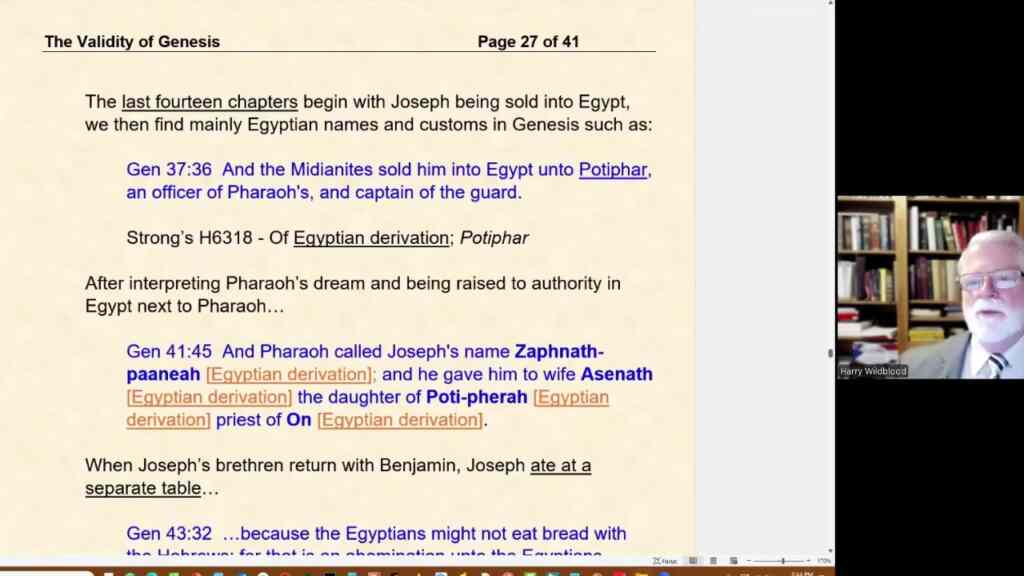
Well, as mankind began to make or recognize more gods, these were also referred to as Elohim. These are also called Elohim. But later, later, Moses fully knew of the over 400 gods of Egypt during his formative years, as well as at the time of the Exodus, and this is even before he had the opportunity to even write Genesis. In fact, Paul refers to this in 1st Corinthians 8, 5.
New Living Translation There may be so called gods both in heaven and earth, and some people actually worship many gods and many lords. Well, these different gods, or Elohim, were given names to distinguish them from one another, but they were all called Elohim. In fact, if you look at the Mesopotamian gods, they had names such as Anu, Enel, Enki, Marduk, and you can read the rest of that. I mean, it’s just a mixed up mess of gods. So Elohim ceased to be used exclusively for the one true creator.
If you say Elohim, the person hearing that would say, which God are you talking about? Which mighty one are you talking about? So that mighty one must be actually clearly identified. Clearly identified. In fact, when we look at Laban and Jacob, they use the term Elohim when, when Laban was looking for the gods, his Elohim that Rachel had stolen, this were called, these were Elohim.
And also Jacob had told his sons, put away all these gods, all these little statues. You have all these Babylonian, Mesopotamian gods. In fact, here’s a, a picture of these from the Oriental Institute. These things that were excavated. So they had all these little.
These are probably the kind of things that Rachel had took with her. But when Moses was told by God in Exodus 6,3 that he had not been known by the name Jehovah in times past, Moses was confronted with the possibility of confusion with a myriad of false gods or Elohim. So how could Moses eliminate the confusion so that Israel knew that he was actually talking about Jehovah? Well, Moses clarified the identity of the original Elohim in the creation account in Genesis 1 by using a unique name of God, Jehovah, to eliminate all ambiguity. This thoroughly explains the use of Elohim and Jehovah in Genesis.
At the dawn of history, there were no other gods to clarify to Adam. There was no chance of confusion. But after this, there were many false Elohim and they were worshiped. So Moses used the phrase Elohim Jehovah to eliminate this. He uses it in Genesis 2, 4.
And if you go through Genesis, you’ll find this phrase, Elohim, Jehovah or Jehovah Elohim, Lord God is used 28 times. To make it clear that Moses is saying, which God? Which Elohim am I talking about? The one true God, who, whose name is Jehovah. So it’s a clarification.
It makes complete sense that we would find both of those names in Jehovah. In fact, if you didn’t, Genesis would be completely unclear as to which Elohim you were talking about. So who wrote the original tablets or records? Well, it’s now well known that writing existed long before the days of Moses, Abraham and even Noah. Writing and pictographs have been found which, which are reported as antediluvian, such as the one that we see here.
Things before the, before the flood. Well, since the structure of early writing is found in Genesis 1:1 through 2:4, it’s reasonable to conclude that the earliest parts of Genesis were compiled from written records. Written records. The creation account could not be written from eyewitness accounts. We know that because in Genesis 2:4, these are the generations of the history of the heavens and the earth when they were created in the day that the Lord God made the heavens, the earth and the heavens, the creative days trace the reasonable process for the preparation of Earth’s crust for life.
There is no comparison of this account with the wild mythological Babylonian creation accounts with. You can’t compare the Babylonian accounts with the scientifically accurate, though very brief account in Genesis. Genesis makes, makes, makes sense scientifically. In fact, Brother, brother Jim Parkinson gave a talk on that, which I, which I appreciate, but what’s in the Babylonian accounts is totally ridiculous. Anybody who knows any science at all realize Babylonian accounts are just ridiculous.
The knowledge of cosmology in the day of cosmology is really of what’s going on in the universe and the different principles that control the universe. The knowledge of cosmology in the, in Moses day or after the Babylonian captivity was not adequate to falsify the Genesis account. There’s no, no way they can come up with something that is so scientifically accurate, and although not in Genesis, the Job account. Notice that what Job says, he stretcheth out the north of the empty place and hangeth the earth upon nothing.
Well, that’s correct. It’s accurate, and this is over 4000 years ago. When Job said this, this had to come from God. I mean, here’s another, most likely a tablet from Job that was appended later, and we have it in our scriptures now.
Well, the wording in Genesis is very simple. It’s very straightforward. On the sixth day, God created man in the image and likeness of God, and God said, let Us make man in our image, after our likeness. Let him have dominion over, you know, the fish, the fowl, the cattle, etc.
Etc. So God created man in his own image, in the image of God created he, him, male and female. Notice in Genesis 1:1 29 it says, and God said. God said. God was communicating with Adam and in a way that Adam could understand.
Adam was created with intelligence, with reason.
It seems clear he had verbal ability. He was endowed with the, with the ability to communicate and understand what God was saying, and note that this account was written down even before the two great lights. Even before the two great lights. Genesis 1:14.
And God said, let there. Let their lights, excuse me, let there be lights in the firmament, another firmament. Divide the day from the night, etc for seasons and days, and then God made two great lights, the greater light to rule the day and the lesser light to rule the night. Let me just say this, the account shows that God planned this before it was executed.
This was not written down by Adam before these two great lights were were created. That, that’s, that can be misunderstood as what I intended there. So God first explained that he would create the lights and then what they were for, and then he executed them. But note that the sun and the moon, as we said before, they weren’t even given names at this point. This is a vital point.
Every other culture, in every other culture, the sun and the moon were given names and worshiped as gods. In fact, the Babylonian name for the sun God was Sheamish. That was one of their gods, their moon God. Moon God had the name of sin and Nana. Well, these earliest records show that God was the instructor of Adam.
In fact, you’ll find nine times in, in Genesis 1 and God said three times and God called. These words were spoken to the first man who recorded them in a precise manner. Adam was endowed with language and reasoning abilities and he could understand what God was telling him even with no prior experience. Adam was introduced to the concepts of earth, seas, day, night, vegetation, seed, marine life, land animals, birds, dominion, and the fact that he would be the caretaker of all these things and that God would provide for this his living creation. In 130 he says, and I have given every green herb for meat.
And it was so for all these living land animals. Genesis 1 is so ancient that it create. It contains no mythical or legendary material. It was written before any myths or fables had even been devised by fallen mankind and allowed to grow and proliferate. There was nothing in this account to evoke fear as the later mythical accounts of vengeful gods did in the Babylonian and Sumerian myths.
The first tablet ends with these are the generations of the histories of the history of the heavens and the earth when they are created. But the second tablet, from Genesis 2:5 to Genesis 5:1, is also a personal account of Adam and Eve and their relationship with God.
Okay, we have just a minute or minute or so left. God’s first law was given to Adam. We know that in the that you can’t eat of the tree of knowledge. If you do it, you’ll die. Eve is created, then the fall is recorded in Genesis 3.
And this account is almost. Is almost unthinkable in Jewish literature because notice the familiarity. Jews would never address God directly, and Lord God called Adam and said, where are you? And he says, I heard thy voice in the garden.
I was afraid because I was naked. Can you imagine a Jew actually addressing God directly or even thinking that anybody would? Jews can’t even say the Tetragrammaton, the name of God. They won’t even say that. Well, this tablet continues to the sentence on Adam and Eve, the murder of Abel and Cain and the compilation of the history of Adam.
This ends with Genesis 5:1. This is the book. Notice the writing the book, the writing of the generations for the history of Adam in the day that God created man in the likeness of of God made he him. Let’s stop right there and we’ll continue tomorrow.
Click Here for the PDF transcript.