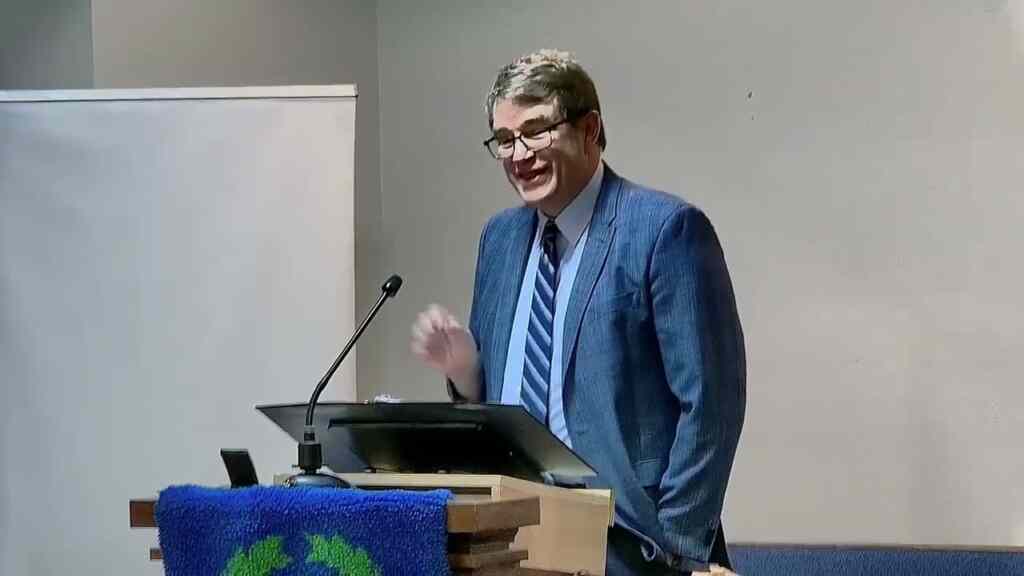
This transcript was generated automatically. Its accuracy may vary
Short Summary
The discourse explores the complex nature of happiness, emphasizing that external factors like wealth, possessions, status, and power often do not lead to true satisfaction. Instead, lasting happiness is linked to purpose, health, and meaningful relationships, with spiritual fulfillment and following Jesus providing a profoun...
This transcript was generated automatically. Its accuracy may vary
Short Summary
The discourse explores the complex nature of happiness, emphasizing that external factors like wealth, possessions, status, and power often do not lead to true satisfaction. Instead, lasting happiness is linked to purpose, health, and meaningful relationships, with spiritual fulfillment and following Jesus providing a profound source of joy. It also highlights the importance of love, acceptance, and appreciation within communities as key elements for cultivating happiness.
Long Summary
Detailed Summary of the Discourse on Happiness, Purpose, and Spiritual Growth
The Search for Happiness and Its Paradox
– People commonly seek happiness but often lack clarity on what truly brings it.
– Ironically, the pursuit of happiness itself can cause unhappiness.
– Global Happiness Index data shows a worldwide decline in overall happiness and satisfaction, including in the U.S.
– Youth today face greater social, economic, and technological pressures than previous generations, contributing to widespread unhappiness.
– Contrastingly, some children in poorer, developing countries exhibit higher happiness levels despite fewer possessions.
Intellect and Happiness
– Example of Dr. Young Hoon Kim, reputed for extremely high IQ (claimed 276), yet lacking spiritual insight, as he declares Jesus Christ is God, which the speaker questions.
– High IQ individuals tend to struggle more with happiness due to overthinking and heightened awareness of unknowns.
– The danger lies in “not knowing what we don’t know,” underscoring the importance of continual learning and humility.
Common Misconceptions about What Makes People Happy
– A book titled *What Happy People Know* lists five commonly believed sources of happiness:
1. More leisure time
2. Higher status
3. More possessions
4. Wealth or financial security
5. Power or fame
Analysis of Each Common Source of Happiness
1. Leisure Time
– Optimal free time for happiness is 2-5 hours per day; more than 5 hours tends to reduce feelings of productivity and happiness.
– Excessive leisure leads to boredom and dissatisfaction (e.g., watching Netflix all day).
2. Higher Status
– Studies of 3,500 people show higher status increases well-being only if it is relevant to core group identity.
– Status in groups perceived as unimportant doesn’t correlate with happiness.
– No significant happiness difference between blue collar and white collar workers globally.
3. Possessions
– The phrase “He who has the most toys wins” is challenged.
– Finland, ranked highest in happiness for seven consecutive years, has low income levels compared to other countries.
– Factors contributing to Finland’s happiness include trust in institutions, access to nature, work-life balance, low corruption, and clean environment.
4. Wealth/Financial Security
– Income correlates with happiness only up to around $70,000/year, after which satisfaction levels plateau.
– Extremely wealthy individuals (>$10 million) report more worries and problems related to money.
5. Power or Fame
– Having power (e.g., a man with 11 children) often leads to fatigue and loss of personal freedom rather than happiness.
– The pursuit of power tends to reduce control over one’s life.
Overall Findings on Happiness
– External circumstances (age, race, wealth, status) do not reliably predict happiness.
– Studies from Duke University highlight key factors that promote happiness:
– Letting go of suspicion and resentment
– Living in the present instead of dwelling on past mistakes
– Avoiding futile struggles against unchangeable conditions
– Cooperating with life and engaging socially during difficult times
– Rejecting self-pity and self-justification
– Cultivating virtues such as love, honor, loyalty, thrift
– Finding something greater than oneself to believe in — self-centeredness correlates with low happiness
Three Pillars of a Joyful Life: Purpose, Health, and Relationships
Purpose:
– Many seek happiness through self-improvement; vast markets exist for coaching ($8.4 billion) and health ($4.9 trillion in spending).
– Spiritual purpose, following Jesus Christ, provides the deepest meaning and joy.
– Biblical reference: Ephesians 1:10,12 — God’s purpose in uniting all things in Christ and giving believers an inheritance.
– CS Lewis: Once awakened by desire for God, a person fears losing that connection.
– Paul’s analogy in 1 Corinthians 9:24-27 likens spiritual discipline to athletic training—self-control is essential for winning the “imperishable prize.”
– Discipline is the price of freedom to excel spiritually.
Health:
– Physical health is foundational for happiness.
– Research on the heart (“heart brain”) shows it sends signals influencing emotions and can override distress signals from the brain.
– Proverbs 4:23: “Keep vigilant watch over your heart, for life flows from it.”
Relationships:
– The global dating and matchmaking market is growing, showing human desire for connection.
– Dale Carnegie’s wisdom: Genuine interest in others builds friendships faster than seeking their interest in oneself.
– Biblical example: Mary and Martha (Luke 10:39) — Mary’s choice to sit at Jesus’ feet exemplifies valuing spiritual fellowship and learning.
– John 12: Mary shows love by anointing Jesus’ feet, a deliberate act of appreciation and devotion.
Improving Spiritual Relationships
– Acceptance: Avoid imposing a “spiritual straight jacket” on fellow believers to foster trust and influence.
– Approval: Look for and acknowledge positive traits in others to build relationships.
– Appreciation: Express value for others to strengthen bonds.
– Paul’s encouragement (1 Thessalonians 2:8) about joy and comfort in love applies here.
Final Reflections and Encouragement
– True happiness is grounded in God’s word and desire to preach the gospel (reprint 2447).
– Mary’s example of love and devotion to Jesus should inspire our relationships with brethren, seeing Christ in them.
– The “garland offered by easier effort is not worth the gathering.” Faithfulness unto death wins the “crown of life” (Revelation 2:10).
—
Key Bible Verses Mentioned:
– Luke 10:39 — Mary sat at Jesus’ feet listening to Him.
– Ephesians 1:10,12 — God’s purpose to unite all things in Christ and give inheritance.
– 1 Corinthians 9:24-27 — The Christian life compared to athletic discipline and self-control.
– Proverbs 4:23 — “Keep vigilant watch over your heart, for life flows from it.”
– John 12 — Mary anoints Jesus’ feet as an act of love and appreciation.
– Romans 14 — Lesson in prioritizing what matters in relationships.
– Revelation 2:10 — “Be thou faithful unto death, and I will give thee the crown of life.”
—
Summary Conclusion:
True happiness transcends external conditions such as wealth, status, or possessions. It is deeply connected to spiritual purpose, physical health, and meaningful relationships grounded in love, acceptance, and appreciation. Following Jesus Christ provides a clear purpose and model for joy. Discipline and self-control, akin to an athlete’s training, are necessary for spiritual freedom and growth. By embracing virtues and focusing on what is eternal, believers can find lasting happiness and fulfillment despite life’s challenges.
Transcript
People look for happiness, but they’ve got generally no idea what’s going to make them happy, and I like this statement. The search for happiness is one of the chief sources of unhappiness. This is the Global Happiness Index. Maybe you’ve never searched on things like these, but it’s really fascinating when you start looking at statistics because everybody does them today.
You can find anything but focus exactly on the map. The lower map, the global Happiness index in relation to the US and the blue is those that are happier and the red is those that are unhappier as measured by certain happiness statistics that you’ll see. But the sad thing is, if you look at the other chart on the left, that’s the happiness index for the US itself. So what does it mean? The whole world really has declined in satisfaction and happiness.
Some of that. When we look at the youth of the world, how many pairs of sneakers do you all have? Right.
Youth is unhappy. Generally, the social, the economic, technological, sociological pressures on them are greater today than they ever have been. We grew up, Larry and I grew up in the 60s when there was great pressure coming from the outside. But you know, it’s here again and just in different forms. But what we find, kids in poor countries that have far fewer possessions than those that live in rich places are some of the happiest kids around.
Those that are in developing countries that have almost nothing, and I know we have brethren here that come to us from Africa are happier than their wealthier counterparts, especially when we get to school. So some interesting things happen. Speaking of school, Here’s a man, Dr. Young Hoon Kim, who has the highest recorded IQ in the world. 276.
Now, I haven’t had an IQ test in many years, but I’m sure I don’t come close to this. Now, a lot of articles claim he has the highest IQ score, but there’s doubts about whether he does or not. He always puts Dr. In front of his name, but he really only has honorary degrees. We know a lot of politicians do that, but so does he have the highest iq?
Well, one thing he isn’t very smart about is the Bible, because look what he says. He declares Jesus Christ is God. So it doesn’t mean anything because you have an iq. You’re not going to be more astute about what the world is about or what God’s plan is. In fact, people with high iq, it’s shown, really struggle with this idea of being happy.
Why, you can see that the listings I’ve had here are 10 listings I’m not going to read them all. But you see, some of the ones are interesting. You know, they overthink everything, and the number 10 is the interesting one. They’re acutely aware with a high IQ about everything they don’t know.
So you worry I don’t know everything I should because my IQ is so high. We all know that the danger in our lives is we don’t know what we don’t know, and that’s really the only thing that matters, and that’s why we strive to continue to study, to learn more about those things we don’t know that we don’t know.
This book was published some time ago, but it’s called what Happy People Know, and it lists five things that people say would make them happy. So one is more leisure time, a higher status, more possessions, wealth or financial security, and number five, power or fame. I’m going to take a brief look at each of those and see whether that makes sense or not.
But maybe you hadn’t thought about this, but that’s what people generally look at to create happiness. Anybody here subscribe to the World Leisure Journal? Did you even know there’s a magazine and a periodical for everything?
But researchers have looked at leisure time and the relationship between free time, not free time because you’re not working, but just free time and happiness. Now, two to five hours per day of time that you have free to do what you want generally maximizes happiness for people. But how people spend their free time matters more than those two to five hours, and that’s one of the discoveries that’s made when we look at leisure time. If you have more than five hours of free time a day, it makes a person feel less productive and that reduces happiness.
According to Psychology today, the sense of joy is gone when all you do is lay around in a cot all day and watch Netflix at home. Maybe it’s good for a day. But having a consistent abundance of time to do nothing undermines happiness. Because what happens? You get bored and then trouble comes along.
What about a higher status?
There were 10 experiments that was done. Cornell Chronicle recorded this last year. 10 experiments that involved about 3,500 people and attaining the high status positions that go along with it and generally increase the person’s well being. Only under certain conditions if the group was central or if it was relevant to how you identify yourself. We don’t talk about status because we don’t have a status right here.
But think about other groups. People rise to power in certain groups. It bolstered their self esteem the more they rose up in these old organizations. But it wasn’t correlated to status in unimportant groups. Well, no matter how that was measured.
Now, what’s considered an unimportant group? Well, here’s one response. I happen not to enjoy much status at work. That’s okay. Work’s not that important to me.
So that’s the reaction. Well, just make whatever your status is low. Just say, well that’s not an important thing to me. But that’s a struggle again that you see people have and this interesting. We talk about white collar workers, we talk about blue collar workers, but you see the difference here.
The percentage of people who are satisfied with their work isn’t that much different whether it’s blue collar or white collar status, and this is from a 1990 series survey of 26 different nations with white collar and blue collar workers.
So it really is doubtful that status really ends up giving you happiness. But what about the third thing, possessions?
He who has the most toys wins. That’s a saying. I had a lawyer that I worked with and he had that little sign on his desk, he who has the most toys wins. He ended up getting fired. So anyways, but here’s an interesting look.
Finland ranks highest in the happiness ranking for seven years, the past seven years, and this is a 2025 survey population review. But look at the income level, the lowest of anybody on the list. So Denmark, Iceland, Sweden, Netherlands. Look where United States ranked 24th.
That’s the lowest ever. You go back just 12 years, 13 years, that was number 11. So this great increase in wealth and possessions that we’ve seen hit in this country hasn’t really made made a difference in people’s level of satisfaction and happiness. Why does Finland rank there? Finland ranks as the happiest country.
There’s a lot of factors that were put into this. High levels of trust in the institutions they have. Access to nature, access to a work life balance that gives them the right amount of time. Low corruption that’s there in feminine and a clean environment. So you can see for them they reduce the stress and anxiety which creates a lot of unhappiness and growth community.
If you watch Hallmark, you know these little towns always have the greatest happiness and everybody’s getting along and contentment wasn’t material things in Finland that drives their happiness. What about wealth or financial security? Which, outside of this possession idea, does money buy happiness? Talk about that. This chart is pretty interesting, really what it shows when you look at it, you see how it levels out.
The bottom line is the level of income up to about 600,000, just over 600,000. But notice the satisfaction level becomes flat, and really as you get to this level of $70,000 a year, the chart starts to flatten out. People like to have enough to make it comfortable for them, but it’s not about how much they have that gives them the happiness.
And Psychology Today again did in 2022, did a study on this exceptionally affluent people, people that had more than $10 million of household income. Well, they complained that the money actually just created more problems for them than the satisfaction because another third of them said that the constant worry about maybe I need twice as much to feel secure. I actually had a CFO that I worked with and he said, you know, you start out thinking maybe you need the 5 million and you get to 5 million and 10 million is nothing. You know, that’s the peril of focusing on financial security. People that earned less than $100,000 a year need much less to increase and show a positive shift in how they feel about their financial security.
The fifth thing, power or fame.
The problem with a self made man is that he worships his creator, and people that are self made and for power don’t do that well in happiness. People with 11 children have lots of power. Now there is a special thing about this picture I’m showing you. See the man with 11 children, actually just 10 in this because one of the children died earlier.
But the man that’s there with 11 children had lots of power, and up there at the top you may recognize that person. Second from the left is my wife Gretchen. This is her family of 11 kids. 10 kids.
And her dad worked a lot because he couldn’t take all that power over the kids. So they have a lot of power, but it doesn’t make you feel omnipotent. When you have that much and think about it, even when you have those responsibilities, that makes you tired, obligated, because you’re responsible for a lot of people. Unless you’re people like some of the evil ones you see on the right. The rise in power leads to losing power over your own life.
Because now you’re concerned with so many different things.
All the studies I’ve showed you, just a brief glimpse into some of these determine that circumstances of our life don’t really determine the happiness level that one attains. If you’re at midlife, you’re just as happy as a person that’s younger. Or you might complain a little bit. There isn’t a such thing as an empty nest. Syndrome that we always talk about.
Again, we’re talking in generalities and there’s no difference between races in terms of happiness. So it really is not focused on things that are external. That’s what it’s telling us. Neither fate nor fortune has an influence over happiness. Those are just substitutes for happiness.
All the things we’ve mentioned. Duke University did a study on what really makes people happy, and this is what’s pertinent. Not being suspicious or holding resentment. Nursing a grudge was a major factor they found in unhappiness.
Second, living in the present, a lot of unhappiness would stem from preoccupation with the past, mistakes and failures that people have. Third, not wasting your time and energy fighting conditions that you can’t change. What we call spinning your wheels. 4. Cooperating with life instead of trying to either demolish it or run away from it.
If you force yourself to be outgoing with others instead of retreating back within during difficult times, emotional distress, you achieve much more happiness. Number six, refusing to pity yourself or seek self justification in alibis that make you seem noble to yourself or to others. Seven, cultivating virtues, love, honor, loyalty, thrift. Eight and this one is extremely important. Finding something bigger than yourself in which to believe.
What they found is self centered, egotistical, materialistic. People score the lowest of all in any kind of test that measures happiness.
So what brings a joyful and happy life? Three things we can narrow it down to a purpose. Health and relationships. Purpose. Well, people try to achieve self improvement as a purpose.
This just shows you the self improvement products and services market. Now maybe some of you are working in this area, but you can see the amount of money to spend on just trying to achieve some kind of self improvement that people have to get a purpose in their life, and the global life coaching life coaches are big today. But look at the market for this. You know, $8.4 billion in the coaching services market.
If you want to be a coach, you can make $125 to $350 an hour. Not a bad job. Qualifications are. Well, there’s a lot of different ones. Health number two, look at the amount.
This is the amount of spending we have on health. This is in 2023 data we have. Total spending for health is $4.9 trillion. That’s about 14 and a half thousand dollars per person. Almost 18% of gross domestic product that we produce.
And just those people that are smokers or addicts of some kind. The global market for quitting smoking or getting out of an addiction 25 and a half billion dollars in 2023. So you can see health is important. It’s important to everyone, and that’s something that we need to always keep in mind.
We know in this country we have a wonderful health care system, but that is a major effort in achieving joy and happiness because it allows you to do what you want. Number three, relationships. I had to get my dog in here again. This is Gunther and his Wells Fargo pony. He carried that everywhere.
And we never did figure out why he did it. He would eat, and then he would put this pony in his mouth and he’d prance around the house just in a big circle. We never figured out 15 years of doing that. But in 2025, the global dating services market is going to reach almost $8.5 billion, projected to grow up to 9 billion by 2029. People are looking for professional matchmaking.
Also, if you look at this combined market size, growth and forecast significantly larger. Dale Carnegie said, you can make more friends in two months by becoming interested in other people than you can in two years by trying to get other people interested in you. Brethren, that’s a lesson we know, right? Getting to know the brethren is an important part of our life.
Mary and Martha, of course, sat at the feet of Jesus, and I love this scripture. In Luke 10:39, she had a sister, Mary. Remember, Martha was upset about that. She sat at the Lord’s feet listening to what he said.
Brethren, isn’t that what we do? We want to listen to what Jesus is saying that encompasses happiness in our life. Following Jesus gives us three things that are based on those three things I just mentioned. A real purpose. Spiritual health and fulfilling relationships.
A real purpose. Paul tells us in Ephesians 1, 10, 12 that in the dispensation of the fullness of times, he’ll gather together in one all things in Christ, and that’s what is promised, and so for us, Paul says, we have obtained an inheritance predestinated according to the purpose of him who worketh all things. Brethren, we have a purpose because we follow in the footsteps of Jesus.
It gives us an overwhelming joy to know that we have a model like Jesus to follow, and that’s the purpose we can achieve in our life to get the joy and happiness. CS Lewis, who became a Christian late in his life. But he had some very good things to say, and he said, the soul that has once been waked or stung or uplifted by the desire of God will inevitably awake to the fear of losing him.
Brethren, that’s what we Think right, We don’t want to lose that feeling we have for walking in the footsteps of Jesus and following after him, and that fear is not a fear of being scared. It’s a fear of losing God, that feeling we have with him. Paul gave us a formula in 1 Corinthians 9, and this was talked about a little bit earlier where he said, do you not know that all those who run in a race all run, but only one receives the prize? And he talked about those that are in the game, those that compete and exercise.
He says, self control in all things. They do it for a perishable wreath, but we an imperishable, and then he goes on to say, I run in such a way, not without aim, not without purpose. I box in such a way, not just beating the air, but I buffet my body and make it my slave so that I am not disqualified. That analogy Paul made very important.
If we’re unwilling to discipline our. If an athlete is unwilling to discipline their body by regular exercise, they can’t excel. It takes away their freedom. A freedom to excel, a failure to train. If you don’t train, it denies your freedom to build speed and distance.
You’re free to do that when you train. Discipline is the price of freedom for an athlete, and it’s the price for us. Discipline in our lives is the price to be free in God’s work and in his way. There’s four parts, really, to winning as an athlete that Paul sort of defined for us here that are applicable also to what we have to do in our own lives. Number one, visualize the goal.
Know where you’re going, brethren. That’s why we spend the time we do thinking about what’s the purpose of the church. Class number two, practice daily to make achievement a habit. That’s what an athlete does. Third, they stay focused even though there’s pain in preparation and suffering.
It’s part of the preparation, and number four, you can always do more than you think you can. Paul puts it this focus on Jesus and others, the examples we have to emulate him. Make it a daily commitment to study, to pray, to practice the Christian principles in your everyday life, and remember the pain and suffering we go through, the losses we incur.
That’s part of how God is developing us in this training process, the skills of an underpriest, and we never achieve. Paul said he never achieved till the end of his life. But it’s always room for improvement. We can never say, well, Lord, here I am.
I’m ready. Right?
This is from volume one. The concluding thoughts. If you give diligence to the word of God and receive his truths into a good honest, consecrated heart, it will beget in you such a love for God and his plan and such a desire to tell the good tidings, to preach the gospel, that it will become the all absorbing theme of life thereafter. If I asked you here, raise your hand if this is the theme of your life. I think every one of us would raise our hand.
This is the theme of our life. All else is incidental. How about our health? Our purpose is solid, our health. In Proverbs it says, my child, listen carefully to everything I say, true life and it will be true life and good for you.
And he says, keep vigilant watch over your heart. That’s where life starts. The scriptures talk about a heart as the source of love, influence the mind, and research really agrees with the reality of scripture. When I went through a heart procedure a year ago and it got postponed for a day because the doctor that was going to do the surgery to repair one of my valves, he had a heart transplant he had to do.
I said, well, that’s okay, I won’t interfere with that. But the heart transplanted research shows that that heart beats immediately when it’s transplanted and before the nerves even coming from the brain are functional into the heart. Researchers found that some transplant recipients even adopt a prostate. Personality tendencies of the donor. Anyone ever see the movie Return to Me?
That was a great movie, and the guy falls in love with the woman that got his wife’s heart, and he said, something is familiar about you. Have we met before?
The heart has an intrinsic nervous system of its own neurons similar to what you have in your brain, and it controls the beating of the heart, and the nervous system is dubbed the heart brain, and it’s a two way street. Researchers have found that the heart brain has the power to send messages back to the brain via the spinal cord.
It can override the messages coming from the brain, particularly messages of distress that trigger heart attacks, and it helps trigger calming or exciting thoughts. That’s what the psalmist is telling us. What does it mean for us? Look at here, the electrocardiograph.
For one that’s feeling frustration versus one that’s feeling appreciation. That’s the kind of smoothing that can happen with our heart brain. Spiritual organ is our most important organ, the spiritual heart. It’s what sends messages about our thoughts, our affections, our choices. We send the message back to our mind on how we’re going to speak, how we’re going to act how we’re going to respond to the circumstances we’re in.
During all this research, a man named Libet became interested in the possible lag time between four when people get an urge to take action and when they actually take it.
I have an urge to go on. Is it really? I got like nine minutes to go. Is that right? Okay.
I can’t go against my buddy here.
So Labet, he did a series of experiments on patients that were going through brain surgery. They were awake and alert during that surgery, and he monitored them to see how long it took for the brain activity to start to do something, to move a finger or whatever. He found what he called it. There was a quarter second delay between the urge to move the finger and the actual movement.
Now, I know you say a quarter second. That’s nothing.
This is Bob munden. He’s age 68 years old. He appeared in Stan Lee’s Superhumans in a demo. Using a Colt.45 single action revolver, he shot two balloons eight feet apart in less than a tenth of a second.
He could draw, shoot two balloons, holster his weapon in half of a quarter second. Now, I think, I don’t know if we have time, but I want to show you this, just this part, and I’ll see if I can pick up the sound.
We couldn’t pick up the sound. Okay, let me try that again. We’ll go back here.
Okay, you’ll see it.
He shot two balloons and reholstered his weapon doing that, and this went on to talk about the fact that he was a superhuman. They put up the two balloons. You’ll see it. You can’t hear the sound, but you’ll see it again to show that he did this.
These targets in one move. Yeah, I’m going to bring the gun up, fire two shots, one for each target as fast as I can.
It’s just amazing to me. So we’ll take a look here, and they’re recording it here.
You’ll see how you can hardly see, and he put it back in 10th of a second. They go on to show this, two bullets and a tenth of a second from shooting, and that’s. You’ll see the graph that’s there.
And as he says, this is truly amazing. I’m sorry, I can’t hear it. But you can tune it down on YouTube. But I wanted to use it to show that, brethren, every urge that you ever have to strike out or say something hurtful, you’ve got a quarter of a second longer than it took him to shoot two balloons. To disengage from that urge.
Let’s remember that Mary’s actions in sitting at the feet of Jesus show that she was appreciating Jesus. We read in John 12 how she sat at his feet, came in, took her hair down, and put perfume on his feet. You know, at the beginning of his ministry, she discovered a purpose in his words. At the end of his ministry, she appreciated all the work that he did and anointed his feet. Now, usually people poured oil on the head and the servants took care of the feet.
But Mary took down her hair in public, which was never done by women, because she wanted to show Jesus the appreciation she had for his character, and it reflected her true character. We reflect our own appreciation through our association with the brethren when we pour oil on their feet. Through kindness, through tenderness, through love and affection, Paul says, bear one another’s burdens and fulfill the law of Christ. Encourage one another day after day, as long as it’s still called today, so that none of you will be hardened by the deceitfulness of sin. Patience has to be accompanied by priorities.
Romans 14. Read it. It’s a lesson in prioritizing. Everything you believe can’t be at the top of your list. If you’re married more than a week.
You know that some things are worth fighting for, some things are not worth fighting for. But are things really fundamental that you’re upset about?
Paul talked about the love that the Corinthians showed to him and their ability. He says, not as I expected, they were kind to him. Remember, he had chewed the Corinthians out before, but now he got kindness from them that he never expected. So, brethren, there’s three ways we can improve our spiritual relationships. As we wind this up, let’s try for an acceptance of others.
Don’t fashion some spiritual straight jacket around the brethren with whom you fellowship. Be more accepting and you’ll have more opportunity to influence their behavior and their thinking. Gain confidence, trust, ability between the two of you so that you can offer advice. Secondly, approval of others. If you have a hard time with brethren, look for something to approve in them and let them know you approve of this.
The number that you find will grow. If you’re impatient with someone, find one thing you can approve of. You’ll usually find more than one, and you’ll develop new relationships this way. 3. Appreciation of others.
This is a surprise for my daughter. This is Rachel and Eva, who used to be Eva Pervin at this point. Now she’s Eva Sobieski from Poland. But this was back in 2004 when they met, still friends today.
What’s the definition of appreciation? To raise in value? How valuable are the people that you associate with to you? How can you let them know that they’re valuable to you? Paul said, for I have come to have much joy and comfort in your love.
It’s a way we can tell others that they mean a lot to us. Well, as we wrap this up, brethren, from reprint 2447 we read in our ministrations to others we are not to forget that money is not the only thing of which people are sorely in need. Some need love and sympathy. Our Lord was one of these. His own heart, full of love, found comparatively little companionship in the more or less sordid minds of even the noblest of the fallen race represented amongst the apostles.
In Mary he seemed to find a depth of love and devotion which was to him an odor of sweet incense, of refreshment, of reinvigoration. She not only delighted to sit at his feet to learn of him, but now delighted at a great cost to give him some manifestation of her devotion and her love. Brethren, let’s use that example of Mary in our own association with the brethren, because in them we should see Jesus working, and our appreciation to him can be shown through our appreciation to them. Great is the road we climb, but the garland offered by an easier effort is not worth the gathering. Be thou faithful unto death, and I will give you the crown of life.
Revelation 2:10 May the Lord bless you as you go out from the convention and follow in the footsteps of Jesus.
Click Here for the PDF transcript.