This transcript was generated automatically. Its accuracy may vary
Short Summary
The study explores the significance of the peace offering in Leviticus, focusing on the consecration of the priesthood as a prerequisite for the people’s peace offering, which symbolizes reconciliation with God during the millennial age. It discusses two main types of peace offerings—thanksgiving and vow offerings—h...
This transcript was generated automatically. Its accuracy may vary
Short Summary
The study explores the significance of the peace offering in Leviticus, focusing on the consecration of the priesthood as a prerequisite for the people’s peace offering, which symbolizes reconciliation with God during the millennial age. It discusses two main types of peace offerings—thanksgiving and vow offerings—highlighting their symbolic elements, such as the three cakes and the animals (goat, lamb, bullock) that represent different spiritual stages of humanity’s restoration. The session emphasizes the progressive sanctification of individuals, culminating in perfection by the close of the millennial age, when mankind will be fully reconciled and prepared for God’s final judgment.
Long Summary
Detailed Study Summary: “My Fault” — The People’s Peace Offering and the Millennial Age
Study Theme and Context:
– The study focuses on the *People’s Peace Offering*, a concept rooted in the Old Testament sacrificial system, particularly in Leviticus chapters 8, 9, and 16.
– The peace offering is linked with the consecration of the priesthood and millennial age symbolism.
– It is emphasized that before the people can bring their peace offerings, a priesthood must first be established and consecrated.
Priesthood Consecration (Leviticus 8:22-29):
– Scripture reading from Leviticus 8 describes Moses consecrating Aaron and his sons by laying hands on the ram of consecration, sprinkling its blood on their ears, thumbs, and toes, symbolizing full dedication of their faculties to God.
– Moses then places fat, liver, kidneys, and unleavened cakes on their hands and waves them before the Lord as a wave offering, which Moses then burns on the altar as a sweet savor (Leviticus 8:22-29).
– The waving of the offering represents a full consecration to God’s will, and Moses acting as a type of the Heavenly Father.
– The perpetual fire on the altar symbolizes readiness to receive offerings and is a beautiful picture of the millennial age when offerings will be accepted continually.
Peace Offering Law and Types (Leviticus 3, 7):
– Leviticus 3 outlines the general laws for peace offerings from herd, flock, or goat, emphasizing the offering must be without blemish.
– The fat, kidneys, and certain parts are burnt on the altar as a pleasing aroma to the Lord.
– Leviticus 7:11-18 distinguishes two types of peace offerings made by the people:
Thanksgiving Offering: Accompanied by unleavened cakes mixed with oil and leavened bread (Leviticus 7:12-13). This offering reflects gratitude and acknowledgment of God’s providence.
Vow or Freewill Offering: May be eaten on the day of offering and the next, but any leftovers on the third day must be burned (Leviticus 7:15-18). This offering symbolizes a deeper commitment or consecration.
– All fat is the Lord’s and must not be eaten by the offerer (Leviticus 3 and 7).
– The priesthood receives portions of the peace offerings (breast and right thigh) as a perpetual statute (Leviticus 7:29-34), symbolizing their stake in the offerings and ministry.
Symbolism of the Peace Offerings:
– The peace offering symbolizes fellowship and reconciliation with God, especially emphasizing the role of the Melchizedek priesthood (Christ and the Church) as mediators.
– The waving of the offering by the priests until God removes it represents ongoing consecration until divine acceptance.
– The thank offering involves cakes with oil and leavened bread:
– The *oil* symbolizes the power and influence of God’s Spirit.
– The *cakes* represent stages of spiritual growth: justification, sanctification, and glorification.
– The *leaven* (usually a symbol of sin) in this context reminds that even thankful believers recognize their imperfect condition and need for God’s grace.
– The vow offering reflects a full consecration and commitment to righteousness, a personal covenant to God.
Millennial Age Application:
– The peace offerings are primarily a *millennial age* picture where people brought back to life (resurrected) will progressively grow in holiness and peace with God.
– The priesthood (Christ and the Church) must be fully consecrated first before the people can bring their offerings.
– The people’s offerings vary by the spiritual stage of the individual:
Goat: Represents those still rebellious or self-willed, coming back with their old nature.
Lamb: Represents those more docile and humble, willing to follow the Shepherd.
Bullock: Represents perfect humanity, those who have reached full righteousness and consecration.
– The process is gradual: individuals come to peace with God at different times and levels of understanding, reflecting a sanctification process.
– The millennial kingdom will be characterized by service and harmony, contrasting sharply with the sinful world prior to restoration.
Scriptural References and Illustrations:
– Psalms 51:17,19 – “The sacrifice of God is a broken spirit; a broken and contrite heart… Then bulls will be offered on your altar.” This highlights the importance of a contrite heart over mere ritual.
– Hosea 6:2 – “After two days will He revive us; on the third day He will raise us up, and we shall live before Him.” Linked to the vow offering’s timing and the resurrection.
– Luke 13:32 – Jesus mentions “the third day I am perfected,” symbolizing the completion or glorification of the church.
– Luke 20:36 – “Neither can they die anymore, for they are equal unto the angels and are the children of God, being the children of the resurrection.” This verse emphasizes the perfection and immortality of the resurrected during the millennial age.
– Revelation 20:3 – Describes the binding of Satan during the thousand years until the little season, implying the millennial age’s role in perfecting mankind.
Final Thoughts:
– The peace offering reflects the ultimate reconciliation and peace with God, made possible by Christ’s sacrifice and mediated by the Melchizedek priesthood.
– The millennial age is a time of education, sanctification, and gradual perfection for mankind, culminating in a full consecration vow.
– The priesthood’s consecration and continuous role facilitate this process.
– The offerings and their parts symbolize spiritual stages and the believer’s journey from imperfection to perfection.
– The study closes with an optimistic vision of a restored world free of sin, sickness, and death, where all may be “Abraham’s seed,” enjoying eternal life under God’s kingdom.
—
Summary of Key Bible Verses Mentioned:
Leviticus 8:22-29 — Consecration of Aaron and sons with waving of fat and cakes.
Leviticus 3:1-17 — Laws for peace offerings from herd, flock, or goat.
Leviticus 7:11-18, 29-34 — Thanksgiving and vow peace offerings; priest’s portions.
Psalms 51:17,19 — God desires a broken spirit and contrite heart; bulls offered on altar.
Hosea 6:2 — Resurrection on the third day.
Luke 13:32 — Jesus’ perfection on the third day.
Luke 20:36 — Resurrection life; no more death.
Revelation 20:3 — Satan bound during the 1000 years.
This study richly intertwines the Old Testament sacrificial types with their millennial antitypes, emphasizing the priesthood’s role, the people’s offerings, and mankind’s spiritual progression toward perfection and eternal life under God’s kingdom.
Transcript
You know, we thought today, as far as our study goes, you know, gives us an opportunity and the title is probably My Fault, how I sent it over to the brethren, but it should be the people’s Peace Offering because, you know, there’s the peace offering that we have with the Leviticus 16 and, and 9, chapter 9 primarily, and also with the consecration of the priesthood. So we’re talking about the people’s peace offering, and it’s, it’s important, and before that can begin, I feel that’s a millennial age picture. But before that can begin, there has to be our first discussion and that’s what we’re going to talk about.
I’m not going to come up. I’m not going to come out and say, I’ll let you say it and you tell me as we study it.
So we’ll, before we get going on our study, I think we should have some scriptures read and to introduce the first portion of it, and it’s from Leviticus 8 and it’s 22 through 29, and we’ve asked Sister Brenda Condit to read those for us. All right, Leviticus 8, 22, 29, and this is the King James Version.
And he brought the other ram, the ram of consecration, and Aaron and his sons laid their hands upon the head of the ram, and he slew it, and Moses took the blood of it and put it upon the tip of Aaron’s right ear, and upon the thumb of his right hand, and upon the great toe of his right foot, and he brought Aaron’s sons and Moses and he brought Aaron’s sons, and Moses put of the blood upon the tip of their right ear, and upon the thumbs of their right hands, and upon the great toes of their right feet, and Moses, Moses sprinkled the blood upon the altar round about.
And he took the fat and the rump, and all the fat that was upon the inwards, and the call above the liver, and the two kidneys, and their fat, and the right shoulder, and out of the basket of unleavened bread there was before the Lord he took one unleavened cake, and a cake of oiled bread, and one wafer, and put them on the fat and upon the right shoulder, and he put all upon Aaron’s hands and upon his son’s hands, and he waved them for a wave offering before the Lord, and Moses took them from off their hands and burnt them upon the altar, upon the burnt burnt them on the altar, upon the burnt offering. They were consecrations for a sweet savor.
It is an offering made by fire unto the Lord, and Moses took the breast and waved it for a wave offering before the Lord for the. For of the Ram of consecration. It was Moses part, as the Lord commanded Moses. Okay, thank you.
So, a lot of reading. I appreciate it. Why don’t I just get the. Get the context there? So, as you can see in these verses, we’re talking about the consecration of the priesthood.
And so what did, and our first question is, what did the peace offering in Leviticus 8 represent? And what was represented by the waving of the offering and the three cakes? Okay, Dan, do you have it set up to where Brethren Online can also contribute? Yes.
Okay, and Brethren Online, if you have a comment, you can certainly raise your hand and we’ll call upon you.
So our. You know, we’re picturing the scene. We have the. The priests have been. You know, this is where they’re being consecrated.
So we. We know that Moses brought them, washed them, brought them together, clothed them, and now they’re at this point where they’re.
This second we’re talking. There’s a second ram. Okay, and it’s called the Ram of the Filling, the consecration round, and so you got to picture this offering that’s in their hands.
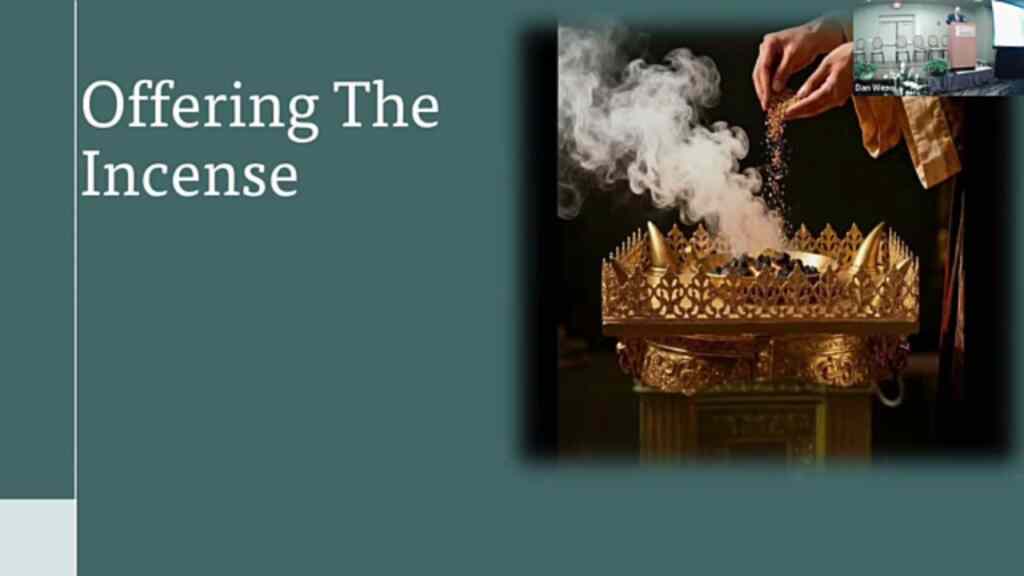
And let’s see if we can bring a picture up. We can share that with you. I want to. I need to bring it online for the brethren too, here.
And Brother Dan, let me know if there. Everybody’s seeing this.
Online. I just want to make sure. Okay, very good. Okay. So in the picture, you can see here that.
You always try to look for the best pictures that you can.
So what we’re picturing here is this the. The meat of this ram with the three cakes, or on this platter, as it were, and it says that Moses put it in their hands. So we’re picturing. Here you have the priests, each one had it in their hands, picturing Moses’s hands under them, and they’re waving it.
It’s being waved together. Okay, and it’s being waved back and forth and back and forth, and then we’re told that Moses takes it off of their hands. Okay.
Brother Ken, I think. Brother Jerry, would that be a picture of the sacrifice that is put upon the priesthood? And there too, and we’re to continually wave that until the Lord takes it off of our hands. Very good.
So, and it’s, and actually that second ram is called the Ram of the Filling. Their hands filled with the purpose of. It’s a full consecration to do the will of the heavenly Father.
And he will say when it’s done, and Moses in this case is representing the Heavenly Father, and so, and we wanted, you know, the main purpose of bringing this into it, because our focus is going to be on the millennial age. But the focus is that you have to have a priesthood before the people can bring their offering.
That’s why they wait for the manifestations of the Son of God. That’s why when in, in chapter nine, when the fire comes down and consumes the offering, then you have Moses and Aaron blessing the people, you know, because now they can bring their offerings. But until the priesthood was established, until that altar, that brazen altar is sanctified to be able to receive and remember, the fire never went out. It was always burning. It’s a beautiful picture how during the millennial age, the altar will always be ready to receive.
Anytime they can bring their offerings, it’ll always be proper for those in the kingdom to bring their offering to. To the Heavenly Father. Yes, Sister Mac, let us know your name, too.
This is sort of a question. I don’t. Can you hear me? Okay, yes. This is sort of a question.
I’m thinking about when Abraham laid the sacrifice on the table and waited for the Lord to. To come and consume it, and he had to wave the. The flies away and keep. Keep them away, and I’m wondering if there’s any relationship to that.
I. I haven’t thought of that. Brethren who are familiar with that, our sister. Sister, what was your name? I’m sorry, It’s Theresa, AKA Tess Warren. Okay, Sister Teresa.
Thank you. So the question is, Abraham had laid out an offering and he had to swish shoe the flies away. Well, I don’t remember the scripture, but the offering, the sacrifice laid there on the table for hours and hours, and he just waited for God to accept the offering and had to keep waving the. The flies away and, you know, getting them off the sacrifice until finally God came and consumed the. The sacrifice.
But it was. He waited for many hours. But I don’t recall the scripture for that. Okay, and I’m, you know, I’m not familiar with that.
I, I appreciate you giving me something, but, you know, go ahead, Brother Ken. I was just wondering, with the sacrifices that you’ve shown us, Brother Jerry, would they. Would that be the. The atonement day sacrifices that were waived and then the peace offering of the people that maybe the area. The reason, the way you are going, is those offerings subsequent to the atonement day sacrifice?
Isis.
Well, in this particular case, what we’re looking to do with, with this was to show that on the consecration of the priesthood solely here, that we’re preparing our priesthood and getting it ready. I’m going to go downstairs. The other question that was being asked, after I get done eating, I’m going to go downstairs and start working. I’m not going to listen to all this. I don’t think it has a connection with it.
Sister. Brother Lynn, Jerry, I just maybe for purpose of defining, when I look at Leviticus 8, 9 and 16, it’s very specific. Leviticus 8 is really all about the consecration of Aaron and his sons. So whatever we type in there to antitype, it should be with that element of Aaron and his sons representing the priesthood. In chapter nine, we have the consecration of the high priest, which is a little different.
That’s when the installation of the priests, and then finally in chapter 16, that’s the annual sacrifice that they did, you know, that had to be done with all these things. So where we are in this particular case of eight, I think it’s dealing with the consecration of Aaron and his sons, those who were part, to be part of this priesthood. I think the other question that was asked, I believe that was in Genesis when Abraham had the covenant made and he had to chase away the birds and he had to chase away the flies, and I think that was a different idea that was associated with the Abrahamic covenant.
Okay, thank you, Brother Len. I appreciate that. So, you know, as far as what Brother Len is talking about, first we had the consecration of the priesthood, then there was the chapter nine. It gives you the experiences of getting the, the priesthood ready. You know, we had the different sacrifices and we have.
And it, and nine was only done, remember whenever there was a change of the high priest. So it wasn’t like it happened all the time, but whenever, you know, Aaron was a, was a high priest for, and so they never did or do that second part until there was another one came into succession. But it, it showed and, and each one was different because in the consecration or in, and you had the people that came to watch, they were, it was visible to them what was being taking place.
So in nine you have this whole preparation period that I really don’t want to, and then, and at the end of that with nine, then of course you have, the priesthood is complete. Aaron comes out and you know, and he gives his blessing to all the people and they’re under the new covenant and the people can now bring their offerings because now you have a priesthood. You have the altar that’s been sanctified Fire perpetually burning to receive their offerings, and so that’s what.
Why we wanted to bring this in, and it, it’s important that we understand that. You see here, the priesthood had to be at peace as well with God. They had to be at peace. So all have to be in union with the Lord.
And so it had to start with, with the house of God always, and so you have the priesthood established. So I think that’s, that’s what we were looking for with, with number eight, and we really didn’t want to get too much deeper in it unless if there’s another thought from anyone. I don’t, I don’t see Brother Dan.
You have to let me know if there’s somebody online. Okay. As a question. All right, thank you, brethren. So now we get into question two.
And question two, it says what two peace offerings were made by the people and what was the difference between them? And so we have quite a bit of reading here. So I’m going to start with Leviticus 3, 1, 17, and this gives us the law of the peace offering and that we’re going to have Sister Rachel Grice read that for us.
Thank you. This is also King James, and if his ablation be a sacrifice of peace offering, if he offer it of the herd, whether it be a male or female, he shall offer it without blemish before the Lord, and he shall lay his hand upon the head of his offering and kill it at the door of the tabernacle of the congregation, and Aaron’s sons of priests, sons the priests shall sprinkle the blood upon the altar round about.
And he shall offer of the sacrifice of a peace offering, an offering made by fire unto the Lord, the fat that covereth the inwards and all the fat that is upon the inwards, and the two kidneys, and the fat that is on them, which is by the flanks, and the call above the kid liver with the kidneys it shall be he take away, and Aaron’s sons shall burn it on the altar upon the burnt sacrifice, which is upon the wood that is on the fire. It is an offering made by fire of a sweet savor unto the Lord, and if his offering for a sacrifice of peace offering unto the Lord be of the flock, male or female, he shall offer it without blemish. If he offer a lamb for his offering, then shall he offer it before the Lord, and he shall lay his hand upon the head of his offering and kill it before the tabernacle of the congregation.
And and Aaron’s sons shall sprinkle the Blood thereof round about the. Upon the altar, and he shall offer the sacrifice. Offer of the sacrifice of the peace offering. An offering made by fire unto the Lord.
The fat thereof and the whole rump it shall he take off hard by the backbone, and the fat that covereth the inwards, and all the fat that is upon the inwards, and the two kidneys, and the fat that is upon them, which is by the flanks, and the call above the liver with the kidneys it shall he take away when the priest shall burn it upon the altar. It is the food of the offering made by fire unto the Lord, and if his offering be a goat, then he shall offer it before the Lord, and he shall lay his hand upon the head of it and kill it before the tabernacle of the congregation, and the sons of Aaron shall sprinkle the blood thereof upon the altar round about, and he shall offer thereof his offering, even an offering made by fire unto the Lord.
The fat that covereth the inwards, and all the fat that is upon the inwards and the two kidneys, and the fat that is upon them, which is by the flanks, and the call above the liver with the kidneys, and it shall he take away, and the priest shall burn them upon the altar. It is the food of the offering made by fire for a sweet savor. All the fat is the Lord’s. It shall be a perpetual statute for your generations throughout all your dwellings, that ye eat neither fat nor.
Nor blood. Okay, thank you. Now, that gives you the overall peace offering. The second part here we’re going to have is Sister Pat Slavic. It’s going to be Leviticus 7, verses 11 to 18.
And this is going to get us more into some of the other detail. You know, as you. As you saw what was being read there, there were different animals being brought into this picture, and so, and it’s very important, you know, we.
So we’ve had the goat, the lamb and a bullock. All right, so now, and we’ll get into that when we get to answering our question later on. But establishing our first question, the two different types, and that’s going to.
I think Sister Pat’s going to cover that down hers, and is NASB all right? Yes, go ahead. Okay. Now this is the law of the sacrifice of the peace offerings which shall be presented to the Lord if he offers it by way of thanksgiving.
Then along with the sacrifice of thanksgiving, he shall offer unleavened cakes mixed with oil and unleavened wafers spread with oil and cakes of well stirred fine flour mixed with oil, with the sacrifice of his peace offerings for thanksgiving, he shall present his offering with cakes of leavened bread. Of this he shall present one of every offering as a contribution to the Lord. It shall belong to the priest who sprinkles the blood of the peace offerings.
Now as for the flesh of the sacrifice of his thanksgiving offerings, it shall be eaten on the day of his offering. He shall not leave any of it over until the morning. But if the sacrifice of his offering is a vow or a voluntary offering, it shall be eaten on the day that he offers his the sacrifice, and on the next day, what is left of it may be eaten. But what is left over from the flesh of the sacrifice on the third day shall be burned with fire.
And 18 so if any of the flesh of the sacrifice of his peace offerings is ever eaten on the third day, he who offers it will not be accepted and it will not be credited to him. It will be an unclean thing, and the person who eats it shall bear his punishment. Okay, very good. So there’s some real established rules here about these offerings that’s being presented to us, and the last part of that is Leviticus 7:29, 34.
And Sister Lisa Bush is going to read that for us.
This is from nasb. Speak to the sons of Israel saying, he who offers a sacrifice of his peace offerings to the Lord shall bring his offering to the Lord from the sacrifice of his peace offerings, his own hands are to bring offerings by fire to the Lord. He shall bring the fat with the breast, so that the breast may be presented as a wave offering before the Lord, and the priest shall offer up the fat in smoke on the altar. But the breast shall belong to Aaron and to his sons.
And you shall give the right thigh to the priest, and as a contribution from the sacrifices of your peace offerings, the one among the sons of Aaron who offers the blood of the peace offerings and the fat, the right thigh, shall be his as his portion. For I have taken from the sons of Israel the breast of the wave offering and the thigh of the contribution from the sacrifices of their peace offering and have given them to Aaron the priest and to his sons in the their allotted portion forever from the sons of Israel. Very good. So you know, if you’ve studied these.
The sacrifices of the. The Day of Atonement sacrifices, the consecration of the priesthood, you see that all of these offerings went to the heavenly Father. But now something different’s happening, and it’s an ordinance by God that when they bring the people’s peace offering, who gets Them, and we’re going to discuss that. So, you know, we, we.
One thing I didn’t say, I’m sitting here talking about the priesthood and they people can bring their offerings. Well, we know that that priesthood that’s been established with the Christ head and body of the Melchizedek order. Okay. That’s. That’s what that consecration of priesthood is picturing.
Okay. So bringing that forward until that sacrifice is completed, the people can’t bring their offerings, and so that’s, that’s where. Where we are in the stream of time. So.
But during the millennial age, when the Christ is complete, we have the second part here. What two offerings then? So we’re going to take this in pieces here and you can, you can expound on it and go deep into it if you’d like. But there’s two offerings. What are they?
They were named in the reading. Two different ones.
And let’s not run out of time, even online you can answer. Just let raise your hand and we’ll call upon you.
How about the brother from albuquerque? Did you. Oh, oh, I saw sister debbie. Good. Thank you.
Sister debbie moss.
Well, I appreciate us discussing this. This is good. Are you referring to the unleavened cakes? So that you have. Well, they’re part of the offering.
Right. So we have two offerings that I’m looking at. There are two different ones said in the reading that they can bring their peace offering in the form of two different. Different ways. Oh, okay.
I misunderstood the question. So.
Besides the cake, verse 13, I’m looking at verses 12 and 13. That’s what I should be looking at right now. Right. Well, look, you can look at in the re. I did.
I didn’t put down exactly where it was in the reading. But there, there is a. There’s first part of the offering. There’s two different offerings that can be acceptable as a peace offering. One is a thank offering.
Do you see that? Yeah, that’s verse 12. Go ahead. For Thanksgiving. Yeah, an offering for Thanksgiving.
Okay, what does it say associated with that one, Sister Debbie? The cakes. The 11 cakes mingled with oil. Okay, and there’s a thanks offering and it has cakes.
You want to expound on that? Yeah. Well, and besides the cakes he shall offer. He shall offer leavened bread.
Yes. With the sacrifice. Very good. Showing that, you know, this is the millennial age again you’re talking about. This is the sanctification process that the world will go through once that’s opened up to them to do this.
Yep. Very good. So the. Any thoughts on what the cakes represent mingled with oil. So that always would mean the power and influence of God to create that reconciliation which is the goal.
So just like the church required the anointing the oil. The oil is the power and influence of God.
Being channeled so that they might be able to be sanctified. It. Yeah.
Sorry. Yeah. Yes. What the cakes might represent, it says, offers faith in Christ’s character. Oh, okay.
Well, no, very good. You know, remember it. It says God’s spirit will be poured out on all flesh. This is what’s going to have help them to come to the Lord and to discern things. But in the picture of the sacrifice, when you see the three cakes, this is demonstrating something.
There’s. They’re demonstrating a knowledge that they’re gaining of understanding. You know, you have the. You have a plain cake, you have the oiled cake and then you have the wafer, right. The translucent wafer.
And so in the people are going to have to remember whose name is going to be above every name and that every knee is going to bow.
It’s our Lord Jesus. Right, and it will be. It will be a condition where the people are understanding where their opportunity. So with the thank offering it’s not really.
They haven’t really made the vow or a covenant yet, but they are thankful and they’re learning and they’re coming along and they’re realizing that they this all there’s only possible through the our Lord Jesus sacrifice and by extension those of the church that are part of the Melchizedek priesthood that they have this opportunity to come to the Lord. That’s the first one online. Who do we have? Brother Dan.
Brad. Brad. Okay, go ahead. Yes, brothers. The second one, first one will be a Thanksgiving.
Second one will be the free willing offering brother. Leviticus 7:16, and yes, brother. Unleavened Cakes is representing three cakes in our Tabernacle Shadows 46 page number. It’s given as a justification, sanctification and glorification over brother.
Very okay, very good. Thank you. That’s right, and so we. We have the perfect humanity the of our Lord Jesus the.
And as far as the church, their justification, they received the holy Spirit and then they have their final reward and the glorification, the completion of it. Thank you very, very much, brother Lynn. Well, I wanted to just mention this third one, the one with leaven. I don’t know if you’re ready for that or not. You know, you wonder well why.
We know leaven generally represents sin and you have these three offerings but yet then you have this waving of the one with sin or with leaven. There’s only two places where that happens here and then Leviticus 23:16, where it’s offered, and that’s a picture we have that takes place after the feast of weeks or after Pentecost, the pouring out of the Holy Spirit. So it’s interesting if we look at these for both ages, you know, we still have, when we offer thank offerings to God, we still have sin and represents, I think, in a way, you know, the recognition that we still have sin even though the Holy Spirit is there, that this offering is made as a thankfulness to God because of the dealing with the sin that we have through the Holy Spirit, and if you think about in Leviticus 23, when we look at the millennial age, when will people offer thank to God these leavened bread?
Well, I think it’s at that point when perhaps they recognize that they have to get the Holy Spirit in a way and that they’re recognizing that they’re sinful and that that Holy Spirit is really what is poured out upon all flesh to help them and as part of a consecration as well to recognize their sin and to say thanks to God for dealing it with, with it through Jesus and his sacrifice, and then also with this, with the Spirit being poured out, the understanding. So I think it is, goes along with the idea that the two ages are represented in this, both in the gospel age and the millennial age, the sacrifices. Thank you, Brother Len. Well said, and I appreciate you bringing up the leavened breath because this is part of that education and understanding that the people have, that they realize their own sinful condition still.
And, and as they’re learning the new laws of this new kingdom arrangement, remember, when they come back, they’re, they’re going to still have the, the mind of, you know, as we were told in Scriptures, as a tree falls, that’s where it lies. There is no knowledge in the grave. So when they’re brought back, they’re going to have to go through this education process and the bringing of these offerings. They’re not forced to do this. It’s, you know, these are something that they’re going to be doing.
It’s going to be a demonstration of their heart and realizing how this was possible, and as it was told, they put their hands on it, representing them, this offering, and, you know, there’s some different options of how they can bring this offering, but it also, as a thank offering, we’re not really making a vow here. They’re acknowledging the wonderful privilege that they have, and so that’s why we want to talk about the next part of it.
So as a vow now, so as a thank offering. Oh, and the last thing we want to talk about is why do you think it had to be eaten in that same day? There couldn’t be any leftover.
Any thoughts on that? Anyone online? No. Brother Ken, Would that day represent the millennial age? That it has to be.
There can be none left over, just like the Passover lamp was in. In the gospel age, and it’s interesting, the fact that you brought up that they would offer these themselves, but they would. The priests are the ones that would burn the offering and that, and so there we see the priesthood and the offering going to the priesthood.
It’s going. Exactly. Very good, Brother Ken, and, you know, and so there you have a situation where the priesthood, it has. Has a stake in it with the people.
You know, there it’s gonna. Everything’s gonna go through them, and the Lord’s made an ordinance that they will get this. So it’s showing that they have a stake in it, and these individuals bringing their offerings and.
Yes, Dan, Who? Sister Karina, go ahead. Well, I was just going to say just that, you know, the principle that nothing should be left, nothing should be held back of what one gives to the Lord. The sacrifice must be fully burned. One must love the Lord their God with all their heart, soul, mind, strength.
Oh, very good, and that leads us into the next offering, the second part. So the second one is a vow. Now, what’s the difference between the vow and the thank offering? So when you bring it as a.
As a vow now, so we know what it is as a thank God, it’s offering, praise, understanding. There’s a knowledge. But when you bring it as a vow, what is that telling us? What is that suggesting?
Any thoughts, Brother lynn?
Sorry, Jerry. So hands are up. I just mentioned, I think in a vow offering, there’s a big difference between. An interesting difference between that and the thanked offerings. Because with the vow offerings, they were.
The thank offerings were supposed to be eaten the same day they were offered. The vow offerings were not. They had beaten. If there was on the next day, and if there was anything left over on the third day, then I think it had to be burned. Right.
So why is that different for a vowel offering? And perhaps one suggestion is it’s a picture of the collective church throughout the age, that the vow that of consecration is burned throughout the whole gospel age, and it continues during that whole 2,000 years, but comes to an end at the close of the high calling, which is really the third day. So I like that suggestion. I think there may be others, but I think there are Hosea pictures that when he says Hosea 6:2, after two days will he revive us on the third day he will raise us up and we shall live before him.
And in Luke 13:32, Jesus says, When they were talking about Herod, he says, and he said unto them, go and say to that fox, behold, I cast out demons and perform cures today and tomorrow, and the third day I am perfected. Brother, Jesus is talking about himself, but I think it’s possible he’s talking about the entire church class. That’s when Jesus is actually his perfection is shown in the glorification of him and his church at that last. So that’s. Wait, before you take the microphone away, I didn’t get the Hosea.
Oh, Hosea 6:2, after two days will he revive us on the third day he will raise us up and we shall live with him. So if that’s a picture the church has raised on the third day at the. The third day. Yeah, well, and we know that after the millennial age, there is no more opportunity, and if, if remain for the third day, the account tells us that they’ll be cut off from the people.
So anyone who professes the consecration and brings a full consecration even to the fact that they believe that, you know, it’s a bullock, they bring their bullock, and that’s what we’re going to talk about next. But if they’ve brought their bullock, which we know the bullock represents perfect humanity, the perfect state. So if they’ve already done that and they don’t eat that offering or, and, and it’s, it’s. They don’t make the full consecration, they go back on it, then they’re not going to be make it.
It’ll be. It’ll mean second death for them. Brother Dand, is there someone else online? Yeah, Sister Pradasha. Yes, yes.
In Anton note on tabernacle a, page number 402. Brother in 402, I’m reading the third paragraph, brother. But the burnt offering and the peace offering imply that the sacrifices voluntarily lay down their earthly rights in the interest of those who will be blessed under the new covenant. Entirely aside from the atonement for Adamic sin accomplished by the same sacrifice, viewed from the standpoint of the sin offering. So there is a one, we have to be lay down our earthly rights and we have to be make the new covenant to complete.
Brother, that’s my Point, brother. Very good. Thank you, dear sister. Okay, so the next part we want to talk. There’s.
We can take these next few questions here.
The question three says that the people’s peace offering is made during the millennial age under the mediation. Is this offering made at the beginning of. Of the age or at the close of the age? And while we’re talking about it, we’re getting into the animals. Now.
Let’s look at question four as well together here. Discuss the three animals permitted as peace offerings and what each pictures. So if you want to talk about, you know, remember, everybody’s going to be coming back into various stages. There’ll be those that are. Have lived more of a righteous life or more of an understanding of the gospel message.
There’ll be those that know nothing about Jesus our Lord, and sacrifice. So there’ll be various stages coming back, but we’re looking for primarily as, you know, we, and keeping it in context, you have the peace, you have a thanks offering, and you have a vow, and so we’re looking to see is when do you think the vow portion or the actual consecration will take place with the individuals? And then if we can talk about the animals that are being brought here and we got, you can see them on the screen.
Any, any thoughts from anyone. You can talk about the animals. You can talk about where you think the it’s going to take place. Brother Dam, who is it online? Sister Lorianne.
Go ahead.
Okay. There you go. Thank you. Yeah. When you ask that question, I think that, you know, everybody in the millennial age, you know, it’ll have to be on an individual level that they come to, you know, that they come in that full peace and harmony with God and make that consecration vow.
And then at the end, you know, the whole my understanding, you know, from what we’ve studied and what the scriptures say that, you know, the whole presentation of mankind will be considered in that perfect state. But it will, you know, the little season then occurs and that those then that turn away from their vow and sin against God and the Christ himself are the ones then, you know, did not have that apparently was not fully in their heart, you know, to love God and all their whole minds and hearts and bodies. Okay, I’ll stop with that thought over. No, very good, and I, I think that as we look at this peace offering, as, as the sister was saying, it presupposes reconciliation and fellowship being and the very developed stages of each person’s course.
And when under the mediator, they’ll have been enlightened, cleansed and brought into peace with God, and they’ll respond with thanksgiving and vows, and in the broad race the Russell describes that it associates the words full perfected peace, offering of life, and it is closer at the closing of the age, and every person is going to have their different experiences and when they.
They come, but they will have to make that. That full consecration. But so it will be going on various stages. Sister Debbie, you had your hand. Thank you.
And Dan, do we have anybody online too? Okay.
The route that the world will have to take, you know, the highway of holiness is a consecration. Their vow will be a consecration not to sacrifice, but to righteousness. So when, as was said, the individualness of that vow to righteousness will take time. It’s a sanctification process, and the animals help show this, that the mediator is not going to step out of the way from the world of mankind until they are capable to bring that bullock.
And then they will be reconciled to God directly, as it says in revelation that, you know, they will be his people. He will be their God. This takes much of the peaceable kingdom, once the new covenant is opened up for them to gradually, because it’s a voluntary thing. It’s not a group thing any more than our consecration to sacrifice is. So all we know is God has allowed the time he’s allowed.
We don’t know how long that peaceful kingdom will be, which part of the thousand years. But it’s enough for everyone raised to be purified in their heart so that they can truly turn their lives over to God. Over. Very good. Thank you, Sister Debbie.
So we can see that at the beginning of the millennial, who are the only ones that will be able to bring a bullock at the very beginning? Ancient worthies. I heard that. Thank you. They’re the only ones that are perfect that that could make an acceptable sacrifice.
But so that would tell us that it’s going to be a. Sister Debbie says, and others have said it’s going to be a process, and. But the Lord is going to allow the church, the Christ will allow, you know, in some of these offerings, if you go back and study them, even a meal, the meal offering is, you know, it’s just plain meal is acknowledged as something as progress because progress has to be made, and so that now we can talk about.
Let’s talk about the animals. The first one is a goat. So what are the characteristics of a goat? What do you. What do you think about that?
If someone brings their goat, they’re at the goat stage. What do you picture.
You Ever see how goats they, they you. Right and sneak up on you, Brother Dan?
Yeah, I think that’s a beautiful aggression of what the Lord is picturing here in these free will offerings, and you have this goat that’s starting out. The person is raised from the dead as you were bringing up. As they go into the grave, they’re going to come out of the grave exactly as they were. Their same heart condition, their same thoughts are all going to be restored.
And so you’ll have many or most perhaps in a goat like condition where they’re rebellious, they kick, they bite, they’re not a friendly animal. Yeah, I like what you have there. Stubborn self. Well, self willed, that’s what the, the goat like characteristics are, and those have to be overcome.
And then you get, would get to a calmer disposition of a lamb. That comes next. Well, go ahead. You want to talk about the land like that. Well, they’re humble and, and they’re a more peaceful animal.
And so you’re not going to have those kinds of rebellious kicking and bucking with the horns that you have with the goat. You’re going to have a sheep that’s more docile and more ready to follow its shepherd. Very good. Well, how about the, how about the bullock? Well, the bullock pictures Christ.
And so this would be perfection. So they would have reached that point in which they have righteousness within themselves, and it’ll be at the end or closer to the end of the millennial age. But there may be some that progress to that bullock stage earlier in the Messianic age. But that would be where they could present themselves.
And so that’s what’s going to end up happening at the very end of the Messianic age. The whole world will be sheep. They will be able to present that bullock at that point because they will be perfected and have perfection or righteousness within themselves. Okay, very good.
I, I have a scripture here, Psalm 51, 17, 19. Does someone want to read that for me? Put your hand up and we’ll. Brother Ken will give you the microphone. So.
Thank you Brother Dan. I didn’t mean to put you on the spot there, but you did a nice job. So you know, when the people come back initially they’ve still got some of that old world mind, right? That old ways of doing things and they want to do things their way and they have to fight against that system. But it’s accepted because it’s progress.
Remember they’re bringing this thing, if they bring it as a thank offering, they’re acknowledging their fallen Condition they’re bringing that leavened take bread and they have the cakes that recognizing how this is possible for them. But then they move on. As they get educated, they’re quieter. I picture them more listening, wanting to follow, say, you know, my life was miserable the way it was. There was death, there was killing.
I don’t want that. I want to learn this new way. I really want to get on board with it, and so they become more docile, more self. Unaware of self, more Remember, you have to love your neighbors yourself.
They’re gonna. Their neighbors can be more valuable than the golden wedge of opar. It would kill them if they would could ever think of hurting their neighbor or doing anything evil against them or going from God, and that’s when we see the bullock and you have this lot of fat. The bull is a very valuable animal in these days.
The plowing, the fields, they’re carrying heavy loads and doing all kinds of things and, and it, and a great amount of fat, and the fire would burn very strongly, and here is where the Christ will recognize, as brother Dan mentioned, the bullock represented perfection.
And this is the ultimate of the vow to come to the point of absolute perfection, to stand the way Adam stood. That’s the point. To get them to this level where they are, and some passages, and when you talk about this, the bull is the evidence of the vow fulfilled.
They have fulfilled their vow. They are perfect human beings, and now they’re going to be ready for the Christ to step out of the way and allow the Lord to make the judgment, and then his right hand of power will step in and execute that judgment and crush Satan’s head, and.
And that will be the end of little season for eternity. But those are the pictures that we were. We wanted to get across from these animals. Brother Len and then sake Sister Joan, I just. To me, the simplicity of the tabernacle is in these offerings there’s a sin offering.
Then you have a burnt offering, and then you have a peace offering, and in all these sacrifices, that progress is what you see why? Because a sin offering is never said to be a sweet savor.
And so how has it become a sweet savor? By the second offering, the burnt offering, and that shows God’s standpoint. God is pleased with the offering that anyone makes that is a sinner, and so that burnt offering shows that.
And then you have the peace offering that always follows the burn offering, and that peace offering is the progress showing that now that person, whoever was individual or they’re at, you know, they’re at peace With God, they have made that progress where God no longer looks at them now as he did when they were in full sin. So whether it’s this age or the next age, that picture, that progress that takes place, I think is pictured in these three offerings. The first, the sin offering, the burnt offering, peace offering, and all three always come together. Excellent.
Thank you, Brother Lynn. Sister Joan.
Oh yeah, appreciate it. This is Psalms 51:17, 19. Okay. Psalms 51:17. This sacrifice of God are a broken spirit, a broken and contrite heart.
O God you will not despise. Do good to Zion in your good pleasure. Build up the walls of Jerusalem. Then all will delight in. Right, Sacrifices in burnt offerings, whole burnt offerings.
Then bulls will be offered on your altar. Okay, bulls. So he’s talking about bringing it back to the perfection there, and remember, the Lord doesn’t delight in these sacrifices. Right, the bloody sacrifices.
So all that we’ve been discussing here is a picture. So you have to. To realize when the antitype has come and fulfilled the type you do. There’s no more reason, and I was talking with brother David before the meeting and.
And so that’s why we don’t offer the sacrifice. We don’t sacrifice lambs at the memorial because the type has already been fulfilled, and so same here, what you’re seeing is taking place in the minds, the transformation of the people and the Holy Spirit there that they’ve been given, and as brother Len said, I just want to make follow up on his point, the whole purpose of the peace offering, who they have to be at peace with its heavenly Father. They have, this is a point of becoming at one with him again.
And they have to be perfect because, you know, remember what the Lord said, He told Moses, you bring the people into the land because if I do it, I’m going to destroy them, and at the time when he was, he was really fed up with them, he told Moses, get out of my way so I can destroy these people, and, and Moses said, no, don’t let your enemies win and think that you can do it, and so Lord said, okay, I won’t destroy them.
But I bring that point up because you here, you have the Christ, head and body, the Melchizedek priesthood, that’s going to be the mediator. They’re going to have total control. So they’re going to bring the people to that point, to where they can stand before God. Because the mediator has to get out of the way for the test to begun for God to make that final judgment. So let’s See, I saw Sister Debbie again.
And we’re going to wrap up with the last question and.
Very quick. Another beautiful sample is that the purpose of all of this is for service. Service to each other and to God, and so the bullock is a service animal, and that’s part of its value.
That’s the goal of everybody, not just us. It’ll be the goal of the world. That’s a beautiful thought. You know, I just look at today. They’ll kill you for gold, right?
That whole mindset’s going to change. Can you imagine a world where no one is even going to think about it? And maybe you can have somebody read Luke 20:36 for me if you can find that verse. I think it’s very powerful, and I’m going to ask the last question here because we’re getting very close out of time.
At the time of the little season in Revelation 23, will all human beings living be perfect at the time of the living season? So put yourselves out there, brethren, on this one, And whoever gets that scripture, we can read it. Okay? Sister Pat, I saw it over here. I’m sorry, Sister John.
Thank you, though. Luke 20:36, is that what you wanted? Yes, please. Neither can they die anymore, for they are equal unto the angels and are the children of God being the children of the resurrection. Now, that is powerful, isn’t it?
These are perfect human beings. This is after. Well, you tell me what it is. But they can’t die anymore. It’s a promise.
Now, could death be possible? Their minds are so changed and transformed, they can’t. It’s not gonna even be. Have to be discussed. Their minds aren’t even going to go there.
They’re not going to think about even transgressing the king. Remember, Adam was supposed to live forever. Okay, but. So these are those with free moral agencies, and they will never die again.
They can’t. Because that’s how powerful and how transformative this the time of the millennium is going to be. So answer my question, brethren. Will they be perfect going into the little season?
Brother Ken, don’t mean to answer it. Revelation 20, verse 3, and cast him into the bottomless pit and shut him up and set a seal upon him, that he should deceive the nations no more till the thousand years should be fulfilled, and after that he must be loosed he little season. The answer to your question, I believe, is yes.
I think that all mankind will have had that just equitable trial, and that only those that have come to perfection to that bull state will go through the. Through the little season into return. Yeah, and we’re told that there may be some that do that, that still revert. I think it’s going to be a test of obedience, but that’s.
That’s what will happen. They will stand as Adam stood. So to be a fair test. Brother Obi, do you. Could you read that portion?
Did you, did you look that up? Oh, thank you. So we’re going to close with this last portion from, from the volume. I think it’s 6:40. Brother Obi’s going to read it.
We were chatting about it. I thought it’d be a nice way to close the session.
No creature of the redeemed race will be too low for divine grace to reach through the all powerful and blessed agency of the kingdom. No degradation of sin will be too deep for the hand of mercy to fathom, to rescue the blood bought soul. No darkness of ignorance and superstition will be so dense in any heart. But that the light of divine truth and love will penetrate its gloom and bring to it a knowledge of the joy and gladness of the new day and an opportunity to share the same by obedience. No disease that can attack and pollute the physical system will be beyond the prompt control of the great physician.
And no deformity or monstrosity or superfluity or redundancy or mental imbecility will be able to resist his healing touch, and if I may make a comment, Abraham was told that he would have seed as the stars of heaven and as the sand of the seashore, and we, as Bible students have often applied that sand of the seashore to the earthly class, and they have thus become Abraham’s seed, and Christ’s reign has been victorious.
Then comes the end when he shall turn all things over to the Father. His work is complete. So it’s the quality of them as sand of the seashore, as Abraham’s seed. It’s not the numbers. The numbers that are deceived are not to be like the sand of the seashore.
Also, it’d be a tremendous failure, wouldn’t it, of the divine plan. Thank you. Thank you for your leadership. Brother Jerry, I appreciate your thoughts for reading that for us. Brother brethren, we thank you so much for your thoughts.
We hope this was helpful. You know, this is a big subject. There’s a lot of wonderful pictures in there, and you’d have to meditate upon them. I’m thankful for so many of the good answers and thoughts that are brought forth, and we.
And again we. We wanted to talk about the kingdom. A little bit. You know, we don’t often do that, and how the world of mankind, because the preparations of it, but how it’s going to benefit them.
You know, having a priesthood that’s sympathetic to them, had all the same experiences and helped them. It’s going to be so much easier for them, and having plus contrasting. Because the only ones that ever saw perfection was Adam and Eve. After that, the rest of the world saw.
Saw the sin and dying condition. Now they’re gonna be able to contrast the sin and dying condition with this world wonderful, beautiful kingdom of love, prosperity and life, and I don’t think they’re ever going to want to. The majority won’t want to go back, and I have some thoughts on that as to how many.
If you want to talk about it in private. Lord bless you, brethren. May the Lord add his blessing.
Click Here for the PDF transcript.